Updated
Why Gorilla Trekking Uganda Is Cheaper Than Rwanda and Equally Special
Uganda vs Rwanda gorilla trekking cost — the $700 saving that does not compromise the experience
Uganda gorilla trekking cheaper than Rwanda is one of Africa’s most extraordinary wildlife experiences, connecting travellers with mountain gorillas in their natural forest habitat. The cost difference between gorilla trekking in Uganda and gorilla trekking in Rwanda is the most discussed financial comparison in East Africa safari travel, and for good reason: it is significant, consistent, and — most importantly for prospective visitors — not accompanied by any meaningful difference in the quality of the gorilla encounter itself. The $700 saving per person on the gorilla permit alone (Uganda’s $800 vs Rwanda’s $1,500) is the headline figure, but the full cost comparison between the two destinations reveals additional savings across accommodation, internal transport, and overall trip cost that make Uganda the more compelling value proposition for the majority of gorilla trekking visitors.
The permit cost: $800 vs $1,500
Uganda Wildlife Authority charges $800 per gorilla trekking permit. Rwanda Development Board charges $1,500. The difference is $700 per person per trek — for the same species, the same type of encounter (one hour with a habituated family), and the same underlying conservation outcome for the gorilla population. A couple travelling together saves $1,400 on permits alone by choosing Uganda over Rwanda. A family of four saves $2,800. These are savings that, depending on your budget, can fund a significant upgrade in the quality of accommodation, the addition of extra activities, or simply the reduction of the total trip cost to a more accessible level.
Why Rwanda charges more
Rwanda’s higher permit price reflects a deliberate strategic positioning decision rather than a difference in the cost of providing the experience. Rwanda has positioned its gorilla trekking product as ultra-premium — targeting a high-net-worth visitor segment that is less price-sensitive and that values the signal value of paying more. The premium positioning is reinforced by Rwanda’s accommodation landscape, which skews more heavily towards ultra-luxury properties than Uganda’s, and by the country’s general tourism brand as a high-end destination. For visitors to whom the premium positioning matters — and there are genuine visitors for whom it does — Rwanda’s product is well-suited. For the majority of visitors who want an outstanding gorilla experience at the best possible value, Uganda is the superior choice.
The accommodation comparison
Luxury accommodation near Rwanda’s gorilla trekking areas — the Volcanoes National Park lodges — is among the most expensive forest lodge accommodation in Africa. The same budget that buys a night in a mid-range property in Rwanda buys a night in a luxury property in Uganda. The mid-range Uganda properties that we recommend as the best value options in our portfolio are comparable in quality to Rwanda’s mid-range options but priced significantly below them. And Uganda’s luxury options — the top-tier forest lodges in Bwindi’s Buhoma, Rushegura, and Nkuringo sectors — offer an experience that Uganda gorilla safari operators and comparison reviewers consistently rate as equivalent to or better than Rwanda’s comparable properties, at lower prices.
Is the gorilla encounter itself different?
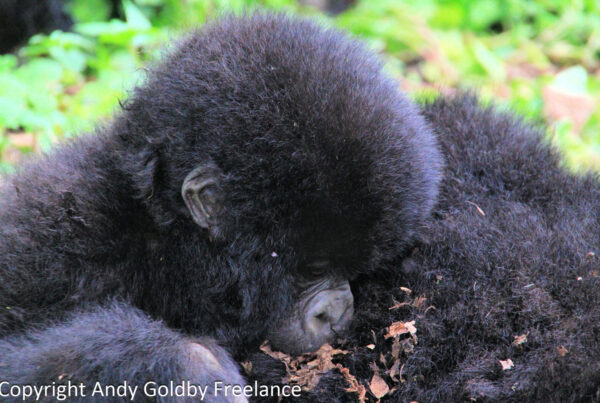
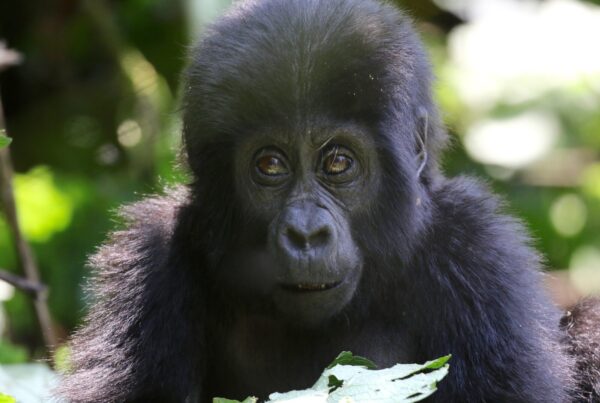
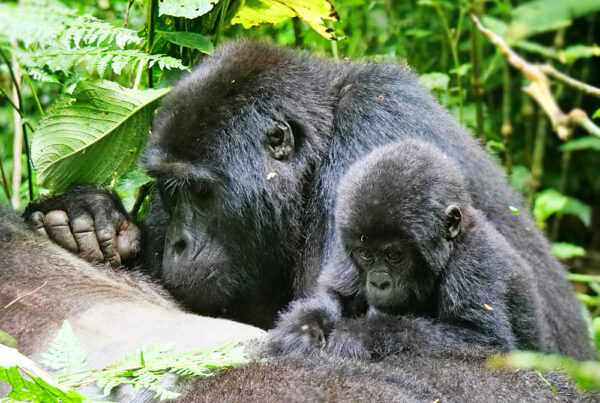
The honest answer is: not in the ways that matter. Mountain gorillas in Uganda and Rwanda are the same subspecies. The habituated families in both countries have been through the same habituation process. The one-hour permit allows the same quality of encounter. The rangers in both countries are highly trained. The forest environments are different — Uganda’s Bwindi is ancient tropical forest on complex terrain; Rwanda’s Volcanoes National Park is dominated by the dramatic volcanic peaks of the Virunga Massif — but both environments are extraordinary and both produce encounters of the highest quality. The gorilla is the same animal in both countries. The saving you make by choosing Uganda does not compromise the encounter — it improves the overall value proposition of the trip in every other dimension.
Frequently Asked Questions
Uganda is significantly cheaper. Uganda’s standard permit costs $800; Rwanda’s costs $1,500. For 4-hour gorilla habituation, Uganda charges $1,800 — Rwanda has no equivalent experience. The $700 saving on a standard permit is the primary reason most budget-conscious travellers choose Uganda.
Uganda. Bwindi and Mgahinga together have 20+ habituated gorilla families and issue more daily permits than Rwanda’s Volcanoes National Park. Uganda also offers the Gorilla Habituation Experience, which Rwanda does not. Rwanda’s advantage is accessibility — Volcanoes NP is 2 hours from Kigali airport.
Yes — this is a popular combination. The Kigali to Bwindi road journey takes approximately 4 hours via Kabale. Some visitors trek in Mgahinga (Uganda) one day and cross into Rwanda for Volcanoes the next. Note that your Uganda permit cannot be used in Rwanda and vice versa — separate permits are required.
Rwanda’s Volcanoes National Park offers easier access (2 hours from Kigali airport), high-end lodge infrastructure, and the Dian Fossey research legacy. Rwanda also offers golden monkey trekking in the same park. However, at $1,500 per permit, it costs nearly double Uganda’s $800 rate for the same 1-hour trek.
Uganda is home to the mountain gorilla (Gorilla beringei beringei), one of two subspecies of eastern gorilla. They live exclusively in the Virunga volcanic highlands (Uganda/Rwanda/DRC) and Bwindi Impenetrable Forest (Uganda only). Mountain gorillas are the only gorilla subspecies that cannot survive in captivity — every individual you can trek is a wild animal.