Updated
The phrase “most biodiverse” is applied to many places and means different things in different contexts. But when it comes to primates — the order of mammals that includes monkeys, apes, and humans — Uganda holds a claim that is not rhetorical. The country has more primate species per unit area than anywhere else on earth, a concentration that reflects its geographic position at the intersection of East African savannah and Congo Basin rainforest, its range of altitudinal zones, and the conservation investment that has protected its key forest ecosystems over the past three decades.
The Numbers
Uganda records 13 primate species, including both mountain gorillas and chimpanzees. For a country of 241,000 square kilometres — smaller than the United Kingdom — this represents an extraordinary concentration. In comparison, the entire Amazon basin, which covers over 5 million square kilometres, holds approximately 15 non-human primate species in Brazil alone. Uganda’s density per unit area surpasses any other region where primates occur.
The 13 species include two great apes (mountain gorilla and chimpanzee), four species of colobus monkeys (black-and-white colobus, red colobus, Angolan colobus, and olive colobus), four species of guenon monkeys (red-tailed monkey, blue monkey, vervet, and L’Hoest’s monkey), the grey-cheeked mangabey, the olive baboon, and the patas monkey. Each species occupies a different ecological niche and is associated with different forest types and elevational zones.
Why Uganda Has So Many
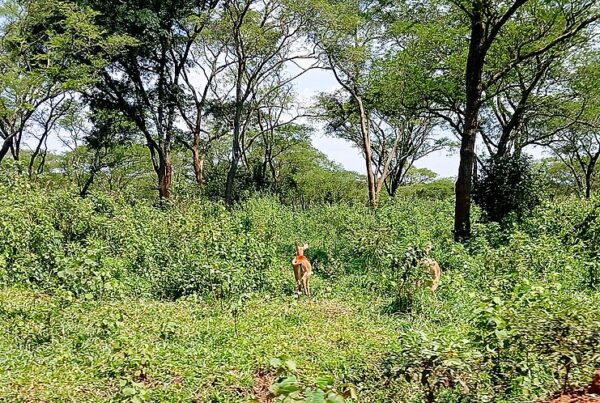
The primate richness of Uganda is a product of the country’s position at an ecological crossroads. Species characteristic of the Congo Basin rainforest — including chimpanzees, colobus monkeys, and mangabeys — reach their eastern limit in Uganda’s western forests. Species more typical of East African environments — including vervets, baboons, and patas monkeys — are found in Uganda’s savannah and woodland areas. The mountain gorilla, a Albertine Rift endemic, exists nowhere else.
Kibale National Park is the most concentrated expression of this richness. Thirteen of Uganda’s 13 primate species are present in or around Kibale, and the park holds the highest chimpanzee density anywhere in Africa — an estimated 500 individuals in a 766-square-kilometre area. The forest canopy at Kibale supports multiple primate species simultaneously: a single morning walk might yield chimpanzees, red colobus, black-and-white colobus, red-tailed monkeys, and mangabeys in the same strip of forest.
The Great Apes
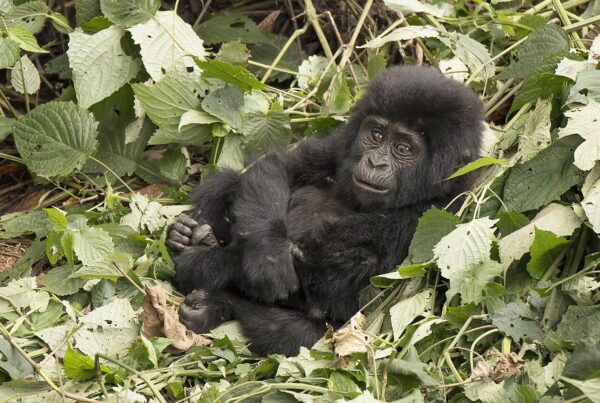
Uganda is unique in offering accessible, regulated encounters with both of Africa’s great ape species — mountain gorillas and chimpanzees. Gorilla trekking at Bwindi Impenetrable National Park or Mgahinga Gorilla National Park costs $800 USD per person for international visitors in 2027. Chimpanzee tracking at Kibale National Park costs $250 USD per person. No other country on earth offers high-quality, habituated encounters with both species within a single country visit.
The quality of both experiences — the intimacy, the habituation level, the forest conditions — is higher in Uganda than at equivalent sites in Tanzania, DRC, or Rwanda for most visitors. The gorilla population in Bwindi has been studied for decades. The chimpanzees of Kibale’s Kanyawara and Ngogo communities are among the most intensively studied wild primate populations anywhere on earth, and the knowledge that rangers and guides carry about individual animals transforms the tracking experience from wildlife spotting into genuine behavioural observation.
Conservation of Primate Habitat
Uganda’s primate wealth is not merely a product of geography. It is also a product of conservation investment. Bwindi, Kibale, Budongo, Echuya, and other forest reserves have been maintained against significant land pressure because the economic case for their protection — grounded substantially in primate tourism revenue — has been sustained. Where forests have been deforested or degraded, primate populations have disappeared. The correlation between forest integrity and primate diversity is direct and documented.
The community revenue-sharing programmes around Bwindi and Kibale, funded by park fees and permit revenue, have created economic incentives for boundary communities to support rather than undermine forest protection. The continued richness of Uganda’s primate fauna is partly a biological inheritance — the right species in the right place — and partly an achievement of three decades of conservation work. Both deserve recognition.
The Primate Itinerary
A Uganda itinerary focused on primates can include gorilla trekking in Bwindi (2-3 days), chimpanzee tracking in Kibale (1-2 days), colobus and mangabey observation on nature walks in Kibale, and forest walks in Budongo Forest for additional chimpanzee contact. The distances between these sites are manageable — Bwindi and Kibale are approximately four hours apart by road — and the combination creates a primate experience that is simply not replicable anywhere else in the world. For anyone with a genuine interest in our closest animal relatives, Uganda is the answer.