Updated
gorilla tourism Nkuringo village transformation Uganda is a subject central to Uganda’s wildlife tourism, where mountain gorilla conservation and responsible visitor experiences go hand in hand. Nkuringo village sits on a ridge above the southwestern corner of Bwindi Impenetrable National Park. In 1991, when Bwindi was gazetted as a national park, Nkuringo was a subsistence farming community of approximately 400 families whose livelihoods depended almost entirely on agriculture on land that bordered or overlapped what was now protected forest. The gazettement was experienced as a loss: access to forest resources that families had used for generations was restricted overnight. Resentment toward conservation was high. Poaching of bushmeat was common. By 2027, Nkuringo is a functioning ecotourism destination with a community lodge, a school, a health clinic, a craft cooperative, and measurably lower rates of forest encroachment than any comparable community in the region. This is the story of that transformation.
The Village That Changed When Gorilla Tourism Arrived: Before and After
The Before: Conservation as Loss
The gazettement of Bwindi in 1991 followed years of advocacy by international conservation organisations and the Ugandan government. From the perspective of conservationists, it was a necessary step to protect one of the last significant habitats for mountain gorillas. From the perspective of communities like Nkuringo, it looked different: agricultural land reclassified as protected area, firewood collection banned, hunting ended, and no immediate compensation for the economic losses this imposed.
Research conducted in the mid-1990s found that communities adjacent to Bwindi had significantly worse attitudes toward conservation than communities further from the park boundary. This was rational: conservation was imposing costs on them with no visible benefit. Bushmeat poaching, tree felling, and encroachment on park boundaries were widespread. The gorilla population — the very species the park was created to protect — was under constant pressure from communities that had no economic reason to value them alive.
The Turning Point: Tourism Revenue Sharing
The introduction of the community revenue sharing programme in the late 1990s began to change the economics. As gorilla trekking numbers grew through the 2000s, the income flowing into CRS funds became large enough to finance meaningful community infrastructure. Nkuringo’s community school was built in 2003, funded entirely by CRS allocations. A health clinic followed in 2006. A clean water system reached 60 percent of households by 2010.
Each of these investments created visible, attributable evidence that gorilla tourism was generating community benefit. The school that local children attended existed because the gorillas generated tourism revenue. This cognitive shift — from “conservation took our land” to “conservation built our school” — did not happen overnight, but it happened.
Employment and the Lodge Economy
The construction of Nkuringo Safari Lodge in 2005 created the first significant formal employment in the community. Local men were hired as construction workers, then as maintenance staff, porters, and community guides. Women found work in the lodge kitchen, laundry, and housekeeping. By 2010, the lodge employed 45 community members directly and supported a further 60 through food supply contracts with local farmers.
By 2027, the lodge economy in Nkuringo area supports over 200 households through direct employment, porter work, craft sales, and agricultural supply contracts. The community has a functioning craft cooperative with 80 members producing traditional crafts sold to tourists. Several families have built guesthouses to accommodate overflow visitors from the lodge. The economic base of the community has diversified in ways that would have been unimaginable in 1991.
What Has Changed in Community Attitudes
Research conducted in 2025 found that attitudes toward conservation among Nkuringo residents had shifted fundamentally from the mid-1990s baseline. Over 80 percent of survey respondents said they valued gorilla conservation and wanted it to continue. Over 70 percent said they would actively report suspected poaching to UWA rangers. These figures contrast with baseline surveys from the 1990s where fewer than 30 percent expressed positive attitudes toward conservation.
The change is not ideological — it is economic. Communities that benefit from gorilla conservation protect gorillas. Communities that bear the costs of conservation without the benefits resist it. The Nkuringo story is the clearest demonstration in Bwindi that tourism-funded community benefit programmes, implemented consistently over decades, can transform conservation outcomes.
What Trekkers See When They Come to Nkuringo
When you trek gorillas in the Nkuringo sector in 2027, you are moving through a landscape whose conservation has been financed in part by the permit fees paid by trekkers like you over the past 25 years. The school you pass on the way to the briefing point, the craft market where women sell weavings to departing tourists, the rangers who greet your group at the gate — all of these are part of the economic ecosystem that your trek sustains. Understanding that context deepens what you see and makes the experience more than a wildlife encounter. It becomes a lesson in how conservation actually works.
Frequently Asked Questions
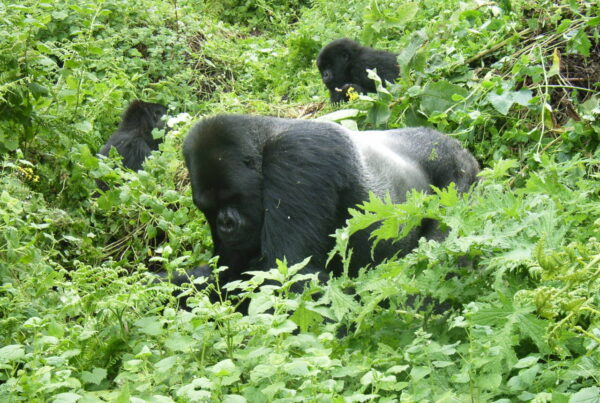
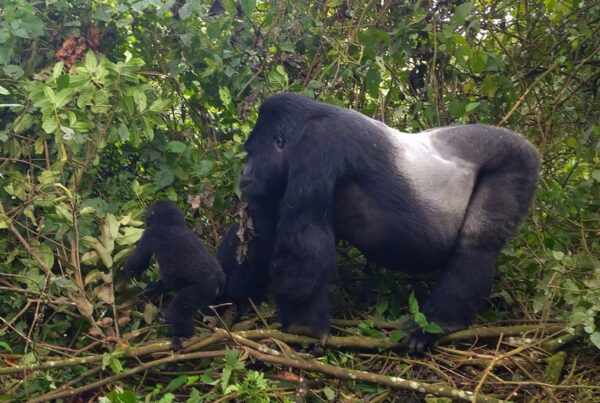
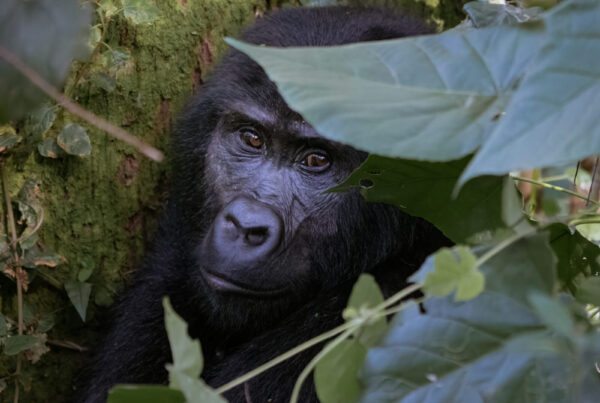
Uganda is home to the mountain gorilla (Gorilla beringei beringei), one of two subspecies of eastern gorilla. They live exclusively in the Virunga volcanic highlands (Uganda/Rwanda/DRC) and Bwindi Impenetrable Forest (Uganda only). Mountain gorillas are the only gorilla subspecies that cannot survive in captivity — every individual you can trek is a wild animal.
The standard gorilla trekking permit gives you exactly 1 hour with the gorilla family. This time begins when you make first contact with the family — the ranger signals the start. The Gorilla Habituation Experience gives 4 hours with a semi-wild family. The walk to find the gorillas can take 30 minutes to 5 hours depending on where the family has moved.
Stay calm, crouch down slowly, avoid direct eye contact, and remain quiet. Do not run — running triggers a chase response. Rangers accompanying your group manage close approaches. Habituated gorillas are accustomed to humans and almost never make contact, but a charging silverback is managed by staying still and following ranger instructions immediately.
A maximum of 8 visitors per habituated gorilla family per day for standard trekking. The Gorilla Habituation Experience has a maximum of 4 visitors per family per day. These limits are set by UWA to minimise stress on the gorilla families and maintain the quality of the experience.
Uganda is home to the mountain gorilla (Gorilla beringei beringei), one of two subspecies of eastern gorilla. They live exclusively in the Virunga volcanic highlands (Uganda/Rwanda/DRC) and Bwindi Impenetrable Forest (Uganda only). Mountain gorillas are the only gorilla subspecies that cannot survive in captivity — every individual you can trek is a wild animal.