Updated
gorilla trekking Uganda photograph desk is one of Africa’s most extraordinary wildlife experiences, connecting travellers with mountain gorillas in their natural forest habitat. I have one photograph from gorilla trekking in Uganda that I have printed and framed and placed on my desk. It sits between my monitor and the window. I look at it most days without intending to — it enters my peripheral vision and I turn toward it. The photograph is not technically impressive. The composition is off-centre and the light was filtered through canopy in a way that softens the focus. But it contains something that no technically better photograph I have ever taken contains, and it has been on my desk for three years. This is what it shows and why it is there.
The Photograph From Gorilla Trekking That Sits on My Desk Every Day
What the Photograph Shows
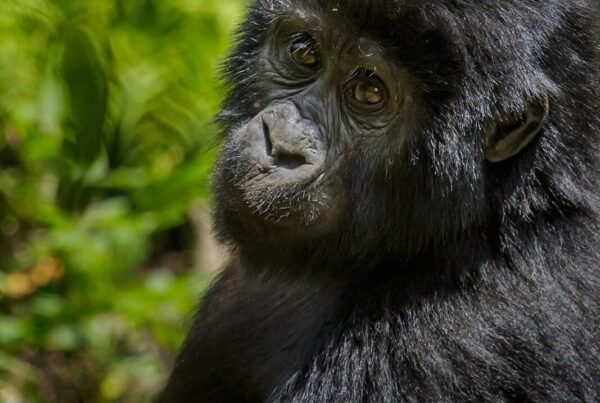
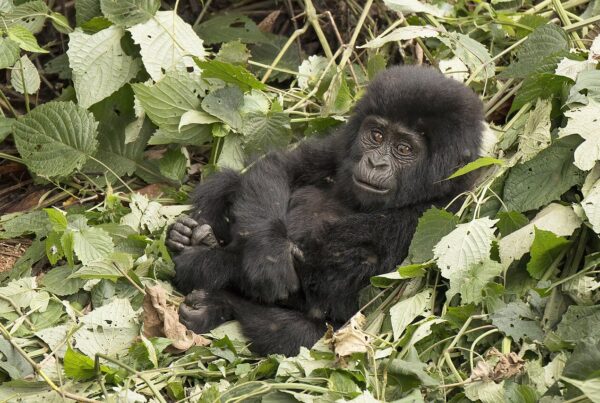
The photograph shows a silverback gorilla, side-on, eating from a plant at the edge of a forest clearing. He is perhaps eight metres from where I was standing when I took it. The forest behind him is dense — layers of green at different distances creating a depth that suggests the forest continues indefinitely behind the frame. The silverback’s expression is entirely absent of self-consciousness. He is simply eating, in a forest, in the morning light, in complete absorption in what he is doing.
I took this photograph at Buhoma sector, Bwindi Impenetrable National Park, Uganda, on a morning in September. The gorilla permit cost $800 USD. The trek to find this animal took two and a half hours. The hour I spent with his family was the most fully present I have been in a defined period of time in the last decade. The photograph is the record of that presence.
Why This Photograph and Not Another
I took approximately two hundred photographs during the hour with the gorilla family. Most of them are technically better than the one on my desk. There are sharper images, better-composed images, images where the animal is looking directly at the camera with an expression that would read as more dramatic in a social media context. I printed none of those. I printed this one because of what I was thinking when I took it.
When I took the photograph I was not thinking about the photograph. I was thinking about how completely absorbed the silverback was in what he was doing — eating this plant, in this moment, with no apparent awareness of or concern about anything beyond the immediate. I was thinking about how rarely I operate that way. How many things I do while simultaneously monitoring how they are going, how they appear to others, whether I am doing them correctly, what comes next. The silverback was eating leaves and that was the entire content of his existence in that moment. The photograph is a record of the moment I noticed that and wanted to hold onto it.
What the Photograph Does on My Desk
It functions as a recalibration device. When the work becomes dense with the particular kind of urgency that corporate environments generate — everything important, everything needed now, every email requiring immediate response — I look at the silverback and the urgency deflates slightly. Not because the work is not real. Because the silverback is also real, and he has been going about his business in that forest while I have been attending meetings and answering emails, and his business and mine are both real and both temporary and both located within a world that is much larger than either of them.
This is not a profound philosophical position. It is a practical one. The photograph helps me stay in proportion. I am better at my work when I am in proportion than when I am not, and the photograph is cheaper and more reliable than most of the other means I have tried for achieving the same effect.
On Keeping Physical Records of Important Experiences
I have photographs on my phone from the same trip that I have not looked at in eighteen months. The photograph on my desk I have looked at thousands of times. The difference is the physical presence — the fact that it occupies space in my working environment rather than existing as one file among forty thousand in a cloud library. If you go to Uganda and something happens there that matters to you, print a photograph and put it somewhere you will see it. The permit costs $800. The framing costs fifteen. The daily recalibration is ongoing and free.
Frequently Asked Questions
A versatile zoom lens in the 24–200mm range (or equivalent on crop sensor) works for most forest conditions. A fast lens (f/2.8) handles the low light under the forest canopy. Mirrorless cameras with fast autofocus track gorilla movement well. Flash is strictly prohibited. Bring a rain cover — the forest is damp year-round.
Set: Shutter priority at minimum 1/250s (to freeze movement), Auto ISO with a ceiling of 6400, continuous autofocus, burst mode. Shoot in RAW for post-processing flexibility. In the dense understorey, light is limited — prioritise shutter speed over aperture. Wide-angle shots require patience as gorillas occasionally approach very close.
UWA guidelines require a minimum 7-metre distance from gorillas at all times. In practice, gorillas regularly approach the human group on their own — rangers manage this by repositioning the group when needed. Most trekkers end up photographing gorillas at 3–10 metres. Infant gorillas sometimes approach even closer, which rangers discourage gently.
Yes — video cameras and smartphone video are permitted. Flash is the only restriction. A monopod is useful for steadier video in low light. If you plan serious video work (wildlife documentary standard), consider the Gorilla Habituation Experience ($1,800) which gives 4 hours to film natural behaviour in a smaller group of just 4 visitors.
Uganda is home to the mountain gorilla (Gorilla beringei beringei), one of two subspecies of eastern gorilla. They live exclusively in the Virunga volcanic highlands (Uganda/Rwanda/DRC) and Bwindi Impenetrable Forest (Uganda only). Mountain gorillas are the only gorilla subspecies that cannot survive in captivity — every individual you can trek is a wild animal.