Updated
gorilla trekking Uganda personal pride family is one of Africa’s most extraordinary wildlife experiences, connecting travellers with mountain gorillas in their natural forest habitat. My son is fourteen. He has the particular quality of attention that fourteen-year-olds deploy when they want a real answer rather than a parental performance of an answer. He asked me one evening what I was most proud of in my life. I have built things. I have been part of things worth building. I have a family I love and a career I have taken seriously. I said gorilla trekking in Uganda. He looked at me for a long moment and then said: tell me about it. So I did. And so will I here.
My Son Asked Me What I Was Most Proud Of: I Said the Gorilla Trek
Why Gorilla Trekking Uganda Became the Answer
The question surprised me into honesty. I had not prepared an answer. My professional achievements were real but they did not feel like pride in the way the question implied — they felt more like competence, like the satisfaction of having done what I set out to do within a system that rewarded doing it. The gorilla trek was different. It was not required of me. It was not professionally relevant. It served no objective beyond the experience itself. I did it because I wanted to and I made it happen in the face of a schedule that did not naturally accommodate it, and what I experienced there was genuinely mine in a way that my professional achievements were not entirely mine.
I went to Bwindi when my son was nine. I had been planning it for two years before that — the gorilla permit is $800 USD and books months in advance, and the logistics of getting from Entebbe to the forest require planning that I treated with more care than I had treated any holiday before or since. The planning itself was a signal of how much it mattered.
The Morning I Remember
I was in a group of eight at Ruhija sector, Bwindi’s most remote entry point. The trek was steep and long — four hours, with a descent into a valley and a climb back up through forest so dense that the light changed colour as we moved through it. I was the fittest I had been in years. I had trained for this specifically — running, walking with a weighted pack on weekends — and the effort of the preparation was repaid in full by being strong enough to fully experience what was at the end of it.
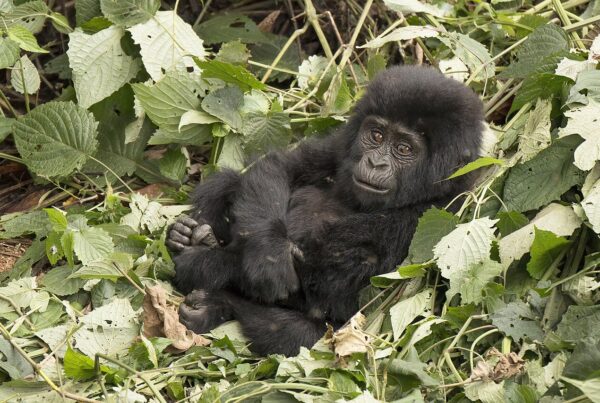
We found the Oruzogo group in a clearing at the valley floor. Twenty-five gorillas. The silverback was in the centre of the clearing, resting. His family moved around him with the ease of a social structure that has been stable for years. Two infants were playing with a kind of physical joy that was contagious — rolling, climbing, falling, climbing again, with no apparent purpose beyond the pleasure of movement.
The Specific Moment
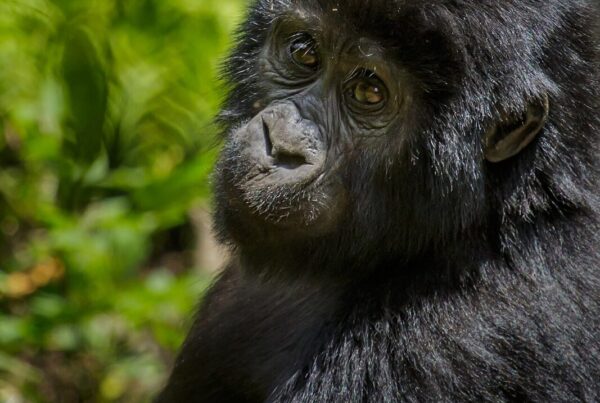
Twenty minutes into the hour a juvenile — perhaps two years old, small enough that its mother remained in close proximity — detached from the group and walked toward our line. The guide signalled us to stay still. The juvenile stopped three metres from me and sat down. It looked at me with an expression I can only describe as curious — the open, unselfconscious curiosity of a young animal encountering something new. I looked back. We regarded each other for perhaps thirty seconds. Then its mother made a sound and it turned and went back to her.
Thirty seconds. I have thought about those thirty seconds more than I have thought about many things that lasted far longer. There was something in the encounter — something about being looked at by something that had no category for me, no expectation, no history with my species beyond the benign encounters of habituation — that felt like being seen cleanly. Without the filters that human social interaction requires.
What I Told My Son
I told him about the juvenile. About the thirty seconds. About the quality of being seen by something that did not know who I was supposed to be. He is fourteen and he listened without interrupting, which is the highest compliment he gives. When I finished he said: I want to do that. I said: we will. I am planning the trip for when he is sixteen — old enough for the trek, young enough that the experience will reach him before the world has convinced him what his priorities should be.
The permit is $800 per person. I will buy two. Some things are worth prioritising over everything else on the list, and this is one of them.
Frequently Asked Questions
Uganda is home to the mountain gorilla (Gorilla beringei beringei), one of two subspecies of eastern gorilla. They live exclusively in the Virunga volcanic highlands (Uganda/Rwanda/DRC) and Bwindi Impenetrable Forest (Uganda only). Mountain gorillas are the only gorilla subspecies that cannot survive in captivity — every individual you can trek is a wild animal.
The standard gorilla trekking permit gives you exactly 1 hour with the gorilla family. This time begins when you make first contact with the family — the ranger signals the start. The Gorilla Habituation Experience gives 4 hours with a semi-wild family. The walk to find the gorillas can take 30 minutes to 5 hours depending on where the family has moved.
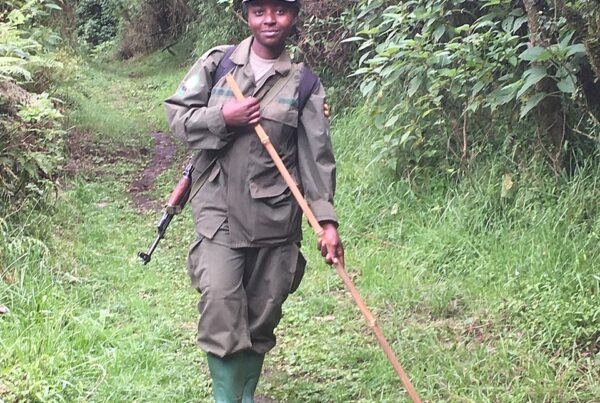
Stay calm, crouch down slowly, avoid direct eye contact, and remain quiet. Do not run — running triggers a chase response. Rangers accompanying your group manage close approaches. Habituated gorillas are accustomed to humans and almost never make contact, but a charging silverback is managed by staying still and following ranger instructions immediately.
A maximum of 8 visitors per habituated gorilla family per day for standard trekking. The Gorilla Habituation Experience has a maximum of 4 visitors per family per day. These limits are set by UWA to minimise stress on the gorilla families and maintain the quality of the experience.
Uganda is home to the mountain gorilla (Gorilla beringei beringei), one of two subspecies of eastern gorilla. They live exclusively in the Virunga volcanic highlands (Uganda/Rwanda/DRC) and Bwindi Impenetrable Forest (Uganda only). Mountain gorillas are the only gorilla subspecies that cannot survive in captivity — every individual you can trek is a wild animal.