The Nile is the world’s longest river — approximately 6,650 kilometres from its most distant source to the Mediterranean Sea. It drains an area of over 3 million square kilometres across eleven countries. It sustained the civilisation of ancient Egypt for thousands of years and continues to provide water, agriculture, and hydroelectric power to hundreds of millions of people. And it begins in Uganda — more precisely, it begins at the point where Lake Victoria discharges into the Victoria Nile at Jinja, from where it travels north through the heart of the country, over Murchison Falls, through Lake Albert, and onward into South Sudan, Sudan, and Egypt. Understanding the Nile’s Ugandan origins is part of understanding what Uganda is and why it matters.
The Question of the Source
The source of the Nile was one of the great geographical mysteries of the nineteenth century. Ancient Egyptian and Greek writers had speculated about the river’s origins without reaching a definitive answer. The exploration of Central Africa by European travellers in the 1850s and 1860s was driven partly by the desire to resolve this question. John Hanning Speke’s identification of Lake Victoria as the Nile’s source in 1858, confirmed by his return expedition with James Grant in 1862-63, is one of the most significant geographical discoveries of the Victorian era.
Speke identified Ripon Falls — the outlet of Lake Victoria at Jinja — as the point where the Nile begins its northward journey. He was right in the immediate sense: the Victoria Nile does indeed flow out of Lake Victoria at this point. The fuller picture — that Lake Victoria is fed by rivers including the Kagera, which itself draws from sources in Rwanda and Burundi — extends the Nile’s drainage system further south. The “longest river” debate has produced various candidates for the most distant source, but the Uganda connection remains: the river that shaped ancient Egyptian civilisation has its hydrological origins in the Great Lakes of East Africa, and it begins its defined journey at Uganda’s northern shore of Lake Victoria.
The Nile Through Uganda
From Jinja, the Victoria Nile flows westward through Lake Kyoga before turning north to enter Murchison Falls National Park. At Murchison Falls, the entire river — which at this point carries a significant volume of water — is forced through a gap of approximately seven metres in the rock at the top of the falls, creating one of the most powerful and dramatic waterfalls anywhere on earth. The water drops forty-three metres from the top of the falls to the pool below. The sound, the spray, and the sheer violence of the passage make Murchison Falls one of the most physically extraordinary geographical features in Africa.
Below the falls, the river broadens and slows, flowing through Murchison Falls National Park to the delta at the northern end of Lake Albert. The boat trip from Paraa to the base of Murchison Falls is one of Uganda’s signature wildlife experiences: the river banks are lined with Nile crocodiles, hippos surface and submerge alongside the boat, and a wide range of waterbirds — including the iconic shoebill — inhabit the channels and swamps of the floodplain. The falls themselves, seen from below, are overwhelming in scale.
Owen Falls Dam and the Changed Nile
The construction of Owen Falls Dam (now Nalubaale Dam) at Jinja in 1954 submerged Ripon Falls beneath the dam’s reservoir. The dam transformed the Nile’s flow through Uganda and provided the country with hydroelectric power that remains the foundation of its national grid. The original falls that Speke described — “a magnificent sight, and much larger than I had imagined” — no longer exist as a natural feature, though the site is marked and the river continues to flow with force through the dam’s spillways.
A second dam, Bujagali Falls Dam (commissioned 2012), flooded Bujagali Falls — previously the most popular white-water rafting site on the Nile. The rafting industry has moved downstream to new sections of the river where the falls and rapids remain. Jinja is still marketed as the “adventure capital of East Africa” and remains a popular destination for bungee jumping, kayaking, and quad biking alongside the white-water activities that the remaining river sections support.
The Nile in Gorilla Trekking Context
For gorilla trekking visitors to Uganda, Murchison Falls and Jinja are two of the most compelling additions to a primarily Bwindi-based itinerary. Murchison Falls National Park is approximately four to five hours by road from Kampala and offers a full-day boat trip experience and game drives with Nile scenes that are unique in African wildlife tourism. Jinja is two hours from Kampala and easily added to any itinerary that passes through the capital. Together, they bring the Nile’s Ugandan story from abstraction into direct experience — the same river that sustained ancient Egypt, beginning here, in the green heart of Africa, from a lake that sits on the equator.
Frequently Asked Questions
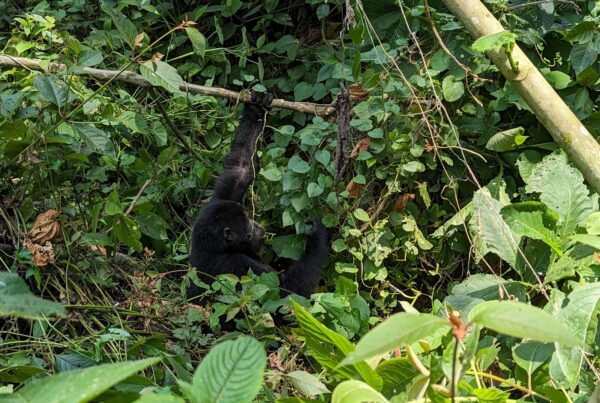
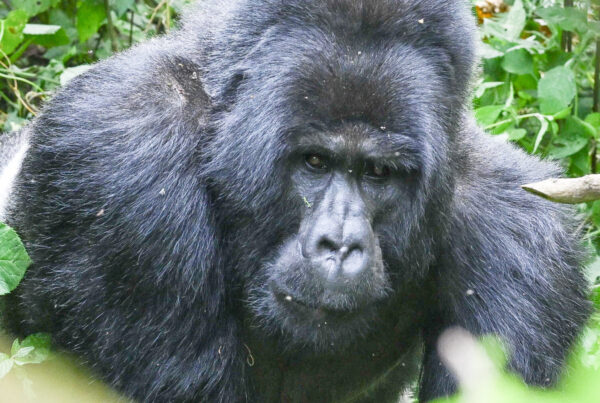
Uganda is home to the mountain gorilla (Gorilla beringei beringei), one of two subspecies of eastern gorilla. They live exclusively in the Virunga volcanic highlands (Uganda/Rwanda/DRC) and Bwindi Impenetrable Forest (Uganda only). Mountain gorillas are the only gorilla subspecies that cannot survive in captivity — every individual you can trek is a wild animal.
The standard gorilla trekking permit gives you exactly 1 hour with the gorilla family. This time begins when you make first contact with the family — the ranger signals the start. The Gorilla Habituation Experience gives 4 hours with a semi-wild family. The walk to find the gorillas can take 30 minutes to 5 hours depending on where the family has moved.
Stay calm, crouch down slowly, avoid direct eye contact, and remain quiet. Do not run — running triggers a chase response. Rangers accompanying your group manage close approaches. Habituated gorillas are accustomed to humans and almost never make contact, but a charging silverback is managed by staying still and following ranger instructions immediately.
A maximum of 8 visitors per habituated gorilla family per day for standard trekking. The Gorilla Habituation Experience has a maximum of 4 visitors per family per day. These limits are set by UWA to minimise stress on the gorilla families and maintain the quality of the experience.
Uganda is home to the mountain gorilla (Gorilla beringei beringei), one of two subspecies of eastern gorilla. They live exclusively in the Virunga volcanic highlands (Uganda/Rwanda/DRC) and Bwindi Impenetrable Forest (Uganda only). Mountain gorillas are the only gorilla subspecies that cannot survive in captivity — every individual you can trek is a wild animal.