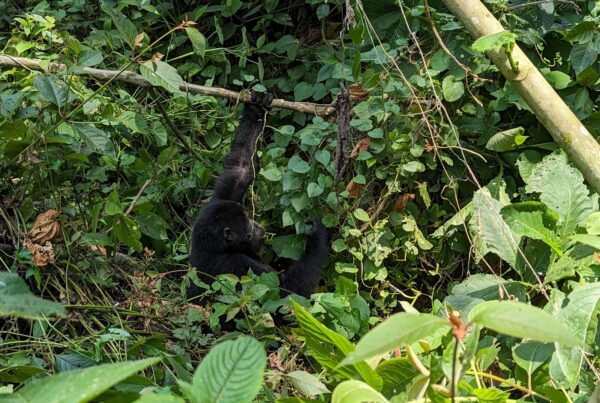
Uganda gorilla ranger UN recognition 2026 — the story behind the award
A Uganda Wildlife Authority gorilla ranger received international recognition from the United Nations Environment Programme in 2026 for her contribution to mountain gorilla conservation — an award that attracted media attention far beyond the conservation community and introduced millions of people worldwide to the human reality of the work that protects mountain gorillas in Bwindi Impenetrable Forest. Her story — a Ugandan woman from a community adjacent to the park who joined Uganda Wildlife Authority as a junior ranger and rose through the organisation over 15 years to become one of Bwindi’s most experienced gorilla monitoring specialists — represents the human dimension of gorilla conservation that is often invisible behind the statistics of population counts and permit revenue.
Her work: daily life as a gorilla ranger
A senior gorilla ranger in Bwindi’s habituated family programme begins her day before dawn. By first light, she is inside the forest, locating the family she monitors through the combination of GPS data from the previous day and direct tracking — reading signs of movement, feeding, and sleeping in the vegetation to establish where the family has been since she last saw them. Once the family is located, she will spend several hours monitoring their behaviour, recording data on individual interactions, births, deaths, and movements, and — on trekking days — guiding visiting groups through the encounter while managing the group’s behaviour and the family’s response simultaneously. The work is physically demanding, sometimes dangerous, and requires a combination of ecological knowledge, primatological understanding, and interpersonal skill that is rarely fully appreciated by the tourists whose encounter she makes possible.
The habituation work
Beyond the daily monitoring of established habituated families, she has also worked on the habituation of new gorilla families — the multi-year process of conditioning wild gorillas to accept human presence. Habituation is described by rangers who have done it as among the most demanding and most rewarding work in the organisation: the patience required, the careful management of each stage of the process, and the ultimate moment of success — when the silverback of a previously wild family makes direct, unhurried eye contact with a ranger without retreating — creates a professional achievement with no equivalent in any other field of wildlife management.
The UN recognition: what it was for
The UNEP recognition cited her specific contribution to the development of community engagement protocols for the rangers working in communities adjacent to Bwindi. The protocols she helped develop — which guide rangers’ interactions with local communities, build relationships between the conservation authority and the people who live alongside the forest, and create the trust that makes community reporting of poaching and forest incursions possible — have been adopted by Uganda Wildlife Authority across all of Bwindi’s sectors and have been shared as a model with conservation programmes in Rwanda and the DRC. The practical impact of these protocols on the effectiveness of community-based anti-poaching operations has been measurable, contributing to the reduction in snare injuries in habituated gorilla families over the past five years.
What her story means for gorilla trekking visitors
For visitors who spend their hour with a mountain gorilla family in Bwindi, the ranger who guides the encounter is the visible representative of an organisation of hundreds of people whose daily work — unseen, underpublicised, and often physically and emotionally demanding — creates the experience that the visitor has travelled from the other side of the world to have. The UN recognition brought that invisible work briefly into international visibility. The testimony it generated — from the ranger herself, from her colleagues, from the conservation organisations that have worked with her — is a reminder that gorilla trekking is not only an extraordinary wildlife experience but a window into a conservation system built and maintained by people whose commitment to the gorillas they protect is the foundation of everything the visitor encounters in the forest.
Frequently Asked Questions
The global mountain gorilla population is approximately 1,100 individuals — one of the smallest populations of any great ape. They exist in two separate populations: one in the Virunga Massif spanning Uganda, Rwanda, and DRC; and one in Bwindi Impenetrable Forest (Uganda only). The population has grown from approximately 620 in the 1980s, largely due to tourism-funded conservation.
Uganda Wildlife Authority directs 20% of every gorilla permit fee to communities adjacent to Bwindi and Mgahinga. These funds pay for school construction, healthcare programmes, borehole maintenance, and community microfinance. Permit revenue also funds ranger salaries, anti-poaching patrols, and the research teams that monitor gorilla health daily.
The Batwa (also called Twa) are an indigenous forest people who lived inside Bwindi for thousands of years until it was gazetted as a national park in 1991. Conservation displaced them from their ancestral forest. Gorilla tourism revenue now funds Batwa cultural programmes and livelihoods. The Batwa Cultural Trail at Buhoma sector is run by the Batwa community and is one of the most authentic cultural experiences near Bwindi.
Mountain gorillas are classified as Endangered on the IUCN Red List — one step down from Critically Endangered, which they held until 2018. Their population has grown consistently since the 1980s, making them one of the few great ape populations increasing in number. This recovery is directly attributed to the conservation funding generated by gorilla tourism.
Uganda is home to the mountain gorilla (Gorilla beringei beringei), one of two subspecies of eastern gorilla. They live exclusively in the Virunga volcanic highlands (Uganda/Rwanda/DRC) and Bwindi Impenetrable Forest (Uganda only). Mountain gorillas are the only gorilla subspecies that cannot survive in captivity — every individual you can trek is a wild animal.