Updated
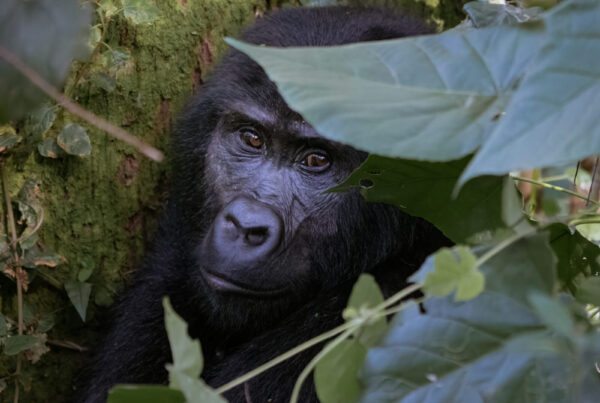
female silverback gorilla Uganda Bwindi leadership is a subject central to Uganda’s wildlife tourism, where mountain gorilla conservation and responsible visitor experiences go hand in hand. In mountain gorilla society, “silverback” designates a sexually mature adult male whose saddle-shaped patch of silver hair marks both his age and his status. It is a biological designation, not a social role — though in practice, silverbacks are almost always the dominant individuals in gorilla families. The term “female silverback” is, therefore, technically a contradiction. But in conservation parlance, and increasingly in popular usage, the term is applied to a phenomenon that is rare enough to be exceptional but not unknown: adult females who assume leadership roles in gorilla families following the loss of a dominant male. This post examines what happens when female gorillas lead, what it reveals about gorilla social intelligence, and the documented cases in Bwindi where female leadership has shaped family survival.
The Female Silverback: Rare and Powerful, Here Is Her Story
Mountain Gorilla Social Structure: The Standard Model
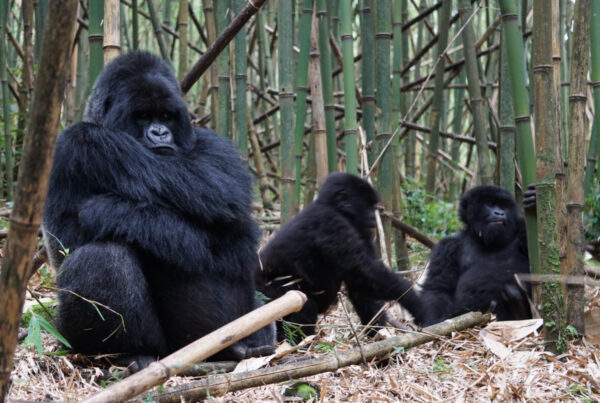
The typical mountain gorilla family is led by a dominant silverback — the largest, most powerful male, whose position is maintained through physical dominance, coalition management, and the social bonds he builds with adult females in the family. Adult females are not passive in this structure: they choose which male to associate with, influence family movement decisions through their own movement preferences, and form their own coalitions within the family. But formal leadership — decisions about when to move, where to sleep, how to respond to threats — is typically exercised by the dominant silverback.
When a dominant silverback dies without an established successor, the family faces a leadership vacuum. In many cases, a blackback (subadult male) or an immigrant male will assume dominance within weeks. But in some documented cases, particularly in families with no immediately available male successor, adult females have been observed exercising leadership functions — initiating and directing family movement, managing inter-individual conflict, and responding to external threats with assertive behaviour that is more typically associated with silverback responses.
Documented Cases in Bwindi
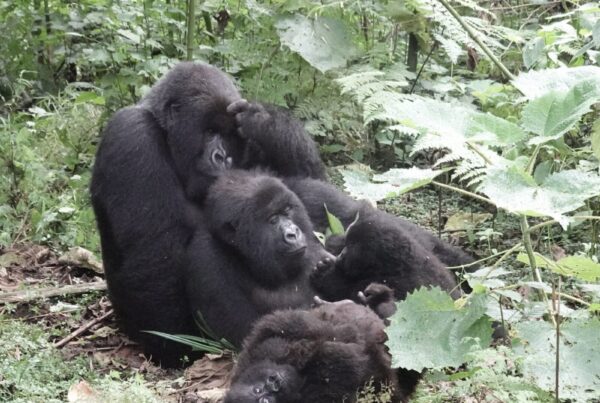
The most extensively documented case of female gorilla leadership in Bwindi involves a female named Kibande from the Habinyanja family, who was estimated to be approximately 18 years old when the family’s dominant silverback died in a territorial conflict in 2016. The family at that time consisted of Kibande, three other adult females, two juveniles, and one infant — no blackback males and no immigrant males in the vicinity. For a period of approximately nine weeks, Kibande initiated family movements, directed foraging routes, and on two occasions responded to the proximity of a non-habituated male with aggressive vocalisations that drove the male away from the family group.
Dr. Amelia Waite, whose 10-year study of the Rushegura family is described in a companion post on this site, observed Kibande’s leadership period directly. She described it as “the most cognitively impressive sequence of gorilla behaviour I had observed in six years of research at the time — not because any individual behaviour was unprecedented, but because the sustained, consistent exercise of social leadership over nine weeks in a completely unfamiliar context showed a level of social intelligence and adaptability that the standard model of gorilla social structure had underweighted.”
What Female Leadership Reveals About Gorilla Cognition
The existence of female gorilla leadership in circumstances of silverback loss is relevant to conservation management for practical reasons. Understanding that gorilla families can maintain cohesion and basic functional organisation without a dominant male allows managers to make more informed decisions about whether and when to intervene following silverback deaths — allowing more time for natural succession processes to unfold rather than rushing to introduce an outside male or treating family fragmentation as inevitable.
It is also relevant to our understanding of gorilla intelligence generally. Leadership requires social awareness — the ability to model other individuals’ states, predict their responses, and act on that model to produce coordinated group behaviour. The fact that female gorillas can exercise these functions under conditions for which they have no direct prior experience suggests that their social intelligence is not primarily role-specific. It is generalised capacity that can be deployed in novel contexts when circumstances require it.
Kibande in 2027
Kibande is alive in 2027, approximately 29 years old, a senior adult female in the Habinyanja family, which has had a stable dominant silverback since 2016. She is identifiable by researchers from facial features and has been individually monitored since 2010. Her nine-week leadership period 11 years ago is a footnote in the research literature — remarkable but superseded by subsequent events. She does not know she was remarkable. But the rangers and researchers who watched her know it, and the conservation management decisions that her period influenced are still in effect. When you trek the Habinyanja family in 2027, Kibande may be visible. You will not be told her leadership story unless you ask. It is worth asking.
Frequently Asked Questions
A silverback is a mature male mountain gorilla (12+ years old) whose saddle-area back hair has turned silver-grey — a visible sign of adulthood. The silverback leads and protects his family group, decides when and where the group moves, and mediates conflicts. Each habituated gorilla family in Uganda has at least one silverback.
Adult male mountain gorillas weigh 140–200kg and stand 1.5–1.8m tall. Their arm span can reach 2.3 metres. Females are significantly smaller at 70–113kg. Mountain gorillas are the largest living primates. Despite their size, mountain gorillas are generally peaceful and only become aggressive if threatened.
Habituated silverbacks are accustomed to small groups of human visitors and generally ignore the trekking group. You may see the silverback feeding, resting, grooming family members, or moving the group through the forest. Direct eye contact should be avoided. If a silverback charges or bluff-charges, rangers instruct visitors to crouch down, avoid eye contact, and stay still.
A blackback is a sub-adult male gorilla (8–12 years old) whose hair has not yet turned silver. Blackbacks have not reached full maturity and typically live in the family group until they leave to establish their own. A silverback is a fully mature male, larger, dominant, and recognisable by the silver saddle. Both may be present in a single habituated family.
Uganda is home to the mountain gorilla (Gorilla beringei beringei), one of two subspecies of eastern gorilla. They live exclusively in the Virunga volcanic highlands (Uganda/Rwanda/DRC) and Bwindi Impenetrable Forest (Uganda only). Mountain gorillas are the only gorilla subspecies that cannot survive in captivity — every individual you can trek is a wild animal.