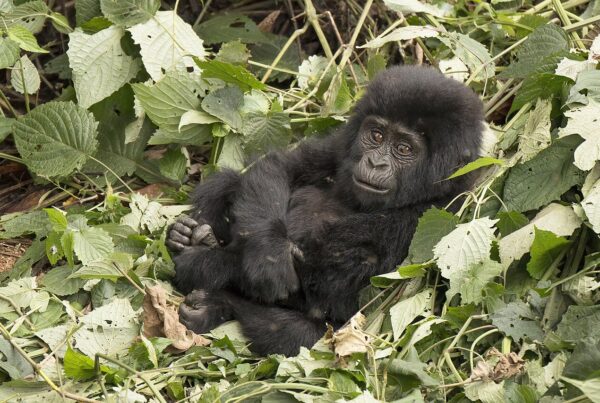
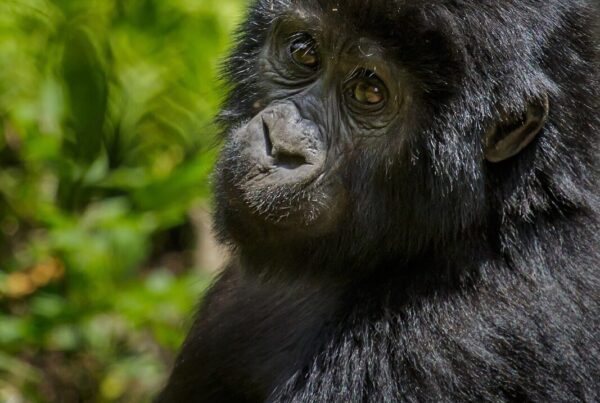
The Congo Basin rainforest is the second largest tropical rainforest on earth, covering approximately 3.3 million square kilometres across six countries in Central Africa. It is home to extraordinary biodiversity — including the mountain gorillas of its eastern fringes — and it performs ecosystem services that affect the entire African continent and, through atmospheric circulation, the global climate system. Among these services, its role in generating rainfall is one of the least understood and most consequential: the Congo Basin produces approximately 40% of the continent’s rainfall through the process of transpiration and the atmospheric moisture it generates.
How Forests Make Rain
Trees in tropical rainforests absorb water from the soil through their root systems and release it through their leaves in a process called transpiration. A large tropical tree can transpire hundreds of litres of water per day. Across a forest of billions of trees, the cumulative effect creates a continuous moisture flux from the forest to the atmosphere — a process sometimes described as a “biotic pump” that draws moisture inland from the coast and sustains rainfall patterns deep in the interior of the continent.
Research by the Global Canopy Programme and other institutions has demonstrated that tropical forests do not merely respond to rainfall — they actively generate it. Deforestation of tropical forests disrupts rainfall patterns not just locally but at regional and continental scales. The loss of forest cover in one area can reduce rainfall hundreds or even thousands of kilometres away, as the moisture cycling that the forest maintained is disrupted.
The Congo Basin’s Continental Role
Modelling studies have estimated that the Congo Basin rainforest contributes approximately 40% of the total rainfall received across sub-Saharan Africa. This figure represents the moisture that the forest generates through transpiration and distributes through atmospheric circulation, contributing to rainfall as far away as the Sahel in the north and East Africa in the east. Countries including Uganda, Rwanda, Kenya, and Ethiopia receive measurable proportions of their rainfall from moisture that originated in the Congo Basin forest.
For Uganda specifically, the western forests — Bwindi, Kibale, and the other forest reserves of the Albertine Rift — act as a local moisture engine that supplements the continental-scale contribution of the Congo Basin. The rainfall that supports Uganda’s agriculture, fills its lakes, and feeds the Nile is partly a product of the forests on Uganda’s western border. The protection of those forests is not simply a biodiversity conservation measure. It is infrastructure for the country’s water and food security.
The Threat of Deforestation
The Congo Basin is currently experiencing deforestation at a rate that, while lower than the Amazon, is accelerating. Subsistence farming, charcoal production, industrial logging, and the expansion of agricultural land for palm oil and other commodities are all reducing forest cover. In the DRC alone — which holds the largest share of the Congo Basin forest — deforestation rates have been increasing despite efforts to establish forest governance mechanisms.
The consequences of large-scale Congo Basin deforestation for African rainfall are modelled but not certain, because the atmospheric systems involved are complex and interact with ocean temperature patterns, jet stream movements, and other variables. What the models consistently show is that significant reduction in Congo Basin forest cover would reduce continental rainfall, particularly in the Sahel and East Africa — regions already experiencing climate variability and agricultural stress.
Bwindi as a Critical Forest Fragment
Bwindi Impenetrable National Park is, in biogeographic terms, an isolated forest fragment at the eastern edge of the Congo Basin. It is separated from the main body of the Congo forest by agricultural land and the Albertine Rift escarpment. Its protection is therefore significant not only for the gorillas and biodiversity it contains but for the moisture cycling role it plays in the western Uganda landscape.
The communities surrounding Bwindi depend on rainfall for subsistence agriculture. The gorilla permit revenue that funds Bwindi’s protection — $800 USD per person per trek in 2027 — contributes indirectly to maintaining the forest that supports those communities’ rainfall patterns. The connection between gorilla tourism, forest protection, and agricultural water security in western Uganda is real, if rarely described in these terms to the tourists who pay the permits.
The Larger Picture
The argument for protecting Africa’s forests has traditionally been framed in terms of biodiversity: the gorillas, the chimpanzees, the endemic birds, the thousands of plant species. These are compelling reasons. But the climate and hydrological arguments are at least as compelling and affect a much larger number of people. The 40% of African rainfall that the Congo Basin generates does not fall primarily on national parks. It falls on farmland, on watersheds, on cities, and on the millions of people who depend on predictable rainfall to grow food.
Protecting Africa’s forests is gorilla conservation. It is also climate adaptation. It is also water security for hundreds of millions of people. When a tourist pays a gorilla trekking permit in Uganda, they are participating — however modestly — in the maintenance of a forest system whose value extends far beyond the extraordinary animals it contains.