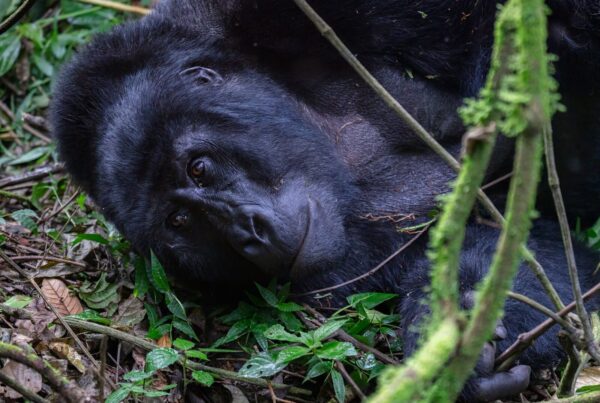
Africa offers hundreds of wildlife experiences that are remarkable, memorable, and worth travelling across the world to see. But within that vast catalogue, there are a small number of encounters that travellers consistently describe not merely as experiences they enjoyed but as experiences that changed something — their perspective on the natural world, on what it means to be human, on what is worth protecting. This is a guide to five of those encounters, and why each of them has the capacity to be genuinely transformative.
1. Mountain Gorillas in Bwindi, Uganda
The hour you spend with a habituated gorilla family in Bwindi Impenetrable National Park is unlike any other wildlife encounter available anywhere on earth. The gorillas — which share 98% of human DNA, have been habituated over years to accept human presence, and live entirely wild lives in an ancient rainforest — confront you with a kind of recognition that other wildlife experiences do not. You are not watching something exotic and alien. You are watching something that is recognisably related to you: a mother holding her infant the same way your mother held you, a juvenile testing limits in the same way any eight-year-old tests limits, a silverback’s slow and deliberate movement that communicates authority without aggression in a way that every human instinctively understands.
The gorilla permit costs $800 USD for international visitors in 2027 and is limited to eight visitors per family per day. The scarcity is part of what makes it transformative — this is not a theme park encounter. You are in a genuinely wild place, with a genuinely wild animal, subject to the same forest rules as the gorillas themselves.
2. The Wildebeest Migration in the Mara, Kenya
Approximately 1.5 million wildebeest, 200,000 zebra, and 500,000 gazelle move in a continuous circuit between Tanzania’s Serengeti and Kenya’s Masai Mara, following the rains and the grass they produce. The river crossings at the Mara River — where thousands of animals plunge into crocodile-filled water in a mass panic that can last for hours — are the most dramatic wildlife spectacle available anywhere. What makes it transformative is not just the scale but the raw, unmediated quality of the life and death happening in front of you. No fence, no net, no intervention. Just animals, water, predators, and the mathematics of a million individual survival decisions playing out simultaneously.
3. Chimpanzees in Kibale, Uganda
Chimpanzees are our closest living relatives — even closer to humans than gorillas. Kibale National Park in western Uganda holds the highest density of chimpanzees anywhere in Africa, in conditions that allow a tracking experience unlike anything available in Tanzania or elsewhere. What makes a chimpanzee encounter transformative rather than merely impressive is the specific quality of chimpanzee social behaviour: the political manoeuvring, the reconciliation after conflict, the tool use, the vocalisation, and most particularly the way chimpanzees look at you. It is not the passive curiosity of a gorilla. It is an active, evaluative gaze that seems to be asking the same question you are asking.
4. Elephant Herds at Amboseli, Kenya
Amboseli National Park holds some of the largest and most intensively studied elephant families in Africa, against the backdrop of Mount Kilimanjaro on clear days. The transformative quality of the Amboseli elephant encounter is not scale — though the herds are enormous — but familiarity. Amboseli’s elephants have been studied as individuals for decades by the Amboseli Trust for Elephants, and knowledgeable guides can describe the matriarch’s history, her relationship with her daughters, the trauma events in her past. Elephants grieve, maintain long-term social bonds, remember specific individuals over decades, and demonstrate empathy in ways that careful observation makes undeniable. An Amboseli encounter in which you understand what you are looking at — not just a large grey animal, but a specific individual with a specific history and specific relationships — changes what you think an animal is.
5. Shoebill Stork at Mabamba Swamp, Uganda
The shoebill is not a charismatic megafauna. It does not run or leap or exhibit the obvious social complexity of great apes or elephants. What it does is stand, motionless, at the edge of a papyrus channel in a Ugandan swamp and look at you with an expression that is difficult to interpret and impossible to forget. The shoebill looks like a living fossil — which in a sense it is, a species whose lineage extends back to the Eocene epoch 50 million years ago. Its global population is between 5,000 and 8,000 individuals. Seeing one at close range from a dugout canoe in Mabamba Swamp, as it regards you with what appears to be ancient and slightly bored contempt, has a quality of temporal displacement that other wildlife encounters do not match. You feel, briefly, that you are the anomaly in a timeline that predates human existence by 49 million years.
What Makes an Encounter Transformative
The common thread in these five experiences is not spectacle — though spectacle is present in each. It is specificity: the encounter requires real presence, real attention, and real proximity to a specific animal in a specific wild place. None of them are available from a screen or reproducible in a zoo. All of them require you to go to where the animal is, submit to the conditions of that place, and pay genuine attention. The transformation, when it happens, is a product of that attention — the moment when the animal you are observing becomes not a species or a symbol but a specific individual in a specific moment of its life, and you understand yourself as a specific individual in a specific moment of yours, sharing the same world.
Frequently Asked Questions
Kibale Forest National Park, near Fort Portal, has the highest density of chimpanzees in Africa and is Uganda’s premier chimpanzee destination. The standard chimp trekking permit costs $300 FNR. The Chimpanzee Habituation Experience at Kibale ($400 FNR) gives 4 hours with a habituated community — Uganda’s only chimp habituation programme.
Yes — the gorilla + chimp combination is Uganda’s most popular primate itinerary. A typical 8-day route: Entebbe → Kibale Forest (2 nights, chimp trekking) → Queen Elizabeth National Park (2 nights, game drives) → Bwindi (2 nights, gorilla trekking) → Entebbe. Charter flights on any leg reduce travel time significantly.
Uganda has 13 primate species. Commonly seen: olive baboon, vervet monkey, red-tailed monkey, black-and-white colobus, L’Hoest’s monkey, grey-cheeked mangabey. Golden monkeys are found at Mgahinga. Kibale Forest has the highest primate diversity of any East African forest. A dedicated primate safari can tick 7–8 species in a single itinerary.
Uganda has over 1,060 recorded bird species — one of the highest counts of any country in Africa. Bwindi alone has 350+ species including 23 Albertine Rift endemics. Murchison Falls, Queen Elizabeth, and the wetlands around Entebbe round out a world-class birding circuit. The African green broadbill and Shelley’s crimsonwing are Bwindi specialities.
Uganda is home to the mountain gorilla (Gorilla beringei beringei), one of two subspecies of eastern gorilla. They live exclusively in the Virunga volcanic highlands (Uganda/Rwanda/DRC) and Bwindi Impenetrable Forest (Uganda only). Mountain gorillas are the only gorilla subspecies that cannot survive in captivity — every individual you can trek is a wild animal.