Kenya or Uganda Safari — Which Should You Book Right Now?
Kenya and Uganda are East Africa’s two most established safari destinations, and the question of which to choose comes up in almost every conversation about the region. They are neighbouring countries, they share the East African Community framework, they can be visited on a combined itinerary — but the wildlife experiences they offer are fundamentally different. Kenya is about open savanna scale: the Masai Mara, the wildebeest migration, lions and cheetahs on flat plains that allow long-distance viewing. Uganda is about forest intimacy: mountain gorillas, chimpanzees, ancient Afromontane ecosystems, and an avian diversity that makes it Africa’s best birding destination by species count. In 2026, with Uganda’s tourism market quieter than usual, the comparison between these two destinations is particularly interesting.
What Kenya Does Best
Kenya’s Masai Mara ecosystem is one of the world’s great wildlife spectacles. The annual wildebeest migration, when 1.5 million animals cross the Mara River between July and October, is among the most dramatic natural events on earth. Kenya’s infrastructure — both at the airports and within the safari industry — is mature and highly polished. The range of lodge options, from luxury tented camps to mobile migration camps, is extensive. The roads into the Mara are good, the guides are experienced, and the predictability of big cat sightings is higher than almost anywhere else in Africa. For a first-time Africa visitor who wants a classic savanna safari experience with reliable infrastructure and strong big-five wildlife viewing, Kenya delivers consistently.
However, Kenya is also one of the most visited safari destinations in Africa, and that popularity has consequences. The Masai Mara during peak migration season can feel crowded around major sightings, with multiple vehicles converging on a lion or cheetah. Permits and lodge spaces book up quickly. The cost of high-quality Mara properties during peak season is substantial. And the iconic experience, while genuinely extraordinary, is one that many people have had before — the reference point is well-established.
What Uganda Does Best
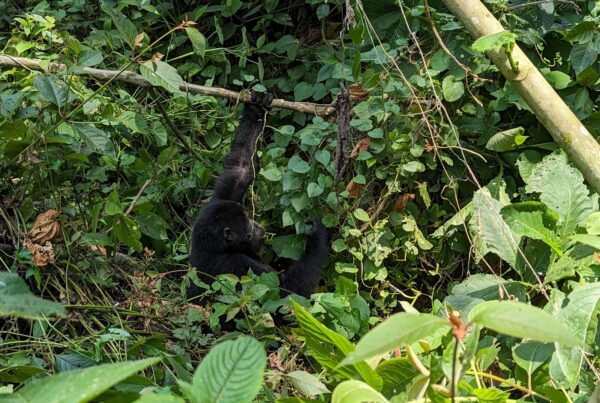
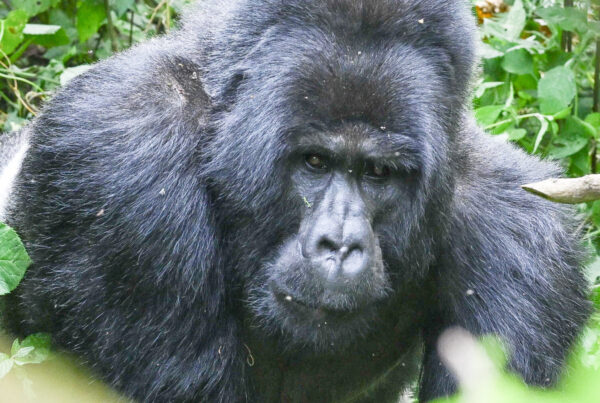
Uganda does things that Kenya simply cannot offer. Mountain gorilla trekking — a forest, on-foot encounter with the world’s largest primates sharing 98.3 percent of human DNA — has no equivalent anywhere in the savanna safari world. Chimpanzee trekking in Kibale provides a second primate encounter of extraordinary quality. The Albertine Rift’s birdlife, with over 1,000 species including dozens of endemics found nowhere else on earth, makes Uganda the premier birding safari destination in Africa. The landscape variety — from the Rwenzori glaciers to the Nile at Murchison Falls to the ancient forest of Bwindi — compresses an extraordinary range of experiences into a relatively compact geography.
Uganda’s safari infrastructure is less polished than Kenya’s at the top end but improving rapidly. Road quality on the main tourism routes has improved significantly over the past decade. Flight connections within Uganda between key parks reduce the impact of long road distances. The lodges near Bwindi range from world-class luxury to excellent mid-range options. For travellers who want something genuinely different from the standard safari template — who want intimacy over scale, forest over savanna, the unprecedented over the iconic — Uganda delivers an experience that Kenya cannot.
The 2026 Comparison
In 2026, the comparison between Kenya and Uganda is sharpened by a specific market dynamic. Uganda’s tourism market has softened due to headline anxiety, creating a window of unusual accessibility and value. Gorilla permits are available for dates that would normally be sold out. Lodge rates in Uganda are competitive and in some cases offer additional value. The experience that awaits visitors to Bwindi in 2026 — smaller groups, more attentive service, more intimate wildlife encounters — is qualitatively superior to what peak-season visitors have experienced in recent years. Kenya, by contrast, is operating at normal demand levels with the associated pricing and availability constraints.
For a traveller deciding between these two destinations right now, the honest answer depends on what you are seeking. If you want the wildebeest migration specifically, and your dates align with July to October, Kenya’s Masai Mara is irreplaceable. If you want the best gorilla trekking in Africa at the most accessible moment of recent years, Uganda is the clear choice. If you can do both — and the East Africa Tourist Visa covering both countries makes this logistically simple — a combined itinerary with gorillas in Uganda and migration in Kenya is one of the great wildlife travel experiences available anywhere on earth.
The Budget Reality
Cost comparisons between Uganda and Kenya are complicated by the specific components of each trip. Uganda’s gorilla permit at USD 700 is a significant cost that has no direct Kenya equivalent. However, Kenya’s premium Mara camps during peak migration season can cost USD 800 to USD 1,800 per person per night, which quickly makes a Uganda gorilla trip look cost-effective by comparison. Mid-range Uganda options near Bwindi at USD 150 to USD 350 per night combined with a USD 700 permit still come in below the all-in cost of a peak-season Mara luxury camp. For travellers working with a clear budget, mapping the full cost of each destination against the specific experience it delivers is more illuminating than permit price comparisons alone.
Frequently Asked Questions
The standard gorilla trekking permit costs $800 per person for foreign non-residents (FNR). EAC foreign residents pay $700. During low season — April, May, and November — the FNR rate drops to $600. The Gorilla Habituation Experience permit (4 hours, Rushaga sector only) costs $1,800 per person.
Permits are issued by Uganda Wildlife Authority (UWA). Most visitors book through a licensed Uganda tour operator, who handles the UWA reservation, permit transfer, and sector logistics. Direct booking via the UWA eTourism portal is available but operators handle the complexity of sector assignment and date changes.
During peak season (June–September, December–February): book 3–6 months ahead. During low season (April, May, November): 4–8 weeks is usually sufficient. The AFCON 2027 period (June–July 2027) will see unusually high demand — book at least 6 months ahead for any date in that window.
UWA gorilla permits are non-refundable but can be rescheduled to another date subject to availability and sufficient advance notice. Your tour operator handles this process. Travel insurance that covers trip cancellation and curtailment is strongly recommended for all Uganda gorilla bookings.
Yes. The permit price is set by Uganda Wildlife Authority and is fixed regardless of which operator you use. No operator can offer a discount on the $800 permit — only their service fees (accommodation, transport, guiding) vary between companies.