Updated
gorilla trekking Uganda grief healing is one of Africa’s most extraordinary wildlife experiences, connecting travellers with mountain gorillas in their natural forest habitat. My father died in February. By May I had done everything I was supposed to do — the funeral, the paperwork, the clearing of his house, the necessary conversations. What I had not done was grieve in any way that felt real. I was functional and numb simultaneously, which is apparently a common and recognised response but which felt, from the inside, like being sealed behind glass. I booked gorilla trekking in Uganda for July. This is what happened.
How Meeting a Mountain Gorilla Helped Me Deal With Grief
Why Uganda
My father had travelled widely when he was young. He had a particular photograph on his bookshelf of himself in East Africa, standing in a landscape that looked like a different planet from the one I grew up in. When I was old enough to ask about it he told me about the quality of the silence in large wild places — that it was not an absence of sound but a presence of something that made sound irrelevant. I never went to Africa while he was alive. The connection between his bookshelf photograph and the impulse to book Uganda after his death was not something I fully understood until I was already there.
Arriving at Bwindi
The charter flight from Entebbe to Kihihi airstrip takes one hour. From 1,500 metres I watched the Rift Valley unfold below — escarpment, forest, the green that I had only seen in photographs. My father’s photograph was taken somewhere in this general part of Africa. I did not know exactly where. It did not matter. The landscape was large enough that the specific location was irrelevant.
I stayed in a lodge at Buhoma. The first evening I sat on the veranda and listened to the forest. My father was right about the quality of the silence. It was not the absence of sound — there were birds, insects, the distant sound of the forest creek — but the sounds existed in a space so large that they were absorbed rather than accumulated. It was the first time since February that I had been somewhere where the silence was not a problem to be filled.
The Morning of the Trek
I was in a group of seven. The briefing covered the rules and the gorilla family we were assigned to. I absorbed it with the particular hyper-alertness that comes from being in an unfamiliar physical situation. The forest, the guide, the other trekkers — everything was concrete and present in a way that the preceding months had not been. Grief produces a kind of abstraction; the forest produced the opposite.
We walked for three hours. The terrain at Buhoma is not flat but it is manageable. My legs found a rhythm. My thoughts, which had been cycling in the same patterns since February, became quieter with the physical effort. Walking in a demanding environment requires a quality of attention that leaves less room for the other things your mind would otherwise be doing.
The Encounter
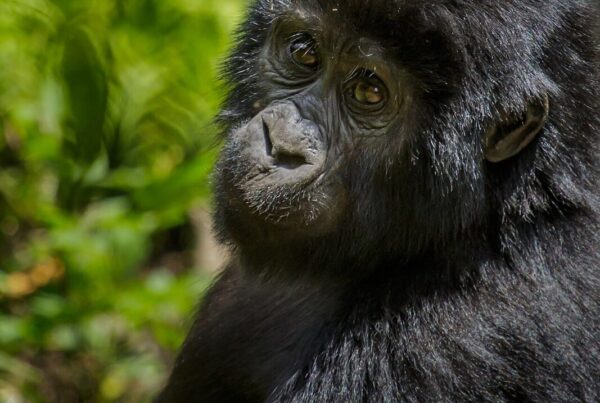
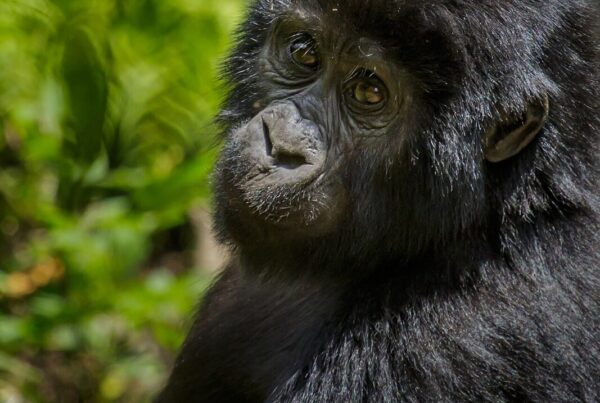
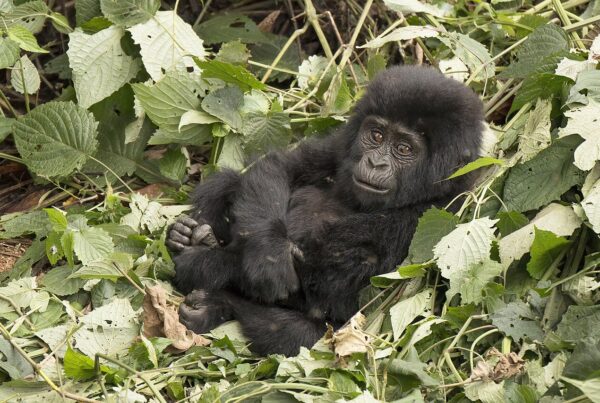
The Rushegura family was feeding in a clearing when we found them. There were seventeen gorillas — the silverback, several females, adolescents, and four infants. The guide moved our group into position and signalled us to crouch. We were perhaps eight metres from the nearest gorilla, a female with an infant clinging to her back.
The silverback was on the far side of the clearing. He was enormous in the way that photographs do not accurately convey — not just large but present in a way that commanded the space around him without apparent effort. He ate methodically, looked at us briefly with an expression that registered our presence and then disregarded it, and continued eating. His family moved around him in patterns that looked like choreography but were clearly habitual — each animal knowing where it was and where the others were, the whole group functioning as a single, coherent organism.
What Grief and Gorillas Have in Common
I know this sounds like a thing a person says to make their experience sound more meaningful than it was. But there was something about the gorilla family — the way they moved together, the way the mothers held their infants, the way the silverback oriented toward the sounds his family made — that was about family in a way that was impossible to avoid. Family as structure. Family as the thing that continues after the individuals within it change. I watched the silverback and thought about my father in a way I had not been able to think about him since February. Not with the sealed-behind-glass numbness. With something that felt more like the right kind of sadness — present, clean, and finally real.
The hour ended. We walked back. I was quiet for most of the return, which my guide seemed to understand was not a problem. We ate lunch at the lodge. I slept that afternoon for two hours, which was the first time I had slept during the day since my father died.
What Changed
Nothing resolved. Grief is not a problem with a solution and I am not suggesting that gorilla trekking is a treatment. What changed was the quality of my access to it. The sealed-behind-glass feeling lifted. Not entirely and not permanently, but enough that when I came home I was able to sit with my grief rather than operate around it. My father would have liked Uganda, I think. He would have liked the photograph I took of the silverback. I have it on my wall now, next to his.
Gorilla trekking in Uganda in 2027 costs $800 for the permit. The rest of the cost is yours to determine. Some of what it gives you back is harder to price.
Frequently Asked Questions
Uganda is home to the mountain gorilla (Gorilla beringei beringei), one of two subspecies of eastern gorilla. They live exclusively in the Virunga volcanic highlands (Uganda/Rwanda/DRC) and Bwindi Impenetrable Forest (Uganda only). Mountain gorillas are the only gorilla subspecies that cannot survive in captivity — every individual you can trek is a wild animal.
The standard gorilla trekking permit gives you exactly 1 hour with the gorilla family. This time begins when you make first contact with the family — the ranger signals the start. The Gorilla Habituation Experience gives 4 hours with a semi-wild family. The walk to find the gorillas can take 30 minutes to 5 hours depending on where the family has moved.
Stay calm, crouch down slowly, avoid direct eye contact, and remain quiet. Do not run — running triggers a chase response. Rangers accompanying your group manage close approaches. Habituated gorillas are accustomed to humans and almost never make contact, but a charging silverback is managed by staying still and following ranger instructions immediately.
A maximum of 8 visitors per habituated gorilla family per day for standard trekking. The Gorilla Habituation Experience has a maximum of 4 visitors per family per day. These limits are set by UWA to minimise stress on the gorilla families and maintain the quality of the experience.
Uganda is home to the mountain gorilla (Gorilla beringei beringei), one of two subspecies of eastern gorilla. They live exclusively in the Virunga volcanic highlands (Uganda/Rwanda/DRC) and Bwindi Impenetrable Forest (Uganda only). Mountain gorillas are the only gorilla subspecies that cannot survive in captivity — every individual you can trek is a wild animal.