Gorilla Speed: The Facts
Mountain gorillas are not built for sustained high-speed running. They are built for strength, stability, and the physical demands of life in dense montane forest — climbing, pushing through vegetation, and the occasional explosive burst of activity during social confrontations or alarm responses. But within those bursts, gorillas can achieve speeds that would outpace any human, and their acceleration over short distances is startling.
Maximum Speed Estimates
Direct measurement of gorilla running speed under controlled conditions is difficult, and most estimates come from field observations of natural movement during display charges and alarm responses. The scientific consensus estimates that gorillas can achieve speeds of approximately 25 to 40 kilometres per hour over very short distances — a sprint of 10 to 20 metres during a charge or flight response.
To put this in context, the fastest human sprinters reach approximately 44 kilometres per hour. Usain Bolt peaked at 44.72 km/h during his 2009 world record 100-metre sprint. The average untrained human can sprint at perhaps 20 to 25 kilometres per hour. A gorilla’s top speed places it faster than a typical human at peak sprint, though not faster than elite human athletes over the very short distances where gorilla speed is relevant.
Over longer distances, the comparison shifts decisively. Gorillas are not built for distance running. Their knuckle-walking gait, while efficient for their anatomy, is less economical over sustained distance than human bipedalism. A gorilla charging for 20 metres is a terrifying prospect; a gorilla attempting to run five kilometres would exhaust quickly.
The Knuckle-Walking Gait and Its Speed Implications
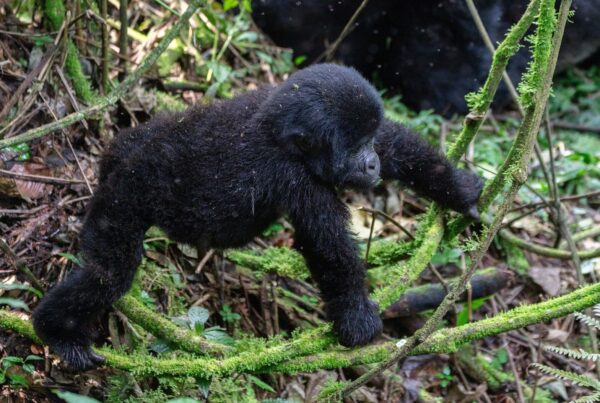
Gorillas typically move quadrupedally, knuckle-walking on the folded second joints of their fingers with the plantar surface of their feet. This gait is efficient for their anatomy and allows them to support their enormous mass while moving through uneven terrain. When moving at speed, they shift to a more galloping gait where all four limbs contribute propulsion in sequence, somewhat analogous to the gallop of a quadrupedal mammal.
Gorillas can also run bipedally — upright on two legs — during display charges and in other high-excitement contexts. Bipedal running in gorillas uses their long arms for balance but does not achieve the speed of their quadrupedal sprint. The bipedal charge is primarily a display behaviour rather than a locomotion strategy: the uprightness maximises visual impact and allows chest beating simultaneously, at some cost to raw speed.
Acceleration: The More Relevant Measure
For practical purposes in gorilla encounters — both in the wild and in the context of understanding the safety protocols of gorilla trekking — acceleration is more relevant than top speed. A 160-kilogram silverback can go from resting to full charge in a fraction of a second, covering the seven-metre viewing distance in less than two seconds at peak acceleration.
This acceleration capacity is partly why the seven-metre minimum distance rule exists as a minimum rather than an optimal distance. The rule is set at seven metres because it provides sufficient time for both the gorilla to abort a mock charge and for visitors to adopt appropriate non-threatening postures (crouching, averting gaze) before the situation escalates. The rule is not set at seven metres because that distance would allow a human to run from a committed gorilla charge — it would not.
Gorilla Strength vs. Speed: The Primary Advantage
Where gorillas truly distinguish themselves physically is not in speed but in strength and explosive power. A gorilla’s musculature, composed of a higher proportion of fast-twitch muscle fibres than human muscle, generates extraordinary force per kilogram. The bite force of a mountain gorilla — estimated at approximately 1,300 PSI (pounds per square inch) — is among the highest of any primate and significantly exceeds the 150-200 PSI typical of humans. The grip strength and arm strength measurements of captive gorillas consistently exceed what any human can generate.
In the context of potential threat, it is this combination of speed and strength that makes gorilla aggression genuinely dangerous — not speed alone. A charging gorilla that makes contact is not simply a fast-moving heavy object; it is a fast-moving heavy object that can also grab, hold, and apply enormous force.
Why This Matters for Gorilla Trekking
Understanding gorilla speed helps trekkers appreciate why the protocols they follow are non-negotiable. When your guide instructs you to crouch, avert your gaze, and hold absolutely still during a mock charge from a silverback, this is not theatre. It is the response that experience and research have identified as most effective at communicating non-threat to an animal that can cover the seven-metre viewing distance in seconds.
Mock charges — where a silverback charges toward a group and stops short, typically at two to four metres — are relatively common in encounters with less well-habituated families or in situations where the group has behaved in ways the silverback finds concerning. These charges are displays rather than attacks. The silverback is not committed to causing harm; he is demonstrating his power and testing the group’s response. The correct response — calm, submissive, non-fleeing — signals to him that the group is not a threat, allowing him to abort the charge without losing status.
Final Thoughts
A mountain gorilla can sprint at approximately 25 to 40 kilometres per hour over short distances — faster than most humans but slower than elite sprinters at peak. The speed is less remarkable than the strength, the acceleration, and the combination of physical capacity with social intelligence that makes gorilla behaviour so complex and their management in trekking situations such a demanding skill. The forest rangers who manage trekking groups have spent years reading gorilla speed and movement as part of the safety and experience management that makes the encounter safe and transformative.
Frequently Asked Questions
Uganda is significantly cheaper. Uganda’s standard permit costs $800; Rwanda’s costs $1,500. For 4-hour gorilla habituation, Uganda charges $1,800 — Rwanda has no equivalent experience. The $700 saving on a standard permit is the primary reason most budget-conscious travellers choose Uganda.
Uganda. Bwindi and Mgahinga together have 20+ habituated gorilla families and issue more daily permits than Rwanda’s Volcanoes National Park. Uganda also offers the Gorilla Habituation Experience, which Rwanda does not. Rwanda’s advantage is accessibility — Volcanoes NP is 2 hours from Kigali airport.
Yes — this is a popular combination. The Kigali to Bwindi road journey takes approximately 4 hours via Kabale. Some visitors trek in Mgahinga (Uganda) one day and cross into Rwanda for Volcanoes the next. Note that your Uganda permit cannot be used in Rwanda and vice versa — separate permits are required.
Rwanda’s Volcanoes National Park offers easier access (2 hours from Kigali airport), high-end lodge infrastructure, and the Dian Fossey research legacy. Rwanda also offers golden monkey trekking in the same park. However, at $1,500 per permit, it costs nearly double Uganda’s $800 rate for the same 1-hour trek.
Uganda is home to the mountain gorilla (Gorilla beringei beringei), one of two subspecies of eastern gorilla. They live exclusively in the Virunga volcanic highlands (Uganda/Rwanda/DRC) and Bwindi Impenetrable Forest (Uganda only). Mountain gorillas are the only gorilla subspecies that cannot survive in captivity — every individual you can trek is a wild animal.