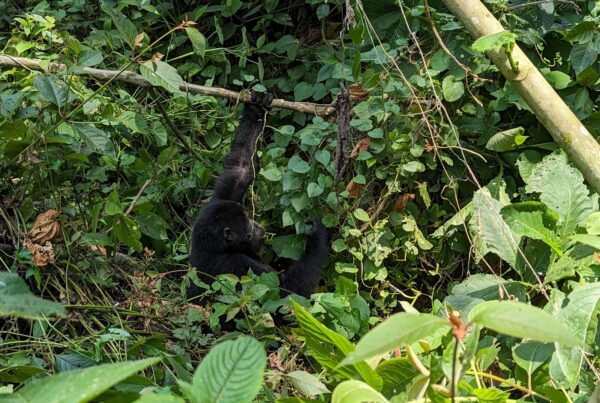
Silverback vs blackback gorilla — how to tell them apart immediately
Silverback vs blackback gorilla identification is one of the first skills that gorilla trekking rangers teach their groups, because understanding which animals you are looking at is fundamental to reading the social dynamics of a gorilla family during the encounter. The terminology can be confusing to first-time visitors — both silverbacks and blackbacks are adult male gorillas, both are large, and in photographs taken at a distance, the distinction is not always immediately obvious. But with a little guidance, the difference is easy to identify in person, and the ability to tell a silverback from a blackback transforms your understanding of what you are watching during the encounter. Here are the six most reliable visual cues.
1. The silver saddle: the definitive indicator
The most obvious and reliable way to distinguish a silverback from a blackback is the silver saddle — the area of silver-grey hair that covers the back from the shoulder blades to the base of the tail in sexually mature male gorillas. This silver coloration develops when a male reaches sexual maturity at approximately 11 to 13 years of age and is permanent for the rest of his life. The silver saddle is very clearly visible in good lighting conditions and is absent in blackbacks, whose coats are uniformly black. In a family group containing both silverbacks and blackbacks, the silver saddle makes identification instant and certain — there is no ambiguity once you know what to look for.
How much silver and where
The extent of the silver coloration varies between individual silverbacks and increases with age. Young silverbacks in their early teens typically have a relatively narrow silver saddle confined to the upper back. Older, more dominant silverbacks often have silver that extends further down the back, sometimes covering the haunches and the sides of the body as well as the back itself. The most senior silverbacks in some families are almost entirely silver across their backs and sides, with only the limbs, face, and belly remaining black. This age-related increase in silver coverage means that the most dominant silverback in a group is often also the one with the most extensive silver.
2. Body size and mass
Silverbacks are consistently larger and heavier than blackbacks. A mature silverback mountain gorilla weighs between 140 and 220 kilograms, with large males at the upper end of this range. Blackbacks — younger adult males — are physically smaller, with a less fully developed musculature and a more slender profile than the fully mature silverback. When a silverback and a blackback are visible together in the same encounter, the size difference is immediately noticeable: the silverback’s head, chest, and arms are proportionally larger, and his overall physical presence is substantially more imposing. This size difference is reinforced by the silverback’s posture — he typically carries himself with greater deliberation and confidence than the more tentative movement of younger males.
3. Head shape and crest
Adult male gorillas develop a sagittal crest — a bony ridge running along the top of the skull — as they mature, and this crest is typically more developed in silverbacks than in blackbacks. The crest provides the attachment point for the powerful jaw muscles that silverbacks use for processing tough vegetation, and it becomes more pronounced as the silverback ages and his jaw muscles develop fully. In profile, a mature silverback’s head has a distinctly domed appearance created by the crest and the heavy musculature of the skull; a blackback’s head is flatter in profile and more rounded, closer in shape to the rounder skull of a female or juvenile.
4. Behaviour and positioning within the group
Beyond the physical cues, the behaviour and positioning of a male within the family group is a reliable indicator of his status. The dominant silverback positions himself at the centre of the family group’s resting site or at the front of a moving group. Other family members orient themselves relative to him — maintaining the appropriate social distance, moving when he moves, deferring when he signals. Blackbacks, by contrast, tend to position themselves at the periphery of the family group — less central, more mobile, more watchful of the dominant silverback’s movements and signals. A blackback who is establishing his social position within the group will demonstrate his lower status in every aspect of his behaviour relative to the silverback.
5. Facial characteristics and expression
Experienced gorilla guides and researchers describe a difference in the overall character of a mature silverback’s face compared to a younger blackback’s — harder to quantify than the silver saddle or the sagittal crest, but nonetheless real. The silverback’s face tends to be broader, heavier around the jaw and brow, and more deeply lined around the eyes and muzzle. His expression, particularly when resting, tends to project a calm authority that guides often describe as “settled” or “certain” — the expression of an animal that is confident in his status and has nothing to prove. The blackback’s expression, particularly in the presence of the dominant silverback, tends to be more watchful, more mobile, and — when the silverback pays him attention — more visibly deferential.
6. The response of other group members to each male
The most reliable non-physical indicator of which male is the silverback is the behaviour of other group members in relation to him. When the silverback moves, the group moves with him or waits for his direction. When the silverback vocalises — even quietly — other group members respond. When an infant is in distress, it moves towards the silverback as well as towards its mother. When a female is feeding in a desirable spot and the silverback approaches, she moves — not necessarily quickly or dramatically, but consistently and without resistance. None of these behavioural responses are directed towards blackbacks in the same way, and observing them in the first few minutes of an encounter allows a careful observer to identify the silverback with certainty even before the silver saddle is clearly visible in the forest light.
Understanding the distinction between silverback and blackback is the first step towards reading the full social complexity of a mountain gorilla family during a trekking encounter. Your ranger will point out every individual in the family and explain their relationships, but the ability to identify the silverback yourself, at a glance, allows you to orient everything else you observe around the social structure that his presence defines. It is the beginning of genuinely seeing what is in front of you — which is the essence of what gorilla trekking in Uganda offers.
Frequently Asked Questions
A silverback is a mature male mountain gorilla (12+ years old) whose saddle-area back hair has turned silver-grey — a visible sign of adulthood. The silverback leads and protects his family group, decides when and where the group moves, and mediates conflicts. Each habituated gorilla family in Uganda has at least one silverback.
Adult male mountain gorillas weigh 140–200kg and stand 1.5–1.8m tall. Their arm span can reach 2.3 metres. Females are significantly smaller at 70–113kg. Mountain gorillas are the largest living primates. Despite their size, mountain gorillas are generally peaceful and only become aggressive if threatened.
Habituated silverbacks are accustomed to small groups of human visitors and generally ignore the trekking group. You may see the silverback feeding, resting, grooming family members, or moving the group through the forest. Direct eye contact should be avoided. If a silverback charges or bluff-charges, rangers instruct visitors to crouch down, avoid eye contact, and stay still.
A blackback is a sub-adult male gorilla (8–12 years old) whose hair has not yet turned silver. Blackbacks have not reached full maturity and typically live in the family group until they leave to establish their own. A silverback is a fully mature male, larger, dominant, and recognisable by the silver saddle. Both may be present in a single habituated family.
Uganda is home to the mountain gorilla (Gorilla beringei beringei), one of two subspecies of eastern gorilla. They live exclusively in the Virunga volcanic highlands (Uganda/Rwanda/DRC) and Bwindi Impenetrable Forest (Uganda only). Mountain gorillas are the only gorilla subspecies that cannot survive in captivity — every individual you can trek is a wild animal.