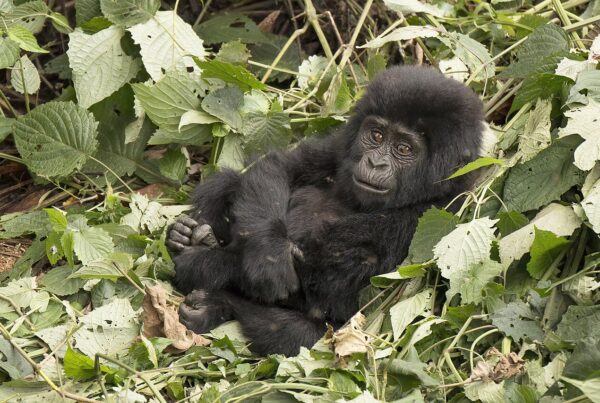
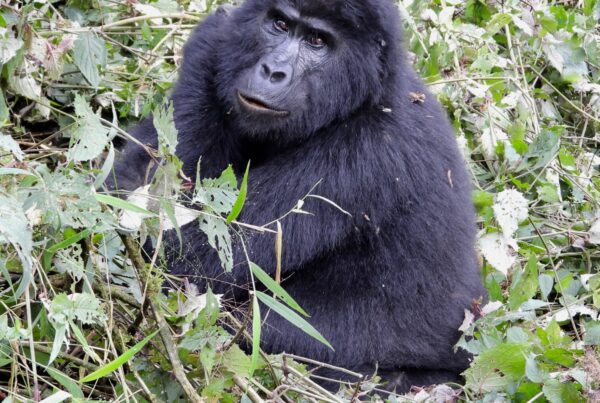
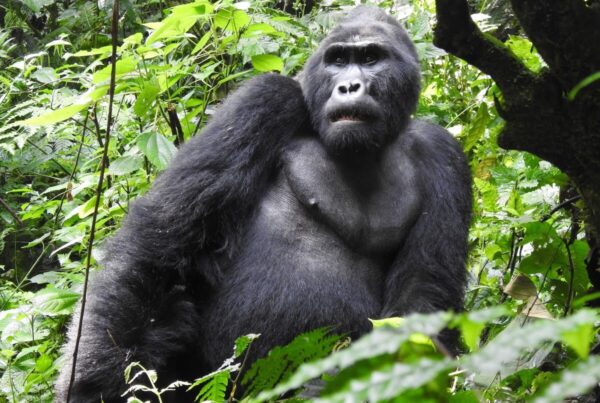
Flash photography is one of the most important prohibitions in gorilla trekking, and understanding why the ban exists — not just that it exists — transforms compliance from an inconvenience into an informed choice. The flash prohibition at Uganda’s gorilla trekking sites is not a precautionary overreaction; it is evidence-based conservation policy grounded in research on gorilla stress physiology and the long-term effects of disturbance on habituated populations. It is also, from a purely photographic standpoint, the right technical call — the available-light images achievable with modern mirrorless cameras in Bwindi’s forest are incomparably more beautiful than anything a flash could produce. This guide explains the science of the ban and gives you the complete technical toolkit to make excellent gorilla images without flash in 2027.
Why flash photography is banned near gorillas
Mountain gorillas have evolved in the dense, filtered light of montane forest where sudden bright flashes of light carry specific survival meanings. In the wild, intense sudden light at close range signals potential predator presence, lightning before a dangerous storm, or — most relevantly — the defensive flash displays of some insects and other animals that signal toxicity or danger. A camera flash produces an intense burst of very bright, spectrally broad light at extremely close range (gorilla encounters happen at 7 metres) that the gorilla’s threat-detection neurology is not equipped to contextualise as harmless. The response is typically a startle reaction ranging from flinching and vocalization to defensive posturing from silverbacks, whose evolved role is to assess and respond to perceived threats to the family group.
Even when individual gorillas do not show visible distress from a single flash, the cumulative effect of repeated flash photography across multiple visitor groups matters significantly. Each habituated gorilla family at Bwindi receives up to eight visitors per trekking session, and multiple sessions can occur across a day for some families. Research published in conservation biology journals has demonstrated that frequently photographed habituated gorilla groups exposed to flash photography show elevated faecal glucocorticoid levels (a proxy for cortisol stress hormone) and altered inter-individual distance patterns compared to groups visiting sites where flash photography is consistently absent. The ban is not overcautious; it reflects documented physiological evidence of harm.
How to disable flash on every camera type
Before entering the forest, actively disable flash on every camera and phone you carry. This sounds simple; it is surprising how many visitors discover mid-encounter that a flash has fired because they did not check their settings carefully enough at the briefing point.
For DSLRs and mirrorless cameras with pop-up flash: switching from Auto mode to Aperture Priority (Av/A), Shutter Priority (Tv/S), or Manual (M) mode prevents the camera from activating flash automatically. Additionally, pop up the flash manually and select the flash-off setting in the camera’s flash menu — this ensures flash cannot fire even if you accidentally switch to Auto mode during the encounter. For mirrorless cameras without a pop-up flash but with a hot shoe: no pop-up flash means no risk of automatic activation; an attached speedlight requires only that you switch it off or cover the shoe. For smartphones: in video mode, most phones activate the LED torch automatically in low light unless this is specifically disabled — go to your camera app settings and disable the torch/flash function before entering the forest. Check this setting at the briefing while there is still time to correct it.
The photographic case against flash: it makes your images worse
Even if the conservation argument did not exist, using flash on gorilla trekking would be a photographic mistake. On-camera flash produces a quality of light that is universally unflattering for wildlife portraiture: harsh, frontal, completely shadow-free illumination that flattens the dimensional structure of a subject’s face, bleaches colour, and eliminates the atmospheric quality that makes forest wildlife photography so compelling. A gorilla’s face illuminated by on-camera flash looks like a passport photo — technically exposed but visually dead. The same gorilla’s face in the soft, directional, forest-filtered available light that Bwindi provides even on overcast days looks like a wildlife magazine cover — dimensional, alive, and rich with mood.
What to use instead: the three techniques that replace flash
Push ISO aggressively and without hesitation
Modern full-frame mirrorless sensors in 2027 produce genuinely usable, shareable, printable images at ISO 6400-12800. The Sony A7 IV, Canon EOS R6 Mark II, and Nikon Z6 III all perform well at ISO 6400 and remain acceptable through ISO 12800 for digital display and moderate-sized prints. In Bwindi’s forest, these values are routinely needed and should be embraced without hesitation or apology. A sharp, slightly noisy image at ISO 12800 is incomparably better than a motion-blurred image at ISO 1600 or a missed shot because you were reluctant to push the ISO. Noise is a texture that post-processing can manage; blur is a permanent failure; a missing shot is gone forever.
Open your aperture as wide as your lens allows
Aperture is your most powerful available-light tool. Shooting at f/4 instead of f/8 quadruples the light reaching the sensor — equivalent to two full stops of ISO reduction for the same exposure. At f/2.8 you collect 16 times more light than at f/8. A 100-500mm f/4.5-6.3 zoom at 300mm, f/5.6 in Bwindi’s forest might need ISO 6400 for a correct exposure at 1/400s. Stopping down to f/8 for “sharper optics” at the same shutter speed would require ISO 12800 — doubling the noise for a marginal corner-sharpness improvement that will be invisible in any normal viewing context. Use the widest aperture that produces acceptable sharpness on your specific lens and accept the shallow depth of field as an aesthetic asset: the out-of-focus forest background behind a sharp gorilla portrait is one of wildlife photography’s most beautiful compositional effects.
Use image stabilisation at its maximum effectiveness
Optical image stabilisation in your lens (OIS) and in-body image stabilisation in your camera body (IBIS) allow you to shoot at slower shutter speeds than would otherwise be possible without camera shake — extending the range of usable shutter speeds in low-light conditions. Five to six stops of combined OIS + IBIS correction (claimed by Sony, Canon, and Nikon in their current top systems) means you can use a shutter speed 32-64 times slower while maintaining equivalent apparent sharpness. In a low-light forest scenario, this extension of usable shutter speed range is equivalent to 5-6 stops of effective ISO reduction — the difference between needing ISO 25600 and ISO 400 for a static subject.
These three techniques — high ISO, wide aperture, and effective stabilisation — combine to make flash photography not merely unnecessary but genuinely inferior for gorilla portraiture. The prohibition on flash is, from the photographer’s perspective, a constraint that improves your images while protecting the animals. The available-light photographs from a gorilla encounter in Bwindi’s extraordinary forest light — moody, dimensional, authentically atmospheric — are the images that will matter to you for the rest of your life. Flash-lit gorilla portraits are forgotten within a week. Learn to use available light well, and you will leave Bwindi with photographs worthy of the $800 experience that produced them.