Updated
mindfulness gorilla trek mental health benefits is one of Africa’s most extraordinary wildlife experiences, connecting travellers with mountain gorillas in their natural forest habitat. The mental health benefits of time in natural environments — reduced cortisol levels, lowered blood pressure, improved working memory, and the diminished activity of the default-mode network associated with rumination — are robustly documented in the academic literature on nature therapy, but the gorilla trekking experience at Bwindi Impenetrable Forest represents a qualitatively more intense version of the “time in nature” that most of the research literature measures, combining the physiological effect of sustained forest immersion with the specific psychological impact of close contact with another great ape species in its natural habitat. The gorilla encounter’s distinct psychological feature is not just the forest context but the encounter itself: the moment of eye contact with a mountain gorilla, the registered weight of the silverback’s presence at close range, and the encounter with a living community whose social dynamics are immediately legible as analogous to human family structure produces a specific quality of present-moment attention that is not achievable through any indoor or urban nature-substitute experience. This guide examines the documented and observed mental health dimensions of gorilla trekking and what the evidence suggests about why the experience has the lasting psychological impact that participants consistently report. For the practical trek logistics, see the permit guide.
Gorilla Trekking and Mental Wellbeing: What the Evidence Shows
- Nature immersion effect: 2+ hours in forest environments measurably reduces cortisol and activates the parasympathetic nervous system
- Presence induction: The gorilla encounter forces present-moment attention — the default-mode network (mind-wandering) goes quiet
- Awe response: The silverback encounter triggers the documented “awe” response — associated with expanded time perception and reduced self-preoccupation
- Physical component: 3-8 hours of highland forest walking has independent cardiovascular and mood benefits beyond the encounter
- Lasting effect: Participants report the experience as a “before and after” marker in their personal history — high durability of psychological impact
- Research context: the “gorilla trekking as therapy” framing is experiential observation, not a clinical protocol — but the mechanisms are real
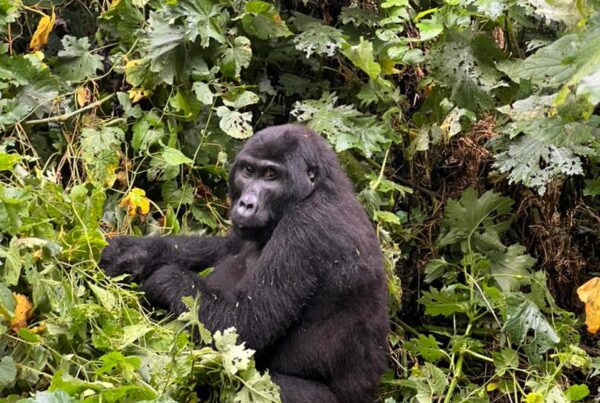
There is a moment that almost every gorilla trekking visitor describes, regardless of how different their background, their motivation for the trip, or their prior experience of nature. It occurs in the minutes immediately after making visual contact with the gorilla family — when the ranger signals that the group has been found and the first individual becomes visible in the vegetation. Everything that has been occupying your mind — work, relationships, logistics, the discomfort of the climb — falls away completely. You are present in the most absolute sense: attending entirely to what is directly in front of you, in this specific moment, in this specific forest. Nothing else is accessible to your attention.
This is not a trivial observation. The state of complete present-moment attention that the gorilla encounter induces is precisely what contemplative traditions, psychotherapeutic practices, and modern neuroscience identify as beneficial for mental health, stress reduction, and psychological restoration. A gorilla trek does not require you to be interested in mindfulness or mental wellness. It produces these effects regardless of whether you are thinking about them. This guide explores the psychological dimensions of the gorilla trekking experience and why time in Bwindi’s forest offers something that structured relaxation methods often struggle to replicate.
Mindfulness in the forest: the mental health benefits of a gorilla trek
The science of nature and mental health
A substantial body of research in environmental psychology demonstrates that exposure to natural environments reduces physiological stress markers, improves mood, enhances cognitive function, and reduces the symptoms of anxiety and depression. The mechanisms are multiple and not fully understood, but include: reduction of cortisol (the primary stress hormone), activation of the parasympathetic nervous system (the rest-and-digest system that counterbalances stress responses), improved working memory through reduction of the cognitive load that urban environments impose, and what researcher Roger Ulrich termed the stress recovery response — the rapid, measurable reduction in physiological arousal that occurs within minutes of viewing natural environments.
Japanese shinrin-yoku research — forest bathing — has demonstrated that two to three hours spent in forest environments produces measurable reductions in blood pressure, heart rate, cortisol levels, and self-reported anxiety compared to urban environment control conditions. These effects persist for days after forest exposure. The specific features of forest environments that drive these effects appear to include the visual complexity of natural scenes (which occupies low-level perceptual processing without demanding high-level cognitive engagement), the sounds of natural environments (birdsong, water, wind through leaves), the reduced noise pollution and sensory overload of urban environments, and the presence of phytoncides — airborne chemical compounds produced by trees that have demonstrated immunological effects in human subjects.
The gorilla encounter as a peak experience
Psychologist Abraham Maslow described peak experiences as moments of profound joy, engagement, and a sense of transcendence — states in which the boundaries of the self temporarily dissolve and the individual feels part of something larger than themselves. He noted that peak experiences were most commonly reported in connection with nature, music, creative work, and deep human connection. Contact with non-human animals — particularly with large, intelligent animals in their natural environment — was one of his original examples of peak experience triggers.
The gorilla encounter satisfies multiple conditions for a peak experience simultaneously. The physical effort of the approach creates genuine physiological arousal that heightens sensory sensitivity. The uncertainty — not knowing when or whether the gorillas will be found — creates anticipation that focuses attention completely. The arrival at the gorilla family provides sudden resolution of that uncertainty with immediate visual reward of extraordinary quality. The animals themselves are large, socially complex, physically powerful, and evidently emotionally expressive — qualities that engage human social cognition at the deepest level. The time constraint (one hour) creates urgency that prevents the attention from wandering. And the forest environment amplifies sensory immersion.
Attention restoration and cognitive fatigue
Modern information-dense work environments impose what psychologist Stephen Kaplan called directed attention — the effortful, sustained focusing of attention on specific tasks that must be consciously maintained against competing distractions. This form of attention fatigues. The accumulated fatigue of directed attention contributes to decision-making errors, reduced creativity, irritability, and the sense of mental exhaustion that characterises cognitive overload in professional environments.
Natural environments restore attentional capacity through what Kaplan termed fascination — an effortless form of attention engagement that does not compete with or deplete directed attention resources. Natural scenes, animal behaviour, and the unpredictable movement of forest life provide endless fascination in this sense: they hold the attention without requiring effort, allowing directed attention systems to recover. A gorilla trekking experience provides an extended immersion in high-quality fascination stimuli — the visual complexity of the forest, the unpredictable behaviour of the gorilla family, the sounds and smells of the mountain environment — for a duration long enough (several hours) to produce genuine restoration of attentional capacity.
The approach trek as a moving meditation
The approach trek to the gorilla family — the one to several hours of forest walking before the encounter — is often overlooked as a psychological resource in its own right. For visitors who choose to attend to it rather than treating it as an obstacle to endure before reaching the destination, the approach provides the conditions for a form of moving meditation that contemplative traditions have recognised for millennia.
Walking meditation — the practice of bringing full, non-judgmental attention to the physical sensations of walking, the sounds of the environment, and the visual landscape — is one of the most accessible forms of mindfulness practice precisely because its object is concrete and continuously available. On a gorilla approach trek, the relevant attentional objects are everywhere: the texture of the forest floor, the sounds of birds overhead, the smell of wet vegetation, the physical sensations of breathing and exertion, the changing light quality as the trail moves between open and closed canopy. Bringing deliberate attention to these phenomena rather than retreating into planning thoughts, memories, or internal commentary produces a qualitatively different experience of the same physical journey.
This is not a technique that requires any prior meditation experience or particular commitment to wellness as a category. It requires only the decision, moment by moment, to notice what is actually present rather than what the mind is generating about what is present. The forest provides the material; the trekker provides the attention.
Awe and its psychological effects
Awe — the emotion triggered by encounters with phenomena that exceed our existing frameworks for understanding the world — has emerged in psychological research as having distinctive and significant effects on mental health and prosocial behaviour. Experiences of awe reduce self-referential thinking (the mental activity associated with rumination and anxiety), increase feelings of connectedness with others and with something larger than the individual self, reduce inflammatory markers associated with stress, and produce persisting positive mood effects.
Mountain gorillas reliably induce awe in visitors. The animals are physically enormous, intellectually complex, emotionally expressive, and behaviourally unpredictable in ways that genuinely exceed most visitors’ prior frameworks. A nursing gorilla mother, a silverback conducting a full chest-beating display twenty metres away, a juvenile leaping off a branch directly overhead — these are experiences that do not fit into ordinary categories. The awe response they generate is not symbolic or intellectual; it is visceral, immediate, and powerful in ways that many visitors report as among the most significant emotional experiences of their lives.
The forest as a space for perspective
There is a particular kind of perspective shift that occurs reliably in environments of great age and scale. Bwindi Impenetrable Forest has been continuously forested for at least 25,000 years — it survived the last ice age’s expansion of arid zones that eliminated most African forest refugia. The trees you are walking among have ancestors that were already old when the kingdoms of East Africa were founded. The gorilla family you visit has a social history that predates any individual human lifetime.
This temporal scale naturally recalibrates the sense of proportion that daily life distorts. The project deadline that felt existentially important before the trek occupies its actual scale — a brief disturbance in a much longer story. Visitors consistently report that the perspective shift produced by a Bwindi gorilla trek persists for weeks and sometimes months after return, affecting how they relate to sources of stress, how they allocate their time and attention, and what they understand to matter. This is not a predictable therapeutic outcome that can be guaranteed. It is an emergent consequence of an encounter with genuine wildness that has no equivalent in managed or digital environments.
Frequently asked questions about the mental health benefits of gorilla trekking
Why does being in a forest like Bwindi have mental health benefits?
The mental health benefits of forest immersion are explained by several converging mechanisms that research in environmental psychology, stress physiology, and attention restoration theory have documented. The stress reduction mechanism: the forest environment lacks the urban stimuli (traffic noise, artificial light, crowd density, ambient digital information) that maintain the sympathetic nervous system’s low-level alert state during ordinary daily life — forest environments that are quiet, green, and unhurried allow the parasympathetic nervous system to become dominant, producing measurable reductions in cortisol, heart rate, and blood pressure. The attention restoration mechanism: the forest’s “soft fascination” (the ambient movement of leaves, light filtering through canopy, the unpredictable appearance of birds and animals) occupies just enough of the cognitive attention system to prevent the default-mode network’s rumination cycle — the repetitive self-referential thinking that characterises stress, anxiety, and depression — without requiring the effortful directed attention of work and problem-solving. The Bwindi highland forest is particularly potent as a restorative environment: it is physically remote (requiring genuine effort to reach), visually complex (the canopy diversity, the layered forest floor, the mist-filtered light), and acoustically rich (the forest soundscape has no urban elements). The 3-8 hour gorilla trekking walk through this environment is a substantially longer nature dose than the typical 20-40 minute “green exercise” sessions that most nature therapy research studies.
What psychological effect does meeting a mountain gorilla have?
The psychological effect of close contact with mountain gorillas in the encounter — as distinct from the effects of forest immersion on the walk to and from the family — involves a specific cluster of responses that are qualitatively different from the general nature-immersion effect and that recur consistently across participants regardless of cultural background, prior wildlife experience, or intended purpose of the trip. The primary responses: the awe response, which environmental psychologists define as the experience of encountering something that challenges the observer’s current cognitive frameworks and requires an expansion of their understanding to accommodate — the scale of the silverback, the immediate family social dynamics, and the eye contact that registers as mutual recognition all trigger this response reliably; the perspective shift, which is an involuntary reordering of the observer’s sense of what matters and what is large — the world of screens, schedules, and social media metrics temporarily loses its apparent importance in the presence of an encounter that operates on a different scale; and the present-moment absorption, which is the complete cessation of the mind-wandering default-mode network activity that underlies rumination, anxiety, and distraction — the encounter forces all cognitive resources into the immediate present in a way that deliberate mindfulness practice attempts to achieve but can rarely produce as completely. These responses are not therapeutic interventions in a clinical sense but they are real psychophysiological events with documented neurological correlates.
Does gorilla trekking help with stress, burnout, or anxiety?
Participants who describe undertaking gorilla trekking specifically in the context of burnout recovery, anxiety management, or high-stress life periods — a relatively common self-reported motivation among gorilla trekking visitors from high-pressure professional backgrounds — report the experience as effective at producing the quality of rest, perspective restoration, and present-moment absorption that they were seeking, in ways that more conventional holiday formats (beach holidays, city breaks) often do not. The mechanism: conventional holiday formats relocate the person without changing the cognitive mode — a person who is prone to rumination and work-preoccupation will ruminate and worry about work in a beach resort as efficiently as they do at the office. The gorilla trekking experience changes the cognitive mode rather than just the location: the physical demand of the highland forest walk displaces cognitive resources from the rumination circuit to the physical effort of the walk; the encounter forces the complete present-moment absorption that rumination cannot coexist with; and the specific content of what the forest presents — wildness, biological time, ecological systems operating independently of human concerns — provides a perspective shift that is difficult to access in any urban environment. This does not make gorilla trekking a mental health treatment or recommend it as a clinical intervention. It does explain why the experience produces lasting psychological impact that many participants describe as more restorative than any other holiday format they have experienced.
Why do people describe gorilla trekking as a “life-changing” experience?
The “life-changing” description that gorilla trekking participants use — consistently, across cultures, age groups, and prior travel experience levels — reflects a specific quality of the experience that distinguishes it from most other high-value wildlife encounters and that has a genuine psychological basis rather than being simply enthusiastic post-trip marketing language. The distinctive features that produce this quality: the encounter’s physical context (the remote highland forest, the physical effort of reaching the family) invests the experience with a sense of achievement and earned privilege that a zoo or safari vehicle encounter does not produce; the proximity and duration of the contact (7 metres minimum distance, 60 minutes minimum time — significantly closer and longer than most wildlife encounter formats) allows for genuine observation of individual gorilla behaviour, expression, and social dynamics rather than the brief sighting that most wildlife encounters offer; the encounter with another great ape species — the closest non-human relatives — activates a recognition response that the encounter with more distant species (elephants, lions, birds) does not, producing the specific quality of connection that participants describe as “meeting” rather than “seeing”. The combination of physical effort, genuine remoteness, extended proximity, and interspecies recognition produces an experience structure that is unusual enough in most participants’ lives that it functions as a marker — a “before and after” point in their personal narrative. This is the experiential basis of the “life-changing” description, and it is not exaggerated by the frequency with which it is offered.
How long does the psychological impact of gorilla trekking last?
The psychological impact of the gorilla trekking experience demonstrates unusual durability compared to most travel experiences — participants consistently describe the encounter as vivid in memory years and decades after the event, in a way that most holiday experiences are not. The reasons for this memory durability: the encounter has the characteristics that memory consolidation research identifies as producing strong long-term memory encoding — high emotional arousal (the initial sight of the silverback, the eye contact, the mock charge), sensory novelty (the specific forest sounds, smells, and physical sensations that have no urban equivalent and therefore no competing memories to dilute them), and narrative structure (the walk to the family, the encounter, the return has a beginning-middle-end structure that the brain encodes as a complete episode). The perspective shift quality of the experience — the involuntary reordering of priorities and scales that the encounter produces — also tends to persist beyond the trip itself, with some participants reporting that the experience changed their relationship to their work, their consumption habits, or their engagement with environmental issues in ways that had practical behavioural expression for months or years after the trip. This is not a universal effect and cannot be predicted for any individual, but it is documented consistently enough in participant accounts to be a real dimension of the experience’s psychological signature rather than a coincidental co-occurrence.
Experience the restorative power of the Bwindi forest
- Gorilla Permit Guide — the permit for the experience this guide describes
- Uganda Gorilla Families — the families at Bwindi and their individual characters that shape the encounter’s quality
- Bwindi Sector Guide — sector terrain and forest character for choosing the encounter setting
- Full Safari Cost Guide — complete trip investment for planning the experience this guide describes
- Safari Itineraries — Uganda itineraries that build in sufficient forest time for the full restorative effect
- World Wildlife Day 2026: Protect Medicinal and Aromatic Plants – Conserving Health, Heritage and Livelihoods in Uganda’s Gorilla Forests
- Mindfulness and presence in the forest: the art of the slow gorilla trek
- The quiet mind: mindfulness and mental stillness on a gorilla trek
- Mindfulness and the gorilla encounter: how to be fully present in the forest
- Bwindi Impenetrable Forest – Gorilla Trekking in Uganda’s UNESCO Jungle
- Meet the conservationist protecting mountain gorillas in the heart of the impenetrable forest.
- 2020 Gorilla Baby‑Boom in the Impenetrable Forest
- Gorillas and Their Fascinating Social Structures: The Heartbeat of the Forest
- Uganda Primate Safaris: Journey Into the Forests Where We First Belonged
- Silverback Gorilla Size: The Full Measure of a Forest Titan