Updated
gorilla encounter awe gratitude psychology wildlife transformative is a subject central to Uganda’s wildlife tourism, where mountain gorilla conservation and responsible visitor experiences go hand in hand. Visitors to Bwindi frequently report that their gorilla encounter was “life-changing”—a phrase that can sound like hyperbole in the context of tourism marketing but that appears to reflect a genuine psychological phenomenon. Research in environmental psychology, positive psychology, and the emerging field of nature connection studies suggests that encounters with large, intelligent wild animals in intact natural environments can produce the specific emotional states of awe and gratitude that are most strongly associated with lasting positive changes in wellbeing and values. Understanding what is happening psychologically during a gorilla encounter gives those who seek it more capacity to receive what the experience offers.
Gratitude and awe in the forest: the psychology of transformative wildlife encounters
Awe: the psychology of vastness
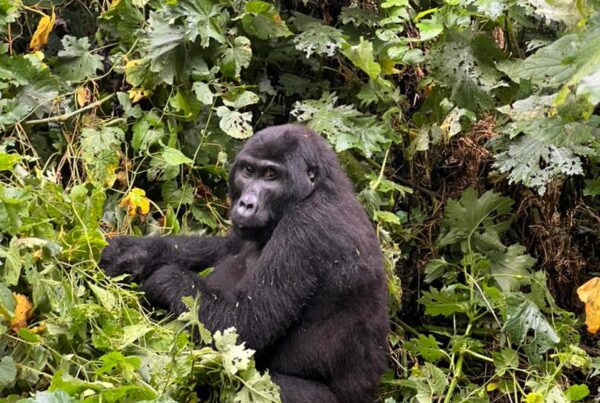
Awe is defined by researchers Dacher Keltner and Jonathan Haidt as the emotional response to stimuli that are vast, novel, and require accommodation—a revision of mental frameworks that current understanding cannot immediately contain. Meeting a mountain gorilla in the wild reliably triggers this response: the gorilla is large beyond expectation, behaviourally rich in ways no documentary preparation fully communicates, and proximally present in a way that places the encounter outside the category of “watching wildlife.” The silverback’s gaze registers differently in person than on screen because it is an actual directed act of perception—the gorilla is genuinely looking at you—and the human nervous system responds to this mutual awareness in ways that are older and deeper than language.
Research on awe shows that it reliably reduces the salience of the individual self—the sense of personal importance and the preoccupation with personal problems that characterises ordinary consciousness—in favour of a felt sense of belonging to something larger. Trekkers who have just spent an hour with a gorilla family consistently report feeling less anxious about personal concerns, more connected to other people (including their trekking companions, whom they often barely know), and more aware of the importance of what they were witnessing. These are the characteristic psychological signatures of awe.
Gratitude: the relational dimension
Gratitude—the recognition that something good has been given—is one of the most robust predictors of psychological wellbeing in the positive psychology literature. Gorilla encounters reliably elicit gratitude in multiple directions simultaneously: gratitude toward the rangers who made the encounter possible, gratitude toward the conservation organisations that protected the gorillas, gratitude toward the Ugandan communities that coexist with the park, and a form of gratitude directed toward the gorillas themselves—an appreciation for their willingness to tolerate human presence, their patience with the encounter, their unaggressive inclusion of the group within the perimeter of their morning.
This multi-directional gratitude is socially significant. Trekkers who leave the forest feeling grateful toward communities, rangers, and the conservation system are more likely to become advocates for the protection of what they experienced. Gratitude motivates reciprocity: the desire to give back to what has given to you. In the context of conservation, this translates into donations, public advocacy, permit purchases for future trips, and the informal ambassadorship of telling the experience to others in a way that moves them toward their own connection with the cause.
Cultivating openness before the encounter
Psychological research on awe suggests that the experience is more available to people who approach novel stimuli with openness and curiosity rather than evaluation and comparison. Trekkers who enter the gorilla encounter mentally comparing it to a previous wildlife experience, checking it against expectations formed by documentary images, or remaining in a state of active assessment are partially protected from the awe response by their evaluative stance. Trekkers who approach with explicit willingness to be surprised—who set aside what they expect to see and allow the actual encounter to register without filtering—are more permeable to awe’s disruption of ordinary consciousness.
The simplest preparation is also the most powerful: in the moments before the gorillas are reached, take a deliberate breath, acknowledge that you do not know what is about to happen, and set aside the camera for the first two minutes of the encounter before raising it. Let the experience enter before you begin to capture it. The gorillas have been present in this forest for longer than recorded human history; a few minutes of simple attention is not too much to offer in return.
- World Wildlife Day 2026: Protect Medicinal and Aromatic Plants – Conserving Health, Heritage and Livelihoods in Uganda’s Gorilla Forests
- Are There Other Animals on the Gorilla Trek in Bwindi? Forest Wildlife Beyond the Gorillas
- Best Wildlife Encounters on Earth: Why Gorilla Trekking Makes Every List
- 10 Wildlife Encounters That Compete With Gorillas: None Win
- 15 Bucket List Wildlife Encounters: Where Gorilla Trekking Ranks
- Africa’s Top 10 Wildlife Encounters Ranked by People Who Have Done Them All
- The 5 African Wildlife Encounters That Will Change How You See the World
- Africa’s 10 Most Unusual and Rare Wildlife Encounters
- Hippos and Nile crocodiles on Uganda’s waterways: wildlife beyond the forest
- Photography composition for wildlife: framing gorillas and forest animals