TALK TO AN EXPERT +256 716 068 279 WHATSAPP OPEN NOW.
Climate, Weather & Seasons

Uganda’s long rains: trekking in April and May

Home / Travel News, Stories & Tips / Tales from the Mist / Uganda’s long rains: trekking in April and May

April and May sit at the heart of Uganda’s long rainy season — the wettest period of the year across most of the country, including the southwestern forests where gorilla trekking takes place. For visitors considering a Bwindi trek in these months, the question is not whether to avoid the rains (they are unavoidable) but whether the combination of lower costs, uncrowded trails, and a dramatically different forest atmosphere makes the tradeoffs worthwhile. For the right traveller, the answer is a definitive yes. For others, the conditions are genuinely challenging in ways that deserve honest assessment before booking.

What the long rains mean at Bwindi

Bwindi Impenetrable National Park receives rainfall throughout the year because of its position on the eastern escarpment of the Albertine Rift, where moisture-laden air masses rising from the Congo Basin regularly condense over the forest. But the long rains of March through May — sometimes extending into early June — represent a sustained period of elevated precipitation across the entire southwestern highlands. At Bwindi, this translates to daily or near-daily rain, often in extended afternoon and evening periods but sometimes lasting through the entire day.

The practical consequences for trekking are significant. The clay-heavy soils of Bwindi’s steep trails become deeply muddy and highly slippery during the long rains. Descents that are merely steep in the dry season become genuinely treacherous in the wet season — the combination of wet clay, exposed roots, and gradient creates conditions where falls are common and trekking poles shift from useful to essential. The vegetation is dense and often rain-saturated, meaning that pushing through undergrowth quickly soaks clothing and equipment regardless of waterproofing.

Trek distances are broadly similar to the dry season — the gorillas range across the same terrain year-round — but the time required to cover a given distance increases significantly in wet conditions. What might be a two-hour outward trek in July can extend to three and a half hours in April when the group is moving carefully over slippery terrain. Guides and porters are accustomed to this pace adjustment and will manage the group’s speed accordingly, but it means that wet season treks can be physically exhausting in proportion to their length in ways that dry season treks are not.

The appeal of the wet season

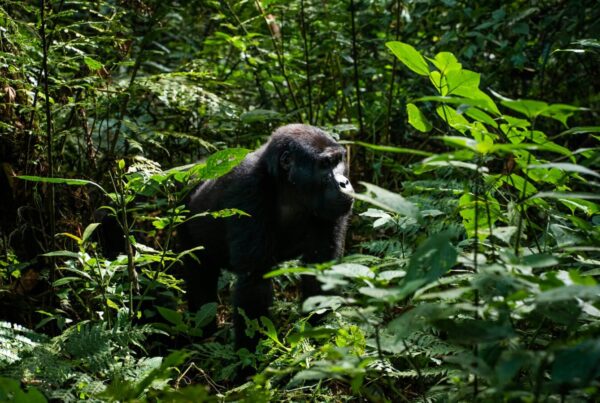
Given all of the above, why do experienced travellers and photographers specifically target April and May? Because the forest in the long rains is visually extraordinary in a way that no other season replicates. The vegetation is at maximum greenness — every leaf, every moss cushion, every fern frond saturated with colour and moisture. The light through the canopy, filtered through heavy cloud, is soft and diffuse — exactly the lighting quality that professional wildlife photographers prize for portraits, because it eliminates the harsh shadows and blown-out highlights that bright equatorial sunshine produces.

Mist in the forest during and after rain creates an atmosphere of extraordinary visual depth — layers of receding tree trunks and canopy in gradually diminishing visibility, with the close vegetation rendered in hyper-vivid detail against soft background blur. This is the forest as it appears in the most atmospheric nature photography and documentary footage, and it is the forest as it actually looks in the long rains. The images taken in these conditions often have a quality that bright-day dry season photography cannot match.

The gorillas themselves behave differently in the rain. They shelter under large-leaved vegetation during heavy downpours — a behaviour that can bring them into small clearings and low-canopy areas where visibility for visitors is better than when they are ranging freely through dense undergrowth. After rain, the forest activity level rises sharply as animals that sheltered resume movement and feeding. Some of the most dramatic gorilla behavioural encounters on record have occurred immediately after heavy rain when the social dynamics of a group that has been sitting still suddenly accelerate.

Visitor numbers and permit availability

April and May are the lowest-demand months for gorilla trekking permits across all of Bwindi’s sectors. The combination of school holiday constraints in the Northern Hemisphere and the reputation of the wet season for difficult trekking conditions keeps visitor numbers at their annual minimum. This has concrete practical advantages. Permits are easier to secure — sometimes available with shorter notice than the months of advance booking required for July and August. There is no competition for preferred sectors or groups. The briefing atmosphere is more intimate with smaller groups. The forest approach from the trailhead involves fewer overlapping parties.

For travellers who find the crowded, high-season atmosphere at popular wildlife destinations uncomfortable — who want to feel that the gorilla encounter is a genuine wilderness experience rather than a managed visitor circuit — the wet season offers something close to that wilderness feeling. Walking to the forest edge with a smaller group, finding the gorillas in mist-wrapped vegetation without the background awareness of other trekking parties nearby, spending the hour with no sounds except the forest and the gorillas — this is an experience qualitatively different from the peak season version.

Lodge pricing and availability

The wet season is low season for pricing at virtually all Bwindi lodges. High-end properties that list at USD 500 to 1,500 per person per night in peak season typically offer wet season rates fifteen to thirty percent lower, and sometimes run specific promotional packages that include extras — additional nights, complimentary activities, airport transfers — that are not available at peak season prices. For travellers who want the experience of a luxury lodge in Bwindi but are working within budget constraints, the wet season is the optimal booking window.

Accommodation availability is generous in April and May — even last-minute planning will typically find suitable options at most price points, unlike the peak season when properties at all levels can be booked out months in advance. This flexibility is useful for travellers whose itineraries are subject to change, who want to confirm weather conditions before committing to specific dates, or who are booking around other commitments that make far-in-advance planning difficult.

Packing for the wet season

Wet season packing for a Bwindi gorilla trek requires some specific adjustments to the standard packing list. A heavyweight waterproof rain poncho — covering both you and your day pack — is more practical than a jacket alone in extended heavy rain. Rubber-soled waterproof hiking boots are essential; trail shoes or non-waterproof boots become thoroughly soaked within the first thirty minutes. Trekking poles with carbide tips provide grip on the wet clay that rubber tips cannot match; if you do not own trekking poles, hire them from your lodge or from the UWA office rather than attempting the wet-season terrain without them.

Gaiters — the ankle-height straps that seal the gap between boot and trouser leg — are more important in the wet season than any other time. Without them, mud and forest debris enter your boots at every step. Carry a dry bag inside your day pack for camera equipment, and use a rain cover over the day pack exterior. Extra dry socks and a fresh base layer in your bag for the return to the lodge are not luxuries in wet season — they are necessities for a comfortable end to the day.

Who should consider April and May

The wet season at Bwindi is best suited to travellers who are physically fit and comfortable with challenging terrain, who have some appetite for the atmospheric forest conditions that come with rain, and who either prioritise photography in soft diffuse light or simply value the lower costs and smaller crowds over ideal trekking conditions. Experienced safari travellers who have visited Bwindi in the dry season and want a contrasting perspective will find the wet season reveals a different and complementary forest character.

First-time gorilla trekkers who are uncertain about their fitness level, travellers with limited experience of difficult terrain, or anyone with mobility considerations that make slippery steep trails genuinely hazardous should think carefully before choosing the wet season for an initial Bwindi visit. The gorilla encounter itself is no less extraordinary in the rains, but the trek to reach it is substantially more physically demanding, and arriving at the forest in poor physical shape after a difficult approach is not the best frame for one of Africa’s most remarkable wildlife experiences.

April and May reward the prepared visitor generously. The forest in the long rains is a different world from its dry season self — wilder, wetter, more atmospheric, more demanding, and in the eyes of many who have experienced both seasons, more beautiful.

Ready to experience Uganda’s mountain gorillas in 2026? Secure your gorilla permits early and let us craft a seamless safari tailored to your travel style, preferred trekking sector, and accommodation level. From luxury lodges to well-designed midrange journeys, every detail is handled for you. Every itinerary is carefully planned to maximize your time in the forest while ensuring comfort, safety, and unforgettable encounters.

Have questions about gorilla permits, travel dates, or the best itinerary for you? Speak with a safari expert and get clear, honest guidance to plan your trip with confidence.

When is the last time you had an adventure? African Gorillas!!! Up Close With Uganda’s Wild Gorillas Touched by a Wild Gorilla: An Unforgettable Encounter Inside Gorilla Families: Bonds, Hierarchies & Jungle Life Face to Face With a Silverback: The Wild Encounter You’ll Never Forget