TALK TO AN EXPERT +256 716 068 279 WHATSAPP OPEN NOW.
Wildlife Beyond Gorillas

Olive Baboon Uganda: Troop Behaviour and Safari Encounters

Home / Travel News, Stories & Tips / Tales from the Mist / Olive Baboon Uganda: Troop Behaviour and Safari Encounters

The olive baboon is Uganda’s most widespread and most commonly encountered primate — present in every savanna national park, conspicuous on roadsides, bold around human settlements, and impossible to ignore on any drive through the country’s open habitats. Troops of dozens or hundreds of individuals range across Queen Elizabeth, Murchison Falls, and Kidepo with a combination of boldness and social complexity that makes them one of the most endlessly watchable primates in Africa. They are also one of the most studied — baboon research has produced some of the most significant insights in primatology.

Physical Description

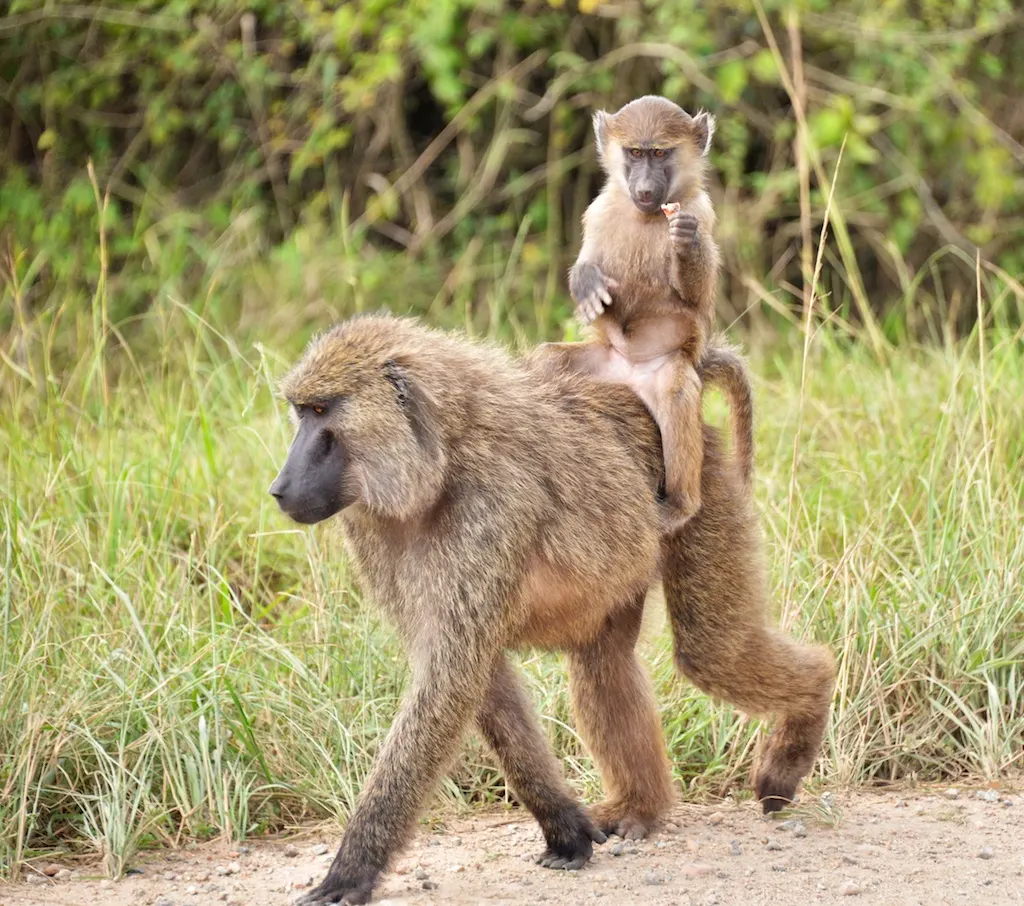
The olive baboon (Papio anubis) is named for its olive-grey coat colouration — a mixture of grey, green, and brown that provides effective camouflage in savanna and woodland. Adults weigh 15 to 37 kilograms, with males significantly larger. The face is elongated — the “dog face” of the baboon is its most recognisable feature — with large canine teeth in males that are used in threat displays and in combat. The bare buttocks are covered by ischial callosities — thickened, brightly coloured skin pads that function as sitting cushions and as visual signals.

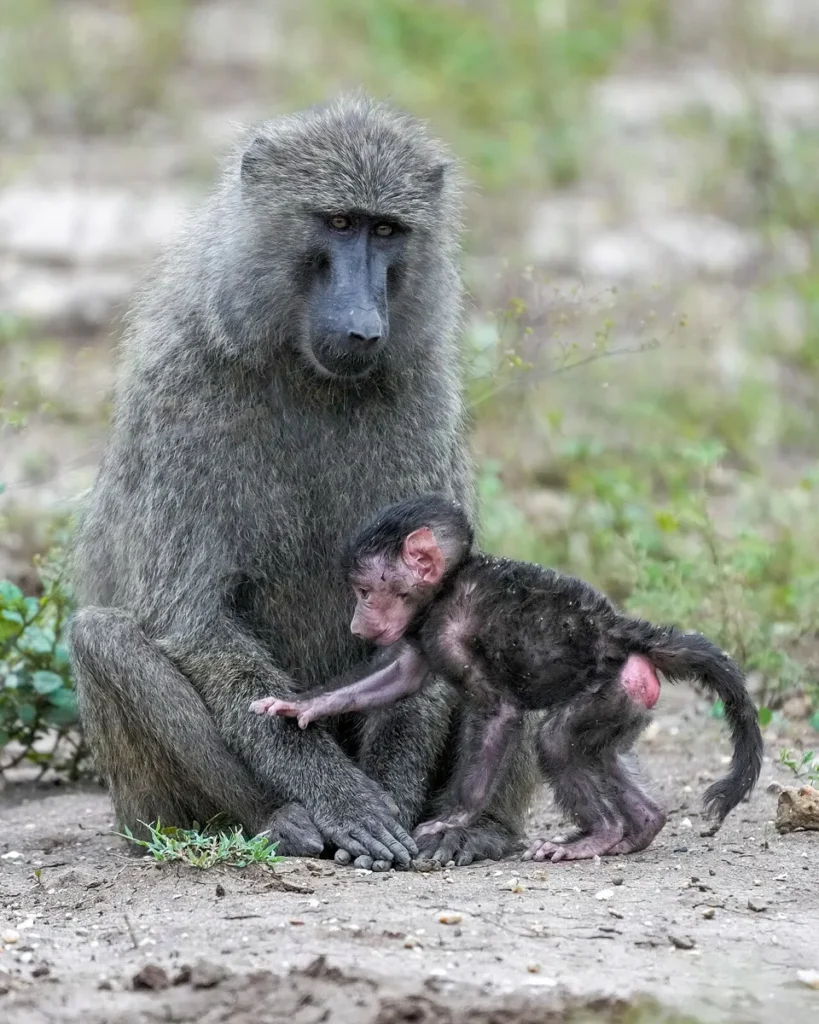
Infants are born with black coats that contrast sharply with the adult’s olive colouration — an adaptation thought to attract adult attention and care. The black infant coat lightens to the adult colour over the first several months of life. Infants’ distinctive appearance gives them “infant privilege” — access to food, freedom from adult aggression, and the ability to approach dominant animals that would threaten an adult of similar size.

Troop Structure and Social Complexity

Olive baboons live in multi-male, multi-female troops of 15 to 200 individuals. The social structure is one of the most intensively studied in primatology. Both males and females have dominance hierarchies, but the two hierarchies operate differently. Female rank is inherited from the mother and is stable over long periods. Male rank is determined by competitive ability and changes frequently as males mature, move between troops, and form or lose alliances.

Alliance formation is one of the most sophisticated aspects of baboon social life. Males form coalitions to challenge higher-ranked individuals, and the most effective strategies involve not just physical capability but social intelligence — reading relationships, remembering past interactions, and choosing alliance partners strategically. Research by Robert Sapolsky and others has shown that male baboon stress physiology, reproductive success, and longevity are all strongly influenced by social rank and the quality of their social bonds — findings with significant implications for understanding human social biology.

Foraging and Diet

Olive baboons are highly omnivorous. They eat grass seeds, corms, tubers, fruits, insects, small vertebrates, bird eggs, and opportunistically hunt small mammals — including hares, young gazelles, and even young monkeys. Large males occasionally take prey the size of a small Thomson’s gazelle. In agricultural areas, they raid crops — maize, sorghum, sweet potatoes — creating serious conflict with farmers. This human-wildlife conflict is one of the primary pressures on baboon populations around Uganda’s national park boundaries.

Baboon Encounters on Uganda Safaris

Olive baboon troops are encountered on every game drive in Uganda’s savanna parks. Large troops crossing a road, foraging on a hillside, or engaged in the dramatic social interactions of the dominance hierarchy are a constant feature of the Uganda safari experience. They are also encountered around lodges and picnic sites in national parks, where habituated individuals have learned to associate humans with food — making them entertaining but also problematic when food-raiding behaviour develops. Watching the social dynamics of a large troop — the grooming pairs, the squabbling juveniles, the political maneuvering of adult males — is one of the most cognitively engaging wildlife experiences Uganda offers, and one of the most accessible. You do not have to go looking for baboons. They come to you.

Ready to experience Uganda’s mountain gorillas in 2026? Secure your gorilla permits early and let us craft a seamless safari tailored to your travel style, preferred trekking sector, and accommodation level. From luxury lodges to well-designed midrange journeys, every detail is handled for you. Every itinerary is carefully planned to maximize your time in the forest while ensuring comfort, safety, and unforgettable encounters.

Have questions about gorilla permits, travel dates, or the best itinerary for you? Speak with a safari expert and get clear, honest guidance to plan your trip with confidence.

When is the last time you had an adventure? African Gorillas!!! Up Close With Uganda’s Wild Gorillas Touched by a Wild Gorilla: An Unforgettable Encounter Inside Gorilla Families: Bonds, Hierarchies & Jungle Life Face to Face With a Silverback: The Wild Encounter You’ll Never Forget