Updated
Why Everyone Is Talking About Uganda Gorilla Trekking in 2026
Uganda gorilla trekking 2026 — why the conversation has never been louder
Why Everyone Is Talking About Uganda Gorilla Trekking in 2026 Uganda gorilla trekking 2026 — why the conversation has never been louder Uganda gorilla trekking in 2026 has reached a level of international visibility and conversation that even operators with decades of experience in the industry describe as unprecedented. Uganda gorilla trekking in 2026 has reached a level of international visibility and conversation that even operators with decades of experience in the industry describe as unprecedented. The combination of a record mountain gorilla population, improved access to Uganda, growing social media coverage from influential creators, major documentary productions, and a global travel market increasingly seeking authentic and conservation-positive wildlife experiences has created conditions in which gorilla trekking in Uganda is discussed, shared, and booked at a rate that has transformed the country’s international tourism profile. Here is the full picture of why the conversation is so loud in 2026 — and why now is the moment to act on it.
The population milestone: conservation good news in a difficult landscape
In a global conservation landscape that is characterised predominantly by decline, the mountain gorilla population milestone of 2026 — over 1,100 individuals, growing — is the kind of unambiguous good news that the media and public respond to powerfully. Coverage of the population milestone has appeared in major international news outlets, science publications, and the wildlife and travel media, generating an awareness of Uganda’s gorilla conservation achievement that the country’s tourism industry could not have purchased at any price. Every piece of this coverage drives search interest in gorilla trekking Uganda, and search interest drives bookings.
Social media and the virality factor
The social media cycle around gorilla trekking content accelerated significantly in 2025 and 2026. A series of extraordinary videos — a silverback crossing a road at Buhoma, a gorilla infant approaching a trekker in the Rushegura sector, a dramatic dawn encounter in Ruhija captured on a visitor’s smartphone — achieved viral reach in the tens of millions of views on TikTok and Instagram. Each viral video drives a wave of search interest, travel enquiries, and permit bookings that operators report with a consistency that confirms the direct conversion from social media exposure to booking intent. The gorilla trekking content cycle has become self-reinforcing: more visitors means more content, and more content means more visitors.
The content creator effect
The arrival of professional travel content creators at Bwindi — YouTubers with subscriber bases in the millions, Instagram photographers with large followings, TikTok creators whose audiences skew younger than the traditional gorilla trekking demographic — has introduced gorilla trekking to audiences that the traditional tourism marketing channels did not reach. A single YouTube video with 2 million views introduces gorilla trekking to an audience that the most expensive travel magazine advertisement cannot reach with the same directness and authenticity. The content creator effect is fundamentally changing who is interested in gorilla trekking and, consequently, who is booking.
Major documentary productions
Several major documentary productions filmed in Bwindi in 2025 and 2026 have generated significant pre-release attention and are expected to drive sustained booking interest when they air. The combination of ultra-high-definition footage, extended access to habituated family groups, and the narrative context provided by experienced documentary makers produces a kind of gorilla content that social media cannot replicate — the depth, the continuity, the scientific context. When these documentaries air to global audiences, the enquiries they generate are typically the most serious and best-informed in the booking pipeline.
Improved access to Uganda
The practical barriers to visiting Uganda have reduced significantly in recent years. New airline routes, improved road infrastructure between Entebbe and the main wildlife areas, upgraded accommodation options at every price point, and a streamlined visitor experience at Uganda’s national parks have all contributed to a visitor experience that international travellers find more straightforward and comfortable than Uganda’s reputation as a “challenging destination” led them to expect. The surprise many visitors express at the quality of Uganda’s tourism infrastructure is, in itself, a powerful word-of-mouth driver that contributes to the growing conversation about gorilla trekking in the country.
The ethical travel shift
The broader travel market is shifting towards experiences that are conservation-positive, community-beneficial, and genuinely meaningful rather than purely pleasurable. Gorilla trekking in Uganda — an experience whose permit revenue directly funds the conservation of a critically endangered species, whose community programmes support local livelihoods, and whose wildlife encounter produces a depth of personal significance that purely recreational travel rarely matches — is extraordinarily well-positioned in this ethical travel landscape. Travellers who want their tourism to mean something are finding that gorilla trekking answers the question more completely than almost any other experience available.
If the conversation about Uganda gorilla trekking in 2026 has reached you, the next step is a permit. Contact our team to arrange your gorilla trekking itinerary, discuss the options across Bwindi’s four sectors, and secure your permit for the dates that work for you. The conversation is loud — and the experience, we promise, is louder still.
Frequently Asked Questions
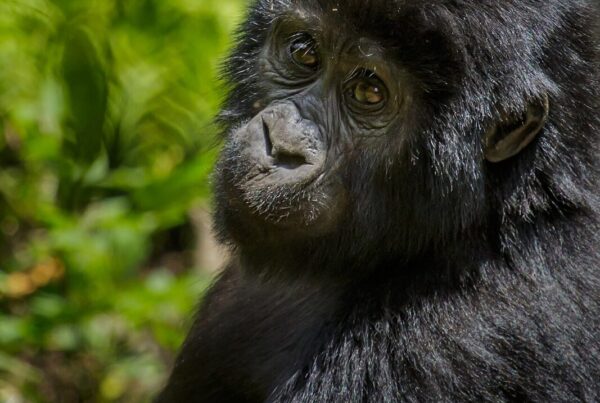
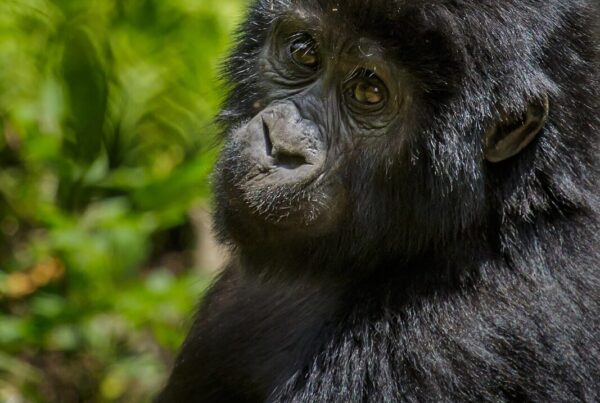
Uganda is home to the mountain gorilla (Gorilla beringei beringei), one of two subspecies of eastern gorilla. They live exclusively in the Virunga volcanic highlands (Uganda/Rwanda/DRC) and Bwindi Impenetrable Forest (Uganda only). Mountain gorillas are the only gorilla subspecies that cannot survive in captivity — every individual you can trek is a wild animal.
The standard gorilla trekking permit gives you exactly 1 hour with the gorilla family. This time begins when you make first contact with the family — the ranger signals the start. The Gorilla Habituation Experience gives 4 hours with a semi-wild family. The walk to find the gorillas can take 30 minutes to 5 hours depending on where the family has moved.
Stay calm, crouch down slowly, avoid direct eye contact, and remain quiet. Do not run — running triggers a chase response. Rangers accompanying your group manage close approaches. Habituated gorillas are accustomed to humans and almost never make contact, but a charging silverback is managed by staying still and following ranger instructions immediately.
A maximum of 8 visitors per habituated gorilla family per day for standard trekking. The Gorilla Habituation Experience has a maximum of 4 visitors per family per day. These limits are set by UWA to minimise stress on the gorilla families and maintain the quality of the experience.
Uganda is home to the mountain gorilla (Gorilla beringei beringei), one of two subspecies of eastern gorilla. They live exclusively in the Virunga volcanic highlands (Uganda/Rwanda/DRC) and Bwindi Impenetrable Forest (Uganda only). Mountain gorillas are the only gorilla subspecies that cannot survive in captivity — every individual you can trek is a wild animal.