The Fastest Growing Gorilla Trekking Sector
Rushaga sector in the southern portion of Bwindi Impenetrable National Park has grown rapidly in the past decade from a secondary trekking option to a fully-developed gorilla trekking destination with its own established gorilla families, quality accommodation, and community tourism programmes. For visitors seeking a Bwindi experience with good infrastructure but less crowding than the more established Buhoma sector, Rushaga is an increasingly attractive choice. It also offers access to the highest number of habituated gorilla families of any Bwindi sector — more gorilla families means more permit availability and more opportunities for the full range of gorilla trekking experiences.
Location and Access
Rushaga is located in southern Bwindi, accessible from the town of Kisoro approximately 17 kilometres to the south. Kisoro is connected to Kampala by a paved road (the Kabale-Kisoro highway) and is also served by scheduled charter flights to Kisoro airstrip. From Kisoro town, the journey to Rushaga takes approximately 30 to 45 minutes on the road north into the park.
The location between Kisoro and Rushaga places the sector in easy reach of Mgahinga Gorilla National Park (approximately 35 kilometres from Rushaga) and Nkuringo sector (approximately 25 kilometres away on the mountain road), making Rushaga a natural base for visitors combining gorilla trekking with visits to multiple park areas. The road between Kisoro and Rushaga provides some of Bwindi’s most dramatic approach views, with the park’s dense forest canopy rising above cultivated hillsides that illustrate the abrupt boundary between protected forest and agricultural land.
Gorilla Families in Rushaga
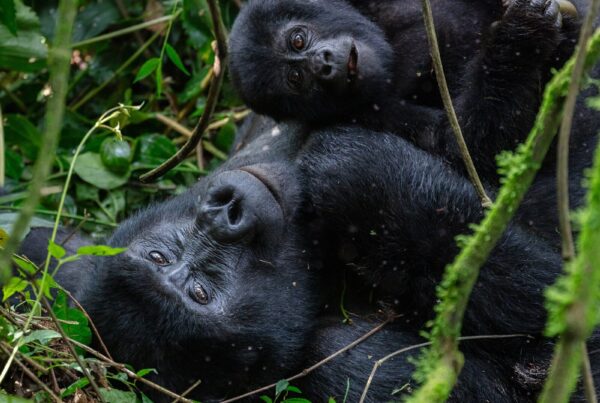
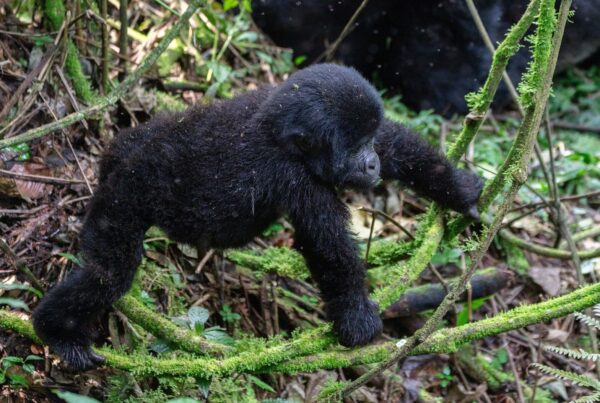
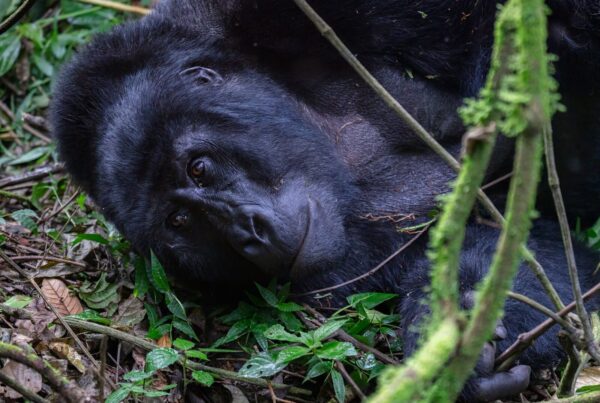
Rushaga is home to the largest number of habituated gorilla families of any Bwindi sector, with typically 6 to 8 families available at different times. Among the most well-known are the Nshongi group — one of the largest gorilla families in Bwindi, at times comprising over 25 individuals — and the Mishaya group, established following a group split from Nshongi. The Busingye group, Kahungye group, and several other habituated families round out Rushaga’s gorilla family portfolio.
The number of families in Rushaga means better permit availability than most other Bwindi sectors, making it an excellent choice for visitors with less flexibility in travel timing. It also means that on any given day, a range of trek difficulty levels is available — some families are more accessible than others, and visitor group assignments can be matched to physical capabilities more flexibly when multiple families are available.
The Gorilla Habituation Experience
Rushaga is one of the two Bwindi sectors (alongside Buhoma) where the Gorilla Habituation Experience (GHE) is offered. The GHE is a fundamentally different experience from standard gorilla trekking: visitors accompany the research and habituation team working with a gorilla family that is still in the process of full habituation — not yet fully comfortable with human presence and therefore not yet available for standard tourism. Visits to partially-habituated families last up to four hours rather than the standard one hour, providing extended observation time and the unique experience of being present during the ongoing process of bringing a wild gorilla family to tolerance of human proximity.
GHE permits cost $1,800 per person, roughly double the standard permit, and are limited to 4 visitors per day. The extended encounter, the partial habituation context (where gorilla responses to your presence may be less certain than with fully habituated families), and the insight into the research process all make the GHE a distinctive experience for visitors seeking deeper immersion than standard trekking provides.
Trekking Character in Rushaga
Rushaga treks tend toward moderate difficulty, with terrain that reflects the sector’s position in the southern highland of Bwindi. Some families have home ranges that regularly bring them to relatively accessible areas near the trailhead; others move through steeper, denser forest that requires more demanding trekking. The sector’s relatively recent development as a major tourism destination means that trail infrastructure is somewhat less mature than Buhoma’s, though UWA maintenance has improved significantly in recent years.
The forest character at Rushaga has a particular quality at higher elevations — the misty, moss-draped trees and dense understorey of high-altitude montane forest create an atmospheric landscape that many visitors find more visually dramatic than the lower-elevation forest around Buhoma. On clear days, the distant volcanic profiles of the Virunga Mountains visible from Rushaga’s higher trails add a dramatic backdrop to the forest landscape.
Community and Culture
The communities around Rushaga include both Bakiga farmers (the dominant highland agricultural people of southwestern Uganda) and Batwa families who were displaced from the forest when Bwindi was gazette. Community tourism programmes in Rushaga include the Batwa Cultural Experience — a guided interaction with Batwa community members that introduces visitors to the forest-dwelling culture and traditional knowledge of these formerly forest-dependent people.
The Batwa Cultural Experience is not without complexity: Batwa communities face genuine poverty and cultural disruption from their displacement, and the tourism experience must be approached with sensitivity to the underlying history. Well-run versions of the experience provide authentic cultural exchange and meaningful income to Batwa families; poorly run versions risk exploiting vulnerable people’s poverty as spectacle. Choosing operators who work with Batwa communities respectfully and ensure genuine community benefit from the cultural tourism revenue is important.
Where to Stay in Rushaga
Rushaga has developed a range of accommodation over the past decade, from budget community bandas to mid-range lodges and one or two properties at the luxury end. Gorilla Safari Lodge and Rushaga Gorilla Camp are among the established properties offering comfortable en-suite accommodation with forest or garden views. Several more recent properties have opened as tourism to the sector has grown, providing options at various price points.
Many visitors to Rushaga prefer to stay in Kisoro town (approximately 17 kilometres away) where a wider range of services, restaurants, and accommodation options is available, and then travel to the Rushaga trailhead on trek day. This arrangement works well for those combining Rushaga with other activities in the Kisoro area — including visits to Mgahinga Gorilla National Park.
Planning Your Rushaga Trek
Rushaga permits are booked through Uganda Wildlife Authority in the same way as permits for other Bwindi sectors. The higher number of families available in Rushaga generally means better permit availability, but peak season (June-August) still requires advance booking. Gorilla Habituation Experience permits should be booked very early — the 4-visitor daily limit means these sell out quickly, sometimes a year in advance for peak season dates.
Combine Rushaga gorilla trekking with a visit to Mgahinga Gorilla National Park (golden monkey or gorilla trekking), a boat trip on Lake Mutanda, or the beautiful lake scenery around Kisoro for a well-rounded southwestern Uganda itinerary that makes full use of the remarkable landscape concentration in this corner of the country.
Final Thoughts
Rushaga sector has emerged as one of the most compelling gorilla trekking destinations in Bwindi, combining good permit availability, the highest number of habituated gorilla families in any sector, the unique Gorilla Habituation Experience, and strong connections to community tourism and the Kisoro area’s broader attractions. For visitors planning a Bwindi visit and seeking alternatives to the most well-trodden Buhoma route, Rushaga offers a genuinely excellent and increasingly well-serviced option.
Frequently Asked Questions
Bwindi has four gorilla trekking sectors: Buhoma (north — most established, best infrastructure), Ruhija (east — highest altitude, cooler), Rushaga (south — most gorilla families, home of the GHEX), and Nkuringo (southwest — most dramatic scenery, most challenging terrain).
Buhoma is generally recommended for first-timers: it has the widest range of lodge accommodation, the most established trekking infrastructure, and moderate terrain. Rushaga is best if you want the Gorilla Habituation Experience. Nkuringo offers the most dramatic views but the steepest descent. Ruhija is quieter and sits at the highest altitude.
You cannot choose a specific family, but you can specify a sector when booking your permit. UWA assigns you to a habituated family within your chosen sector each morning at the briefing. Rangers track the family’s overnight position before your group departs, so by the time you enter the forest, the family’s location is known.
Bwindi is approximately 480–530km from Kampala depending on the sector — roughly 8–9 hours by road. Charter flights from Entebbe to Kihihi Airstrip (for Buhoma/Ruhija) or Kisoro Airstrip (for Rushaga/Nkuringo/Mgahinga) take 50–60 minutes and cost $250–$350 per person on shared charters.
Bwindi currently has over 20 habituated gorilla families spread across its four sectors, making it the most gorilla-dense trekking destination in the world. Rushaga sector alone has more than 6 habituated families. New families are periodically added to the habituation programme as the gorilla population grows.