Updated
How Gorillas Build Their Nests: Materials and Technique
A New Bed Every Night
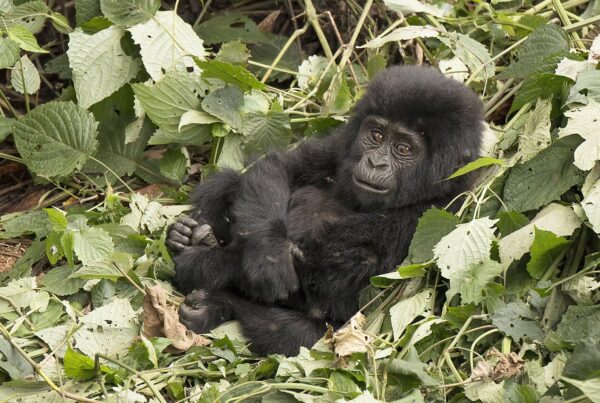
How Gorillas Build Their Nests: Materials and Technique A New Bed Every Night Mountain gorillas build a fresh sleeping nest every single evening. Mountain gorillas build a fresh sleeping nest every single evening. Unlike birds that return to the same nest repeatedly, or humans who maintain permanent sleeping sites, gorillas construct a new nest each night at whatever location they end their day’s movement. This daily construction is one of the more extraordinary and less-discussed aspects of gorilla behaviour — a demonstration of environmental manipulation that requires material assessment, structural competence, and something approaching deliberate planning.
Why Gorillas Build Nests
The function of gorilla nesting is primarily comfort and insulation. Bwindi’s temperatures drop significantly at night, particularly at higher elevations where readings can approach 7 to 10 degrees Celsius. A nest of bent vegetation creates an insulating layer between the gorilla’s body and the cold ground, reducing heat loss through contact conductance. It also provides a degree of cushioning on rocky or root-strewn forest floors.
Nesting serves a secondary social function. When all members of a group nest near each other — which is the typical pattern in close-knit mountain gorilla families — the spatial clustering provides social cohesion and immediate awareness of group members’ positions during the night. A silverback whose family is dispersed across a wider area must monitor a larger spatial zone for threats; tight nesting reduces that monitoring burden.
Parasite Avoidance
A third function may be parasite avoidance. Research examining the invertebrate fauna in gorilla nests has found that fresh vegetation used in nests carries far lower ectoparasite loads than the vegetation in areas where gorillas have been repeatedly present. By constructing nests in new locations nightly, gorillas may reduce their exposure to the tick and mite populations that build up in repeatedly occupied sites — a hygiene strategy by proxy.
Site Selection
Gorillas choose nest sites based on several factors that field researchers have identified through long-term observation. Ground nests, which are by far the most common in mountain gorillas (unlike western lowland gorillas that nest more frequently in trees), are preferentially built in areas with dense, flexible vegetation that can be bent and woven without breaking. Ground slopes are actively avoided — gorillas select flatter ground or create a level platform by bending vegetation uphill to compensate for the slope.
Proximity to the group is essential. Individual gorillas rarely nest more than 30 to 50 metres from the group’s core, and silverbacks typically nest in positions that provide sightlines across the group’s sleeping area. Infants nest with or immediately adjacent to their mothers, and this arrangement is maintained consistently regardless of the wider group’s configuration.
Weather conditions influence site selection. On cold nights, gorillas prefer sites with more overhead canopy cover, which reduces radiant heat loss. Near water sources, where humidity is higher and temperatures typically lower, gorillas sometimes select sites higher in the forest margin. These adjustments reflect a sophisticated, if probably instinctive, response to microclimatic variation.
Construction Technique
Nest construction typically takes 5 to 15 minutes for an experienced adult gorilla. The process begins with the selection of a central foundation — often a clump of dense herbaceous vegetation, a group of saplings, or a low tree branch that can serve as the nest’s core structure. The gorilla bends and breaks surrounding vegetation toward this central point, folding stems inward to create a circular or oval platform.
The technique is primarily bending rather than weaving. Gorillas pull flexible stems toward them, breaking them at the base while keeping the upper portion attached — creating a mat of bent but still living vegetation that springs back partially under the gorilla’s weight, providing a degree of cushioning. Larger, stiffer stems are broken and arranged as structural support. Leafy material is placed on top as a softer layer.
The finished nest is a rough bowl shape, raised slightly at the edges to contain the gorilla within its perimeter during sleep. Adult nests range from about 0.5 to 1.5 metres in diameter depending on body size. Infants sleep in their mothers’ nests for the first year of life; juveniles begin constructing their own nests, initially crude and poorly formed, from around two to three years of age as part of their general motor skill development.
What Nests Tell Researchers
Gorilla nests are invaluable to field researchers as a non-invasive monitoring tool. Census surveys use nest counts to estimate group size and population density across large areas without requiring direct gorilla observation. Each nest corresponds to one gorilla (except infant-mother pairs), so counting nests in a surveyed area gives population data. The freshness of nests — indicated by the wilting state of bent vegetation — tells researchers how recently a group was present at a location.
Faecal samples deposited in or near nests are collected for DNA analysis, health monitoring, and diet reconstruction. Nest vegetation composition reveals which plant species are available and preferred in specific forest areas. The spatial arrangement of nests maps social relationships — who sleeps near whom is not random and reflects alliance, family, and status dynamics within the group.
Nest Construction in Young Gorillas
The development of nest-building skill in juvenile gorillas follows a pattern that researchers have used to study tool construction competence in great apes. Young gorillas begin attempting nest construction at around 18 months, producing crude, ineffective structures that collapse or fail to provide insulation. By age 3, most juveniles produce functional (if simple) nests. By age 5 to 6, nesting technique approximates adult quality.
This extended learning period — unlike the rapid instinctive nest-building of, say, birds — reflects the cognitive and motor demands of the behaviour and its classification as a socially transmitted skill. Young gorillas watch adults build nests, attempt imitation, and improve through trial and error over years. The transmission of nest-building technique from experienced to inexperienced individuals is one of the clearest examples of cultural transmission in mountain gorilla behaviour.
Final Thoughts
A fresh nest, every night, for a lifetime: mountain gorillas spend more time engaged in shelter construction than almost any other animal. The nightly nest-building is not merely a behavioural quirk but a sophisticated environmental manipulation that serves comfort, social, and possibly hygiene functions. The nest sites and the materials within them are also scientific archives, recording gorilla presence, health, diet, and social structure in ways that have transformed our understanding of these animals without requiring their capture or direct handling.