Updated
Gorilla Trekking as a Wheelchair User or With Limited Mobility
Gorilla Trekking as a Wheelchair User or With Limited Mobility
Gorilla trekking is often described as physically demanding, which leads many travelers with mobility challenges to assume it is out of reach. In reality, gorilla trekking wheelchair limited mobility is possible—and increasingly well supported—when planned correctly. With porter-assisted carry chairs, flexible ranger allocation, and the right lodge selection, travelers with reduced mobility can still reach a habituated gorilla family and spend the full one hour observing them. This guide explains what is realistically achievable, how the system works on the ground, and where decisions make the biggest difference.
What UWA and RDB Actually Allow
Accessibility Is Supported, Not Restricted
Uganda Wildlife Authority (UWA) and Rwanda Development Board (RDB) both allow travelers with limited mobility to participate in gorilla trekking. There is no rule excluding wheelchair users or those who cannot walk long distances.
What matters is how you access the gorillas. Rangers assess each group during the morning briefing and can allocate you to a gorilla family that is closer or easier to reach where possible. This is not guaranteed, but it is a standard consideration.
For gorilla trekking wheelchair limited mobility, the system is practical rather than theoretical. The park authorities work with guides and porters daily, and they understand how to adapt the trek to different physical abilities.
The Porter-Carry Chair (Sedan Chair) System
How It Works in the Forest
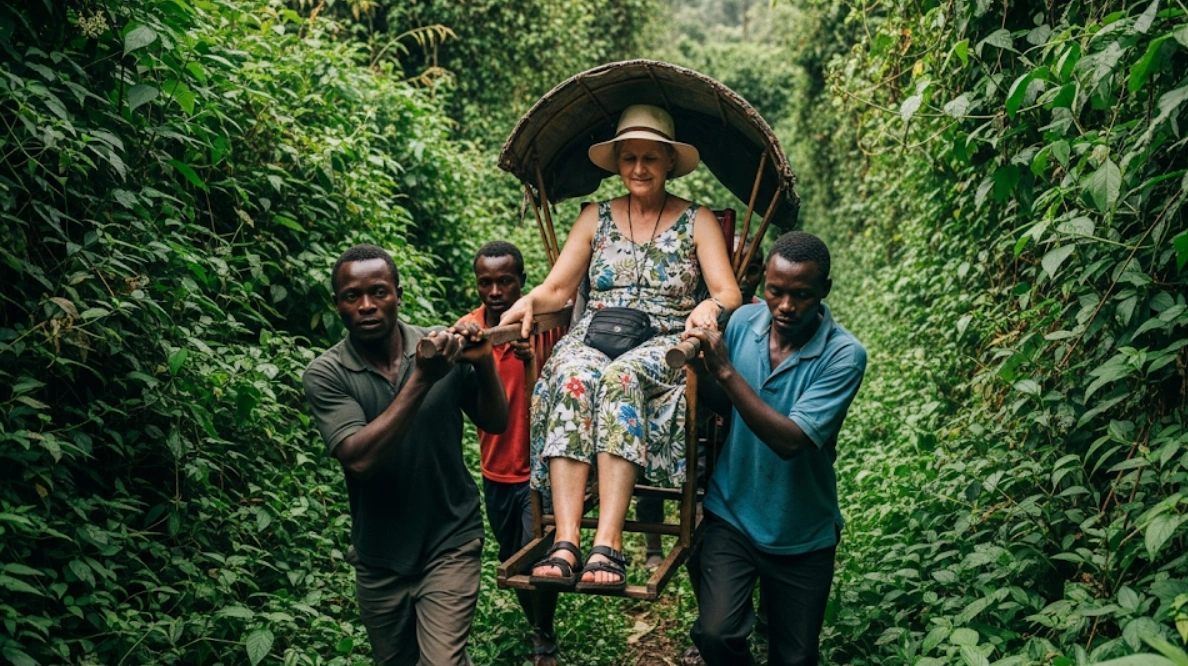
The most important enabling factor is the porter-carried chair, often called the sedan chair or “African helicopter.” A team of trained porters carries you through the forest on a secure seat supported by poles.
This is not improvised—it is a structured service used regularly. The porters rotate positions, maintain balance on uneven terrain, and coordinate with rangers throughout the trek.
You remain stable and elevated, allowing you to move through steep, muddy, and densely vegetated areas without walking. Once you reach the gorillas, you are positioned comfortably at a safe viewing distance.
For anyone researching gorilla trekking wheelchair limited mobility, this is the key detail—the experience becomes accessible without requiring full physical participation in the hike.
Terrain Differences by Sector
Choosing the Right Location Matters
Not all gorilla trekking sectors offer the same level of difficulty. Terrain varies significantly, and this directly affects accessibility.
In Uganda, Buhoma (northern Bwindi) tends to have more gradual terrain compared to the steeper southern sectors like Nkuringo. Rushaga offers more gorilla families, which can increase chances of a shorter trek, though terrain can still be uneven.
In Rwanda, Volcanoes National Park features bamboo zones and open sections that can be easier in certain areas, but slopes can still be steep depending on the gorilla family location.
Understanding these differences is essential for gorilla trekking wheelchair limited mobility. Choosing the right sector improves comfort, reduces risk, and shortens travel time to the gorillas.
How the Trek Is Adjusted for Limited Mobility
Slower Pace, Strategic Allocation, and Support
When mobility limitations are declared in advance, guides and rangers prepare accordingly. The pace becomes controlled, with frequent stops if needed.
Trackers go ahead early in the morning to locate the gorilla family, which allows rangers to plan the most efficient route. If a group is far, adjustments may be made where possible.
Porters assist not only with carrying but also with coordination—navigating obstacles, stabilizing movement, and ensuring you remain secure.
This adaptive approach defines gorilla trekking wheelchair limited mobility—it is not about forcing the trek, but shaping it around your ability.
The Gorilla Viewing Experience
Full Participation at the Encounter
Once you reach the gorillas, the experience is the same. You spend one hour observing the family at close range, following the standard 7-meter distance rule.
Your position is adjusted for clear visibility. You are not kept at the edge of the group—you are part of the experience.
Gorillas move freely, and in some cases, they may come closer regardless of your position. The forest environment remains unchanged, and the encounter retains its authenticity.
For travelers concerned about missing out, gorilla trekking wheelchair limited mobility still delivers the full emotional and visual impact of the trek.
Lodges With Accessible Rooms and Practical Layouts
Where You Stay Matters as Much as the Trek
Accommodation plays a major role in overall comfort. Some lodges offer ground-level rooms, step-free access, and staff support for mobility needs.
In Bwindi, properties in Buhoma such as Mahogany Springs or Bwindi Lodge offer more manageable layouts compared to steeper hillside lodges. In Rushaga, Ichumbi Gorilla Lodge provides easier access than more remote options.
In Rwanda, lodges near Volcanoes National Park such as Mountain Gorilla View Lodge or select high-end properties offer better pathway design and staff assistance, though terrain around lodges can still vary.
When planning gorilla trekking wheelchair limited mobility, selecting a lodge with accessible design reduces strain before and after the trek.
Costs and Logistics of the Carry Chair
What to Expect on the Ground
The porter-carried chair is arranged locally and paid directly to the porter team. Costs vary depending on the park and terrain but are typically in the range of a few hundred dollars.
This fee supports the porters directly and reflects the physical effort involved. It is important to confirm arrangements in advance to ensure availability.
Beyond cost, logistics include briefing the team, adjusting seating for comfort, and coordinating timing with the ranger group.
This practical setup is a core part of gorilla trekking wheelchair limited mobility—it turns planning into execution.
Safety Considerations and Honest Limits
When to Proceed and When to Reconsider
While accessibility has improved, gorilla trekking still takes place in a wild environment. Weather, terrain, and distance remain unpredictable.
Travelers must be comfortable with being carried over uneven ground for extended periods. Medical conditions should be discussed in advance, and travel insurance is strongly advised.
If there are concerns about stability, severe medical limitations, or discomfort with remote conditions, it is better to reassess timing.
A responsible approach ensures that gorilla trekking wheelchair limited mobility remains safe, not just possible.
The Reality: Accessible, But Requires Planning
Turning a Challenging Trek Into a Real Experience
Gorilla trekking is no longer limited to physically strong hikers. With the right preparation, support system, and location choice, it becomes accessible to a much wider range of travelers.
The key is early planning—choosing the right sector, arranging porter support, and selecting suitable accommodation. When these elements align, the experience becomes seamless.
At its core, gorilla trekking wheelchair limited mobility is not about overcoming barriers in the moment—it is about removing them before the trek begins.
- How People with Limited Mobility Can Trek to See Gorillas
- How We Arrange Gorilla Trekking for People With Limited Mobility
- Gorilla Trekking Uganda for Wheelchair Users
- Gorilla trekking with limited mobility: adaptive options and what to expect
- Gorilla Trekking Uganda Wheelchair Accessible: What Is Possible
- Gorilla Trekking Uganda 2027: Reserve Your Permit Now — Limited Quota
- Gorilla Trekking Uganda: The Guide for People With a Limited Budget
- Book Gorilla Trekking Now for the 2027 July-August Peak: Permits Limited
- Book Two Gorilla Treks and Get a Free Night: Limited Offer Explained
- Samsung Galaxy gorilla photography: tips for Android users