Updated
Uganda rainfall seasons gorilla trekking best time is one of Africa’s most extraordinary wildlife experiences, connecting travellers with mountain gorillas in their natural forest habitat. Uganda experiences a bimodal rainfall pattern — two distinct rainy seasons separated by two relatively drier periods — that shapes the annual rhythm of gorilla trekking trail conditions, wildlife activity, and tourism volumes across Bwindi Impenetrable National Park: understanding this pattern allows visitors to make an informed choice between the peak dry season (June-August) with its firmer trails, clearer skies, and heaviest permit demand, and the quieter wet seasons (March-May and October-November) with their softer light, lower visitor numbers, exceptional forest birding, and the trade-off of muddier paths and more frequent afternoon downpours. Neither season makes gorilla trekking bad — but they make it different, and choosing the right season for your priorities is one of the more consequential decisions in planning a Bwindi gorilla trek. See Uganda safari packages across all seasons.
- Long dry season: June-August — peak gorilla trekking season; firmer trails; heaviest permit demand; book 3-6 months ahead
- Short dry season: December-February — second-best conditions; fewer visitors than June-August; good option for Christmas/New Year travel
- Long rains: March-May — wetter, muddier trails; fewer visitors; excellent forest birding (breeding season); lower lodge rates possible
- Short rains: October-November — similar to March-May but shorter; transition season with mixed conditions
- Gorilla trek availability: runs every day year-round regardless of weather; rain never cancels a permitted trek
Uganda experiences a bimodal rainfall pattern — two distinct rainy seasons separated by two relatively drier periods — that shapes the annual rhythm of gorilla trekking conditions, wildlife activity, and tourism volumes across Bwindi Impenetrable National Park and the country’s other major wildlife destinations. Understanding this rainfall cycle and its practical implications for trek conditions, wildlife behaviour, and accommodation availability allows visitors to choose their travel timing intelligently rather than simply booking the first available dates or defaulting to generic “dry season” advice that may not reflect the nuanced reality of Bwindi’s specific climate.
Uganda’s long rains and short rains: planning a gorilla trek around rainfall patterns
The bimodal pattern: Uganda’s two rainy seasons
Uganda’s rainfall pattern is driven by the Inter-Tropical Convergence Zone, the equatorial belt of low pressure where northeast and southeast trade winds meet and trigger convective rainfall. As the ITCZ migrates north and south with the sun’s apparent movement across the sky, Uganda experiences two rainfall peaks: the long rains from March through May, when the ITCZ sits north of the equator, and the short rains from October through November, when the ITCZ returns southward. These peaks are most consistent at lower altitudes and in areas with less topographic influence on rainfall patterns; at Bwindi’s altitude, the pattern is somewhat moderated by the orographic effect of the Albertine Rift highlands.
The terms “long rains” and “short rains” reflect the relative duration of the two wet seasons rather than necessarily their rainfall intensity. In practice, monthly rainfall totals at Bwindi during the long rains can be comparable to or occasionally lower than totals during the short rains in specific years, reflecting the variability that characterises East African rainfall patterns and that has increased under current climate change trends. Travellers planning around rainfall statistics should treat historical average data as indicative rather than predictive, particularly for specific weeks or months.
Dry season (June to September): peak tourism and optimal conditions
The June to September period, Uganda’s main dry season, is the peak gorilla trekking season and the period during which permits are most difficult to obtain, accommodation rates are highest, and the overall visitor experience is most comfortable. Daily rainfall events are less frequent and generally shorter than in the wet seasons, forest trail conditions are firmer and drier underfoot, and the risk of prolonged rain during a trek is lowest. The forest itself looks magnificent in this period — the reduced rainfall intensifies certain floral elements and the clearer air on ridge positions provides the best visibility for landscape photography.
Wildlife behaviour during the dry season favours more predictable gorilla group locations, as the relative scarcity of moisture in the environment reduces the abundance of certain herbaceous plants that gorillas favour in wetter conditions and tends to keep groups in lower-altitude, more sheltered forest areas where moisture retention is higher. This predictability is partly a function of the gorillas’ dietary needs and partly of the tracker teams’ accumulated experience with dry season ranging patterns in specific gorilla groups, and it translates into shorter average trek times to locate habituated groups during the peak dry period.
The dry season’s logistical advantages come with corresponding drawbacks. Permit availability requires booking four to six months in advance for popular trekking sectors. Premium lodge rates can be 30 to 50 percent higher than low season rates. The concentration of visitors in the park during peak months means more people on trail systems simultaneously, and while each trek group is limited to eight visitors, the cumulative human presence in the park is higher than in quieter periods. Visitors who value solitude and a sense of wilderness may find the low season experience more rewarding despite its less comfortable conditions.
Long rains (March to May): challenging but rewarding
The March to May long rains period produces the most challenging trekking conditions of the year but also some of its most atmospheric and scenically striking experiences. Daily rainfall is more frequent and prolonged than in other seasons, trail surfaces become genuinely muddy and slippery, and the forest feels more enclosed and mysterious in the mist and low cloud that heavy rainfall produces. These conditions require excellent waterproof equipment and a willingness to be physically challenged, but they reward preparation with encounters in a forest that looks and feels completely different from its dry season character.
The forest vegetation is at its most lush during and after the long rains, with fresh green growth visible throughout the understory and canopy and a floral diversity that dry season forest cannot match. Waterfalls and streams run strongly, adding sound and visual interest to the landscape. The forest floor is covered with fungi, mosses, and ferns that thrive in the moist conditions, producing a ground-level visual complexity that photographers focused on forest ecology find more interesting than the cleaner but drier dry season floor.
Bird activity in the long rains period is significantly higher than in the dry season, reflecting both the flush of insect availability that rain produces and the breeding activity of many species that time their nesting to coincide with peak food abundance. Forest birding during this period, conducted on the approach walk or in lodge gardens at dawn, can produce encounters with species in breeding plumage or in breeding behaviour that dry season visits miss entirely. Serious birders often deliberately target the wet season for Bwindi visits because the bird activity more than compensates for the reduced comfort of wet trail conditions.
Short rains (October to November): the underrated season
The October to November short rains period is the most underrated gorilla trekking season in Uganda, combining relatively manageable rainfall with moderate visitor volumes, good wildlife activity, and accommodation rates that are typically below peak levels without reaching the deep low season discounts of the long rains. The short rains are generally less intense than the long rains at Bwindi, with rainfall events more often occurring in the afternoon rather than disrupting morning trek departures, and the forest conditions are wetter than the dry season but significantly drier than March to May.
Permit availability in October and November is considerably better than in the June to September peak, with last-minute permit purchases more often possible than in the peak months. Visitors who have flexibility in their travel timing and who find peak season permit scarcity frustrating often discover that an October visit provides a significantly more accessible booking experience without the full wet season physical challenges that March visits involve.
The December to February dry season, often treated as an extension of the October-November shoulder period, represents an intermediate condition: drier than the wet seasons, slightly wetter and less predictable than the June-September main dry season, and significantly less visited than the mid-year peak. January and February in particular can provide excellent gorilla trekking conditions with lower permit competition and moderate lodge rates, and Christmas and New Year periods bring visitor spikes that temporarily push availability and rates toward peak levels before settling back in January.
Planning around the rainfall cycle: practical guidance
The practical guidance that emerges from understanding Uganda’s rainfall cycle is more nuanced than the standard “visit in the dry season” advice that most travel publications provide. The best time to visit depends on visitor priorities: peak dry season for maximum comfort and trail conditions; long rains for lush scenery, competitive rates, and serious birding despite physical challenge; short rains for a balance of conditions and availability; December to February dry period for intermediate conditions with better availability than mid-year peak.
No season guarantees rain-free gorilla trekking — even during the driest months, afternoon rain events occur, and morning mist is common at Bwindi’s altitude regardless of season. The appropriate response to this reality is not to chase the mythical dry day but to prepare adequately for wet conditions regardless of season and to treat the forest’s various weather states as different rather than better or worse. The gorilla encounter itself is season-independent: habituated groups are found and approached successfully throughout the year, and the quality of the encounter depends on gorilla behaviour and guide quality rather than on whether the trail was muddy en route.
What is gorilla trekking like in the June-August dry season?
June-August is Uganda’s primary dry season and the peak period for gorilla trekking at Bwindi. Trail conditions are at their best: drier ground means firmer footing on the steep slopes, faster progress on the approach to the gorilla family, and significantly less mud on the descent. Photographic conditions are generally good — the vegetation remains green (Bwindi never fully dries out) but the cloud and mist that soften light in wet season are less persistent, producing cleaner light particularly in the morning hours of the trek. The trade-off: June-August is the period of highest permit demand, and permits for the most popular Bwindi sectors book out 3-6 months in advance. Lodge prices are at their peak. Visitor volumes are highest, meaning that while the maximum group size at the gorilla family remains 8, the briefing area and approach trail are more crowded than in quieter months. For visitors with fixed July-August travel windows, advance booking of both permits and lodges is non-negotiable.
Is the March-May rainy season worth visiting Bwindi for gorilla trekking?
Yes — the March-May rainy season has specific advantages that make it genuinely attractive for well-prepared visitors. Permit availability is significantly better: permits that would be unavailable in June-August can often be booked with just weeks’ notice in March-May. Lodge rates are often lower or negotiable. The forest at peak rain is extraordinarily lush and green — the visual intensity of Bwindi’s vegetation in March-May is something that dry season photos rarely capture. Birding is exceptional: March-May coincides with the peak of the breeding season for many of Bwindi’s Albertine Rift endemic birds, and the dawn chorus in the forest is one of the richest acoustic experiences in African wildlife. The gorilla encounter itself is unaffected by rain in terms of permit validity or encounter quality — gorillas in rainy season shelter under canopy and are often easier to photograph because they are more stationary. The trade-off is trail difficulty: muddy slopes are physically harder and require good boots and physical fitness.
How does rainfall affect gorilla ranging patterns at Bwindi?
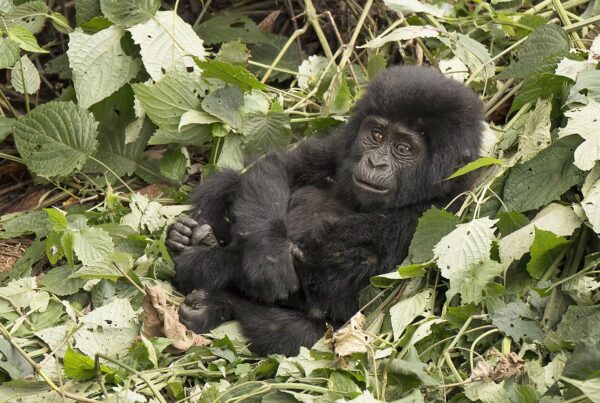
Gorilla ranging patterns at Bwindi are influenced by food availability rather than directly by rainfall, but the two are linked: rainfall determines when specific food plants produce fruit, new shoots, and flowers, and these phenological events drive gorilla movement decisions. In wet season, food is abundantly available across a wide area and gorilla families may range more widely. In dry season, some food sources become scarcer and gorillas may concentrate in areas with reliable food — which can sometimes mean shorter approaches for visitors if the family is reliably in a productive food zone. Rain also directly affects gorilla behaviour on the day of the encounter: gorillas typically shelter under dense canopy during heavy rain, reducing movement and making them easier to observe from a fixed position. In dry weather, families may be actively feeding and moving across a wider area, producing more dynamic but sometimes less static encounters. Neither pattern is consistently better for visitors — they are different experiences of the same gorilla family.
When should I book gorilla permits to get my preferred dates?
Booking lead times vary significantly by season. For June-August (peak season), booking permits 3-6 months in advance is the minimum to have a reasonable chance of securing specific dates — for July school holiday peak periods, 6+ months is safer. For December-January, book 2-4 months ahead. For March-May and October-November, permits can often be obtained with 4-8 weeks’ notice, and last-minute availability is possible (though not guaranteed). The booking mechanism: gorilla permits are booked through Uganda Wildlife Authority’s online portal or through licensed tour operators who have allocation access. Most visitors book permits through their tour operator as part of a complete safari package, which removes the logistical burden of direct UWA interaction but adds operator margin to the cost. Direct booking through UWA is possible and slightly cheaper but requires self-managing the associated logistics. The permit itself is non-refundable but may be transferable to another date through UWA — confirm the transfer policy when booking.
Does the short dry season (December-February) offer good gorilla trekking?
Yes — the December-February dry season is Uganda’s second-best gorilla trekking period and a strong choice for visitors whose travel window falls in the Christmas-New Year or early new year period. Trail conditions are similar to June-August: firmer, drier, faster approaches. Visitor volumes are lower than the June-August peak (though Christmas week is busy with families). Lodge rates are generally mid-season rather than peak. The main practical consideration is that December-February is the Northern Hemisphere school holiday period, which means Christmas and New Year weeks (approximately December 20 – January 5) are as busy as July-August for Bwindi with limited permit and lodge availability. Outside that specific window — January and February in particular — the dry season benefits of firmer trails and good photographic conditions combine with significantly lower visitor numbers than June-August, making January and February an underrated gorilla trekking option for flexible travellers.
- Uganda’s long rains: trekking in April and May
- Gorilla trekking in October and November: navigating the short rains
- Gorilla trekking in March and April: the long rains and why some visitors prefer them
- Gorilla trekking in October and November: the short rains and what they mean for trekkers
- October and November in Bwindi: navigating the short rains for gorilla trekking
- What Happens If It Rains on Your Trekking Day?
- What Happens If It Rains During Gorilla Trekking? Rainy Day Guide
- What Happens If It Rains on My Gorilla Trek? Complete Guide
- What If It Rains on My Gorilla Trek? Complete Guide
- What Happens If It Rains During the Gorilla Trek in Uganda? Complete Guide to Trekking in Wet Weather