Updated
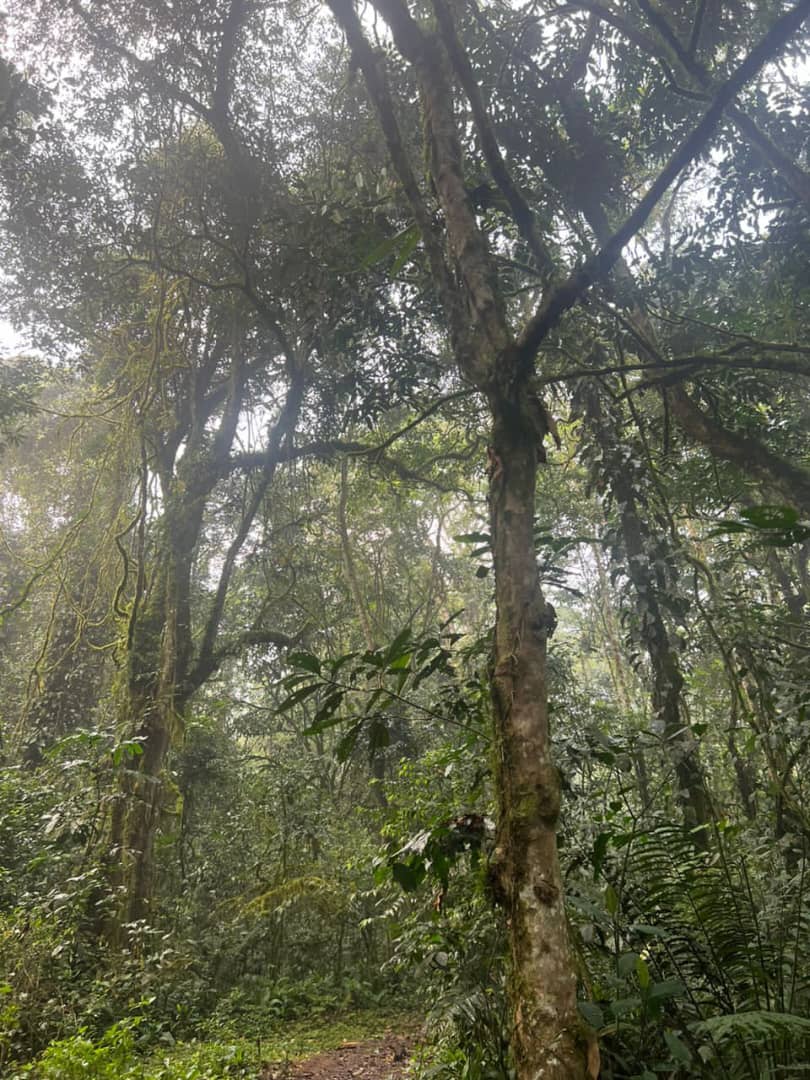
mist photography Bwindi gorilla is a subject central to Uganda’s wildlife tourism, where mountain gorilla conservation and responsible visitor experiences go hand in hand. Bwindi’s mist is not a weather inconvenience. It is one of the defining atmospheric conditions of montane tropical forest, and photographs taken in the early morning fog — when visibility drops to tens of metres and the forest resolves into layers of grey-green depth — are often among the most evocative images from a gorilla trek. The tendency to wait for clear conditions before raising the camera misses some of the most distinctive and unrepeatable atmospheric moments of the highland forest experience. Learning to work with mist rather than against it transforms what might seem like a photography obstacle into a specific set of creative opportunities.
Mist and cloud in Bwindi: photographing the forest in atmospheric conditions
The meteorology of Bwindi’s mist
Bwindi sits in the highlands of the Albertine Rift at elevations where the temperature-dewpoint relationship produces regular cloud formation at or near ground level. Warm, moisture-laden air rising from the lowlands to the west and north cools as it gains altitude, and when it cools below the dewpoint — the temperature at which the air holds all the water vapour it can carry — the excess moisture condenses as cloud or ground-level fog. In a forest environment, this condensed moisture is also deposited directly onto vegetation surfaces — a process called fog interception or horizontal precipitation — where it drips to the ground and contributes meaningfully to total water input to the ecosystem.
Mist at Bwindi is most frequent in the early morning, particularly during the cooler months of June–September and December–February, and during transitional periods at the onset and end of the rainy seasons. By mid-morning, solar heating of the air mass typically disperses the mist, and afternoons in the dry season are often clear with excellent visibility. The variability within and between days means that conditions at the park gate at 07:30 may be entirely different from conditions two hours later during the gorilla encounter — and different again by the time the group returns to the forest edge.
Exposure for misty forest conditions
Mist in forest photography creates exposure challenges that are different from the standard low-light forest conditions already discussed. The backscattering of light by water droplets in the air increases the overall brightness of the scene relative to clear conditions at the same ambient light level — mist effectively adds a diffuse, omnidirectional light source that raises the baseline exposure value of the environment. This means that exposures appropriate for the gorilla hour in clear conditions may be overexposed in heavy mist, and automatic exposure systems can be confused by the high proportion of bright fog in the frame.
The practical response is to check your histogram or highlights warning after the first few shots in misty conditions and to apply modest negative exposure compensation (-0.3 to -0.7 EV) if the bright mist is blowing out in the upper range. The goal is to preserve detail in the mist itself rather than to expose for the darker forest elements — an overexposed white fog is visually dead and loses the layered depth that makes mist photography distinctive, while a slightly underexposed forest interior is easily recovered in post-processing.
Creative approaches to mist photography
The most rewarding creative approach to misty forest conditions is to embrace layering — the way that mist creates distinct planes of visibility at different distances, with nearby objects sharply defined and distant objects progressively dissolved into grey. Positioning yourself or framing the shot to emphasise this layering, with a clearly defined subject in the foreground and the mist providing depth behind it, produces images with a distinctly atmospheric quality that clear-air photography cannot achieve.
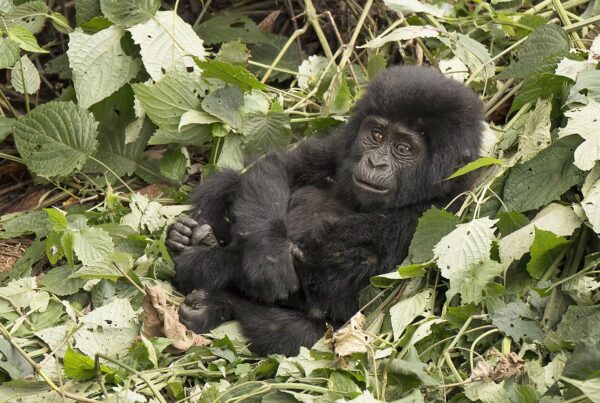
Gorillas in mist are among the most celebrated wildlife photography subjects, and for good reason: the combination of the animals’ dark forms against the pale fog creates natural contrast that simplifies composition, while the atmospheric softening of the background eliminates the distracting vegetation complexity that can make forest wildlife photographs feel cluttered. If your gorilla encounter occurs in misty conditions, resist the instinct to wait for clarity — the mist is defining the image in your favour.
Silhouettes in mist — a gorilla or a ranger backlit by the diffuse light from a fog-filled clearing — are visually powerful in a way that front-lit images in clear conditions rarely match. The silhouetted form against the bright background reads immediately as a presence in a mysterious, enveloping environment, which is precisely what the highland forest and its mist feel like from the inside. Expose for the background brightness — this will render the foreground subject as a clean silhouette rather than a partly-lit ambiguous form.
Equipment care in high humidity and mist
Camera equipment in Bwindi’s misty conditions faces specific risks. Moisture from the air deposits on lens elements and can produce a slightly diffuse quality in the optical image that is visible in the final photograph as reduced micro-contrast — not catastrophic but noticeable when comparing misty-conditions images against clear-conditions images from the same lens. Keep a clean microfibre cloth accessible during the trek for quick lens surface wipe-downs when visible moisture has accumulated.
The junction between lens and camera body — where the mount seal is — is a potential entry point for moisture under sustained exposure to rain or heavy mist. Weather-sealed camera and lens combinations are inherently more resistant, but no combination is entirely weatherproof in sustained rain at high humidity. A rain cover for the camera — a simple sleeve available from most photography retailers — provides adequate protection for the combination of mist and light rain encountered on most gorilla treks without the bulk or cost of professional wet-weather housings.
- Bwindi Impenetrable Forest – Gorilla Trekking in Uganda’s UNESCO Jungle
- Chimpanzees Confirmed in Bwindi Forest
- Bwindi Forest: What Happened to the White-Bellied Duiker?
- Bwindi Forest Gorilla Trekking: An Unforgettable Journey
- Uganda Gorilla Trekking Bwindi Impenetrable Forest: The Complete Guide
- The History of Bwindi Impenetrable National Park: From Forest to World Heritage Site
- Where Exactly Is Bwindi Impenetrable Forest? Location, Geography, and How to Get There
- Are There Other Animals on the Gorilla Trek in Bwindi? Forest Wildlife Beyond the Gorillas
- How Old Is the Bwindi Impenetrable Forest? Age and History
- Bwindi Impenetrable National Park: Uganda’s Gorilla Forest