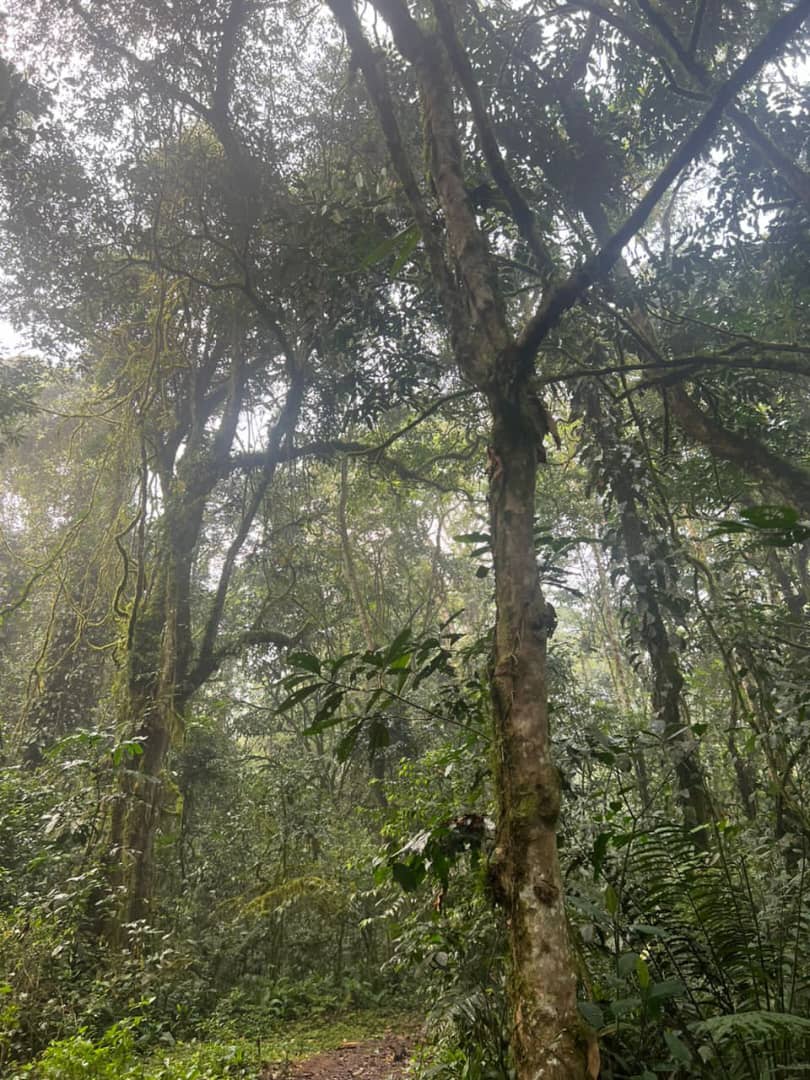
Shelley’s crimsonwing is one of the jewels of Bwindi Impenetrable Forest — the male of this small forest finch has deep crimson-red upperparts that glow in the forest understorey, making it one of the most brilliantly coloured birds in Uganda’s mountain forest, a species prized by birders who add Bwindi to their itinerary specifically for Albertine Rift endemics that cannot be seen anywhere else on Earth. Shelley’s crimsonwing is on the must-see list for any birding Uganda safari that includes Bwindi.
- Scientific name: Cryptospiza shelleyi — named after the British ornithologist George Ernest Shelley
- Status: Vulnerable (IUCN); Albertine Rift endemic; found in Bwindi, Mgahinga, Rwenzori, and adjacent montane forests in DRC and Rwanda
- Identification: male: crimson-red crown, back, and wing coverts; black face and belly; green flanks; female: duller olive-green with some red on crown
- Habitat: dense montane forest understorey from 1,800 to 2,800m; thickets near forest streams; bamboo zone edges at Bwindi
Shelley’s crimsonwing is one of the jewels of Bwindi Impenetrable Forest. The male of this small forest finch has deep crimson-red upperparts that glow in the forest understorey, making it one of the most brilliantly coloured birds in Uganda’s mountain forests. As a near-endemic of the Albertine Rift, it is a high-priority target for birders visiting Uganda in 2027.
Despite its striking colouration, Shelley’s crimsonwing can be challenging to find. It inhabits the dense undergrowth of montane forest, often feeding on the ground or in low vegetation where it can easily be hidden. Knowing where to look and having a specialist guide who knows the bird’s habits and current locations is essential for a successful sighting.
Identification
The male Shelley’s crimsonwing is striking and distinctive. The entire upperparts, wings, and tail are deep crimson-red. The underparts are olive-green to yellowish. The bill is short, thick, and finch-like. The face and crown are slightly darker crimson than the back. The overall impression of a male in good light is of an intensely red bird glowing against the green forest background.
The female is olive-green overall with less obvious red markings, making her much harder to identify and often overlooked. Juveniles resemble females. The calls are soft and melodic — a series of musical notes given from dense undergrowth. The species is a seed-eater and is most often found near the forest floor and in low shrubs.
Habitat at Bwindi
Shelley’s crimsonwing is found in the undergrowth of montane forest in the Albertine Rift. At Bwindi it is present throughout the forest but is most reliable at the Ruhija sector at higher elevations. It favours areas of dense shrub layer within primary forest, often along streams and in areas where bamboo meets montane forest.
The species feeds primarily on small seeds and occasionally insects. It forages quietly in low vegetation and on the forest floor, which makes it easy to walk past without noticing. The Mubwindi Swamp trail at Ruhija is one of the most productive areas, where the bird is regularly encountered in the thick understory vegetation around the swamp edges.
Conservation Status
Shelley’s crimsonwing is classified as Near Threatened by the IUCN due to its restricted range and dependence on montane forest. The species occurs in Uganda, Rwanda, Burundi, and eastern Democratic Republic of Congo — all countries where montane forest faces ongoing pressure from agriculture and charcoal production.
In Uganda, Bwindi’s protected status provides a crucial refuge. The gorilla tourism income supports forest management that benefits not just gorillas but the entire forest ecosystem, including range-restricted birds like Shelley’s crimsonwing. Birdwatching tourism adds a further economic layer that helps justify the forest’s protection to surrounding communities.
Photography Tips
The male Shelley’s crimsonwing is one of the most beautiful photography subjects in Ugandan forests, but the dim forest floor setting creates exposure challenges. A fast prime lens with good image stabilisation is essential. High ISO performance matters more than megapixels in this situation. Use positive exposure compensation to expose for the crimson plumage rather than the dark forest background.
See Shelley’s Crimsonwing in 2027
The gorilla trekking permit costs $800 in 2027. Combining your gorilla trek with two days of specialist birding at Bwindi’s Ruhija sector gives you the best chance of seeing Shelley’s crimsonwing alongside other Albertine Rift endemics. Contact us to arrange a bespoke 2027 Uganda itinerary that targets this and other forest special species.
Where exactly in Bwindi is Shelley’s crimsonwing most reliably seen?
Shelley’s crimsonwing occurs throughout Bwindi but is most reliably found in specific habitat. Altitude preference: the species prefers mid-to-high altitudes in Bwindi from approximately 1,800-2,800m; the Ruhija sector at higher elevation is generally the most productive site. Ruhija: the highest and most birder-visited sector of Bwindi; the forest here has bamboo, Hagenia, and dense understorey; crimsonwing pairs and small groups are most often found along forest streams and in dense thicket edges. Buhoma: the main visitor entry point for gorilla trekking; lower altitude; crimsonwing is less common here but present; the trail to the waterfall passes through appropriate habitat. Strategy: a dedicated birding morning with a Bwindi birding guide at Ruhija; move slowly through understorey; listen for the soft, liquid call; the bird feeds on grass seeds and tiny insects near the ground and moves in pairs or small groups of 3-5.
What are the other Albertine Rift endemic birds that birders seek at Bwindi alongside Shelley’s crimsonwing?
Bwindi holds an extraordinary concentration of Albertine Rift endemics. African green broadbill (Pseudocalyptomena graueri): one of Africa’s rarest birds; found only in Bwindi and adjacent DRC; vivid green; sits quietly in mid-canopy; top target species. Grauer’s warbler: endemic to Bwindi and eastern DRC; dense bamboo; very hard to see. Handsome francolin: endemic to the Albertine Rift; forest floor; often heard before seen. Strange weaver: Albertine Rift endemic; forest interior; Bwindi is the most accessible site. Archer’s robin-chat: montane forest; Ruhija area; distinctive call. Kivu ground thrush: endemic; dense forest floor; very secretive. Banded prinia: Albertine Rift; forest edges. Regal sunbird: Albertine Rift endemic; high altitude; brilliant iridescent plumage. Total endemics: Bwindi holds more than 23 Albertine Rift endemic species making it the most important single birding site in East Africa for regional endemics.
Why is Shelley’s crimsonwing classified as Vulnerable?
The Vulnerable classification reflects a small, fragmented range and specific habitat needs. Range: the total global range covers Bwindi and Mgahinga in Uganda, the Rwenzoris, the Virunga volcanoes and Kahuzi-Biega in DRC, and parts of Rwanda’s Nyungwe Forest; this is a very small total area. Population: the total population is not precisely known; estimated in the low thousands; the DRC population is potentially the largest but DRC forest has suffered severe habitat loss and human pressure. Habitat specificity: the species requires dense, wet montane forest understorey with specific grass and seed species in its diet; degraded forest does not support it. Uganda protection: within Uganda, Bwindi’s formal park status and buffer zone management provides good protection; the population at Bwindi is thought to be stable.
Do you need a special permit to birdwatch in Bwindi Impenetrable Forest?
Birding in Bwindi requires an entry permit from Uganda Wildlife Authority but not a gorilla permit. Birding permit: the standard non-gorilla Bwindi entry permit costs USD 40-50 per person per day as of 2027; this covers trail access for birding and forest walks. Gorilla permit: USD 800 per person per trek; needed only if you want to track gorillas; birding visits can be done without this. Birding guide: engaging a specialist Bwindi birding guide is strongly recommended; the forest is dense and species are cryptic; guides who know where individual pairs of crimsonwing or African green broadbill are currently located dramatically improve the sighting rate. Best season for birding: Bwindi birding is good year-round; March-May and September-November when migrants are present and resident birds are breeding are considered peak; the dry season (June-September) is also productive and more comfortable.
How does Shelley’s crimsonwing feed and what is its behaviour?
Shelley’s crimsonwing is a seed and insect specialist of the forest floor and understorey. Feeding: the crimsonwing feeds primarily on small grass seeds and tiny arthropods; it moves through dense understorey vegetation close to the ground; it gleans insects from leaf surfaces and bark. Pair behaviour: Shelley’s crimsonwing typically moves in monogamous pairs or small family groups; the pair maintains contact with soft contact calls as they move through dense vegetation. Cryptic when alarmed: when disturbed the bird freezes in dense vegetation or flies quickly into deeper cover; patience and slow movement are essential for good views. Morning activity: most active in the early morning from 6am to 10am; the crimsonwing feeds actively at this time before retiring to rest in the heat of the day. Nesting: breeding recorded in Bwindi; the nest is a neat oval structure of grass; exact nesting sites are rarely observed given the secretive nature.
- Cross River Gorilla: Africa’s Rarest Gorilla Subspecies
- Gorillas in Bwindi Eat 200 Different Plant Species: A Diet Study
- African Green Broadbill Uganda: Bwindi Endemic Species Guide
- Uganda’s Most Rare Animals: 10 Species Almost No One Has Seen
- Fig trees of Bwindi: the keystone species that feeds the whole forest
- Bwindi’s bird life: 350 species and the holy grail of African birding
- The fig trees of Bwindi: keystone species and the forest’s feeding calendar
- Fig trees as keystone species: how one plant feeds Bwindi’s whole forest community
- Top 10 bird species to see in Bwindi Impenetrable Forest
- Bwindi Impenetrable Forest – Gorilla Trekking in Uganda’s UNESCO Jungle