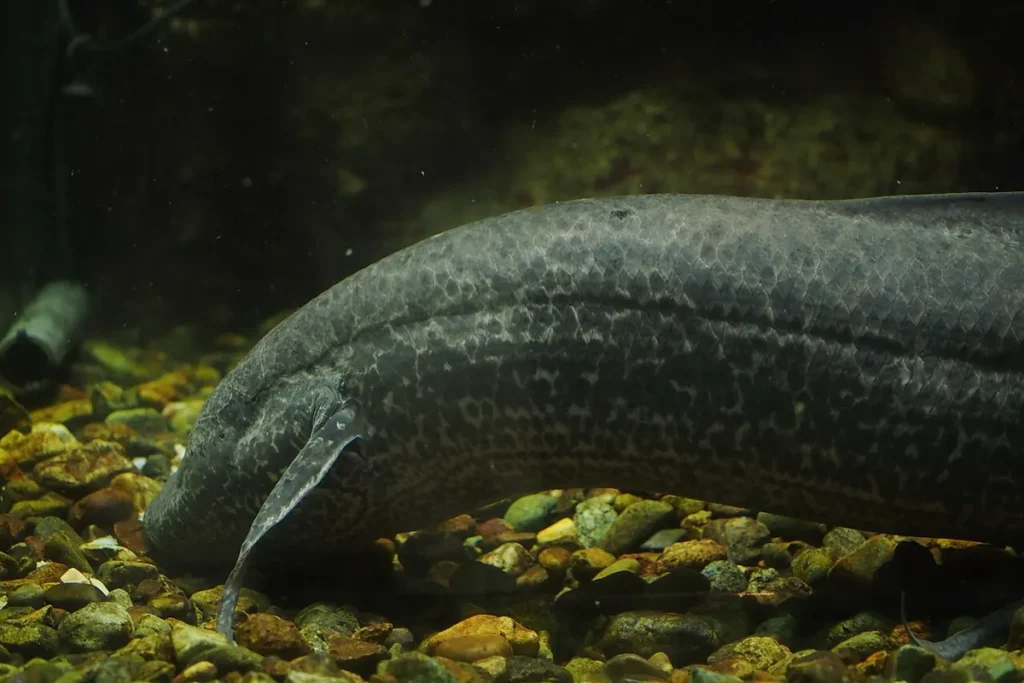
The African lungfish is one of the most extraordinary animals in Uganda’s waters — and one of the most ancient vertebrates on Earth. A living fossil in the truest sense, the lungfish lineage has existed largely unchanged for over 400 million years, predating the dinosaurs, the colonisation of land by vertebrates, and the entire evolutionary history of mammals. In Uganda, it inhabits swamps, slow rivers, and shallow lakes across the country, and it is the primary prey of the shoebill stork — one of the most unusual predator-prey relationships in African wildlife.
What Makes Lungfish Extraordinary
The African lungfish (Protopterus aethiopicus) possesses both gills and a functional lung — hence the name. It breathes air obligatorily: if prevented from surfacing, it drowns. It surfaces every 20 to 30 minutes in normal conditions to breathe, and this surface-breathing behaviour is what makes it vulnerable to the shoebill’s ambush strategy. The lung is a modified swim bladder — a structure that in most fish is used for buoyancy regulation — that has been repurposed over hundreds of millions of years into a functional air-breathing organ. The African lungfish is one of the species that bridges the evolutionary gap between fish and terrestrial vertebrates.
Adults reach 1 to 2 metres in length and can weigh up to 20 kilograms. The body is eel-like but with small, fleshy paired fins rather than the typical fish fin structure. These fins are used in crawling movements along the bottom of shallow water — a locomotion mode that hints at the evolutionary origins of tetrapod limbs. The lungfish can survive out of water for years by burrowing into mud and secreting a mucus cocoon in which its metabolism drops to near-zero — a state of aestivation that allows it to survive complete desiccation of its habitat.
Cultural and Economic Importance
African lungfish are an important food fish in Uganda, particularly in the regions around Lake Victoria and the Nile. They are caught using traps, nets, and by hand in shallow papyrus swamps where they are relatively easy to locate. In some traditional Ugandan communities, lungfish hold cultural significance and are featured in food customs around specific ceremonies. Dried and smoked lungfish are traded in local markets.
The Shoebill Connection
The lungfish’s obligate air-breathing behaviour makes it vulnerable to a highly specialised predator: the shoebill stork. The shoebill waits motionless at the edge of papyrus swamps, perfectly positioned to intercept lungfish as they surface to breathe. When a lungfish rises, the shoebill lunges with explosive speed — a whole-body strike that uses the massive, hooked bill to seize the fish before it can submerge. Large lungfish require vigorous shaking and sometimes decapitation before they can be swallowed. The shoebill-lungfish relationship is one of the most specialised predator-prey dynamics in African wetland ecology, and the best way to see both species is at Mabamba Swamp near Entebbe.
Lungfish in Uganda
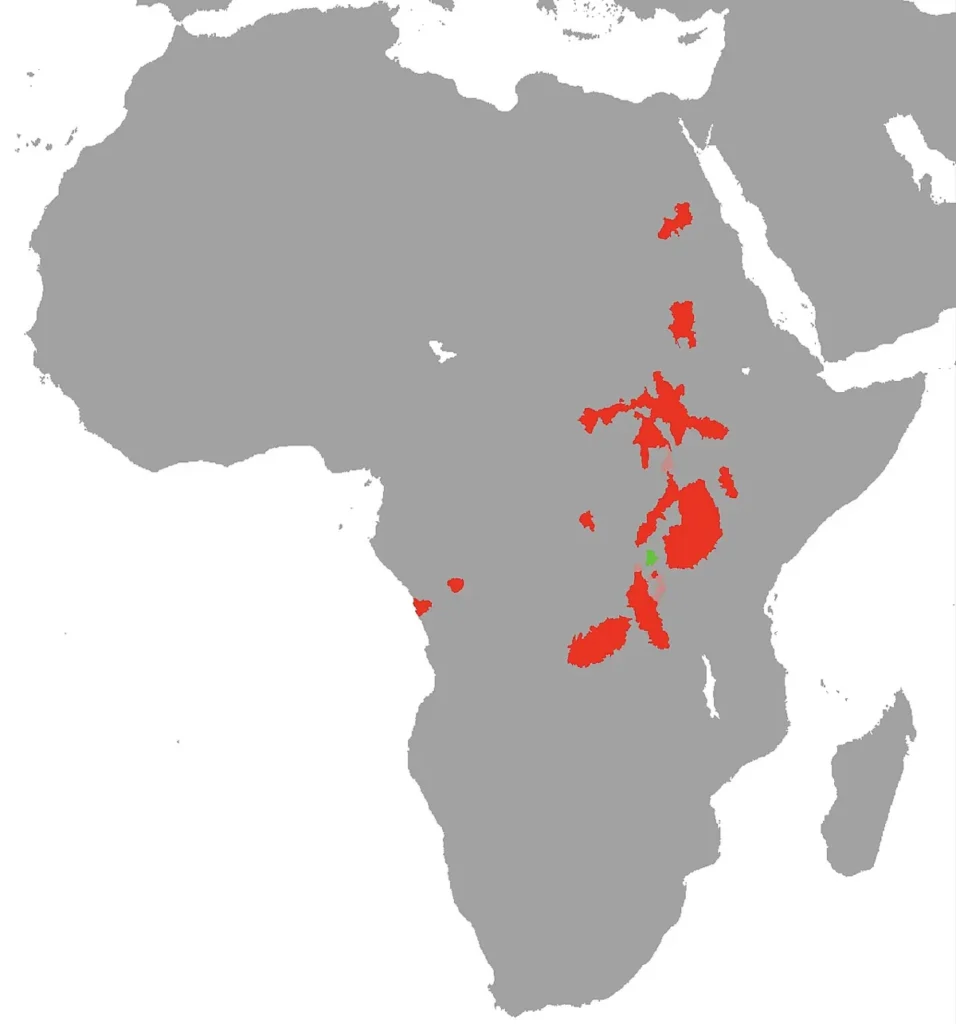
African lungfish are found throughout Uganda’s swampy and slow-water habitats: Lake Victoria’s papyrus edges, the Albert Nile floodplains, the swamps of western Uganda, and wherever shallow, oxygen-poor water allows their air-breathing adaptation to function as a competitive advantage. They are most commonly encountered through their surfacing behaviour — a slow, deliberate roll to the surface, the nostrils briefly above water, then a return to depth. At Mabamba Swamp, where shoebill trekking brings visitors into the papyrus on canoes, watching a lungfish surface and the shoebill’s response provides one of the most direct wildlife ecology moments available in Uganda.