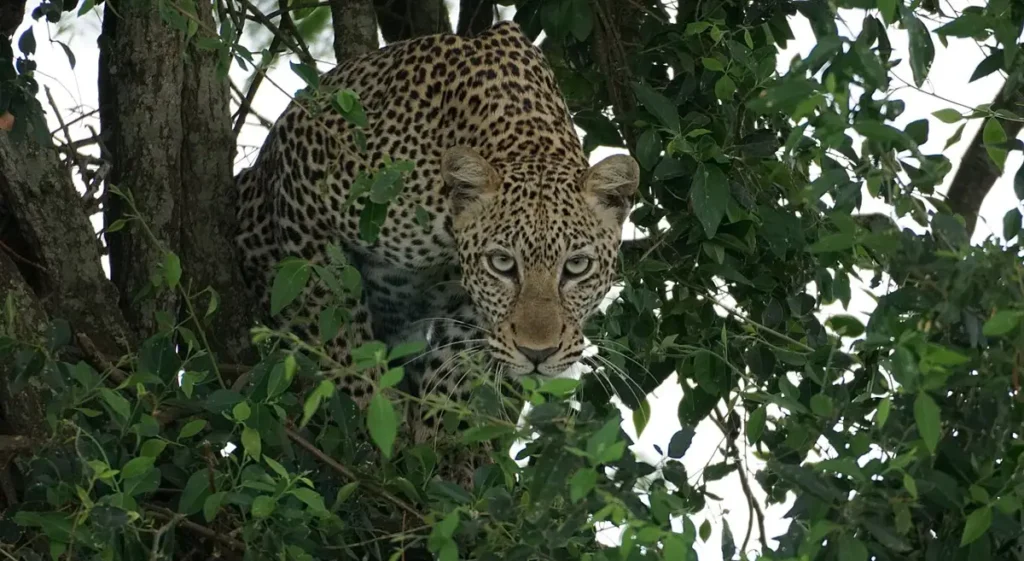
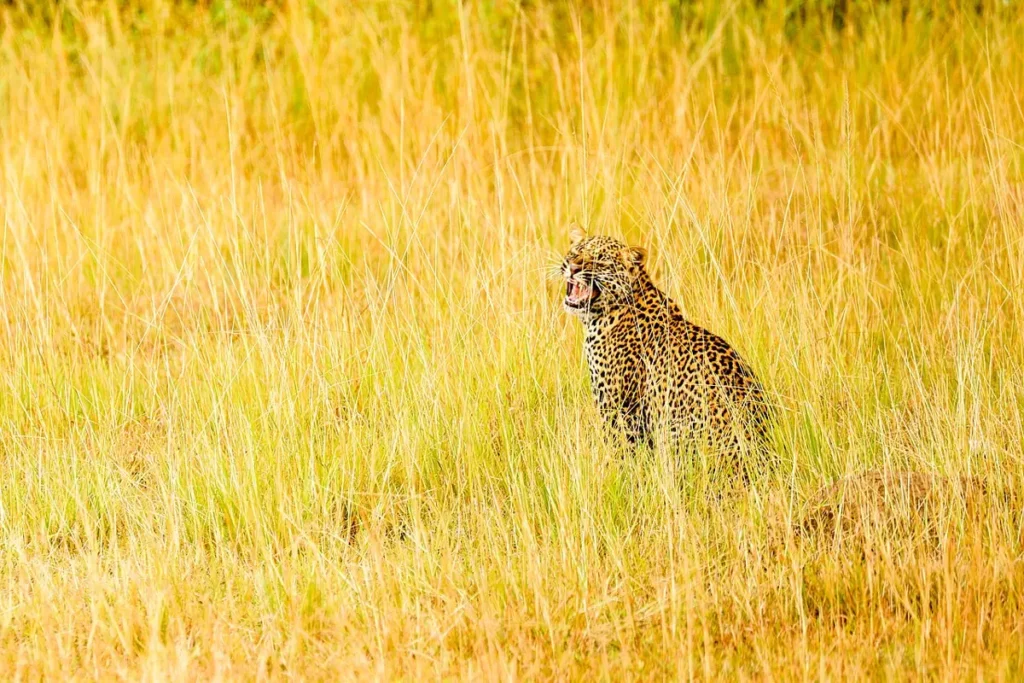
Of Africa’s five big cats, the leopard is the one most likely to make you feel watched without seeing it. Perfectly camouflaged, primarily nocturnal, and deeply solitary, the African leopard has evolved over millions of years into a creature so adept at concealment that experienced guides estimate you pass unseen leopards far more often than you see them. Uganda has a healthy leopard population, and with the right knowledge and timing, an encounter is possible — though never guaranteed, which is part of what makes it extraordinary when it happens.
African Leopard: Species Overview
The African leopard (Panthera pardus pardus) is the largest of the nine leopard subspecies and one of the most widely distributed large carnivores on the continent. Adults typically weigh between 30 and 70 kilograms — males considerably heavier than females — with body lengths of 1 to 1.9 metres excluding the tail. The tail itself is long and heavy, used for balance when climbing.
The coat pattern of rosettes — dark spots arranged in clusters around a lighter centre — provides near-perfect camouflage in dappled light. In forests, this pattern makes a leopard effectively invisible at twenty metres. In open savanna, the animal disappears in tall grass. Melanistic individuals (black leopards, often called panthers) occur rarely in Africa and are more common in Asian subspecies.
Nocturnal Habits and Hunting Behaviour
Leopards are primarily active between dusk and dawn, though daytime activity occurs — particularly in areas with low human pressure. They are ambush predators, relying on stealth and proximity rather than speed. A leopard typically approaches prey to within five or ten metres before launching an explosive short-distance charge. The kill is made with a bite to the throat or back of the skull.
What distinguishes leopards from other large cats is what happens after the kill. Leopards habitually carry prey up into trees — sometimes hoisting animals larger than themselves — to avoid losing kills to lions, hyenas, and wild dogs. A leopard in a tree with an impala carcass draped over a branch is one of the iconic images of African wildlife, and Uganda’s savanna parks offer the chance to see exactly this.
Prey and Diet
Leopards are the most generalist large predators in Africa. They eat virtually anything they can catch — Uganda kob, impala, warthog, baboon, hyrax, mongoose, birds, reptiles, and fish when accessible. This dietary flexibility is a major reason leopards have survived across such a wide range of habitat types, from dense rainforest to semi-arid savanna. In areas where large prey is scarce, leopards thrive on smaller mammals. In areas of intense competition with lions, they shift their hunting focus toward prey too small for lions to bother with.
Where to Find Leopards in Uganda
Queen Elizabeth National Park is Uganda’s most reliable leopard location. The Kasenyi Plains in the northern sector and the Ishasha region in the south both hold resident leopard populations. The animals are seen most often in the early morning and late afternoon, when they move between hunting grounds and resting sites. A dawn game drive across the Kasenyi Plains offers a realistic chance of encountering a leopard returning from a night’s hunt, sometimes still with prey.
Murchison Falls National Park also has leopards, though sightings are less frequent due to the density of the vegetation in much of the park. Kidepo Valley National Park in Uganda’s remote northeast holds a strong and relatively undisturbed leopard population — encounters there are reported with reasonable consistency, particularly on night drives. Bwindi Impenetrable Forest has leopards in its interior, though forest leopard sightings are rare anywhere in Africa.
Night Drives and Leopard Sightings
Night drives, where permitted by national park regulations, dramatically increase the chances of leopard encounters. Most Uganda national parks restrict night driving, but Kidepo Valley NP allows it, and some private conservancies bordering the parks offer night game drives. A leopard caught in a spotlight — eyes reflecting amber in the beam, body low against the ground — is a sighting that rewires your understanding of what the African night contains.
Leopard Ecology and Territory
Leopards are solitary and territorial. Male territories are large — up to 80 square kilometres in areas of low prey density — and overlap with the smaller territories of several females. Males and females interact only to mate, after which the female raises cubs alone. Litters typically contain two to three cubs, born after a three-month gestation. Cubs remain with the mother for up to two years, learning hunting techniques before establishing their own territories.
Territorial communication is achieved through scent marking — urine, gland secretions, and scratch marks on trees — and through a distinctive sawing cough vocalization that carries far through the night. Hearing a leopard call in the dark, in a national park where the only light is stars, is an experience that bypasses rational thought entirely.
Conservation in Uganda
Leopards are classified as Vulnerable globally, though they remain more widespread than lions or cheetahs. In Uganda, the main threats are habitat loss at park boundaries, conflict with farmers when leopards prey on livestock, and retaliatory killing. Uganda Wildlife Authority works with communities bordering the parks on livestock protection measures and compensation schemes designed to reduce the incentive for retaliatory killing.
The leopard’s talent for invisibility is both its greatest asset and the reason its conservation status is difficult to assess accurately. Population estimates remain uncertain. What is clear is that Uganda’s national parks provide viable habitat, and leopards continue to thrive in them — watching, from the trees and the shadows, with those amber eyes that see everything while revealing nothing.