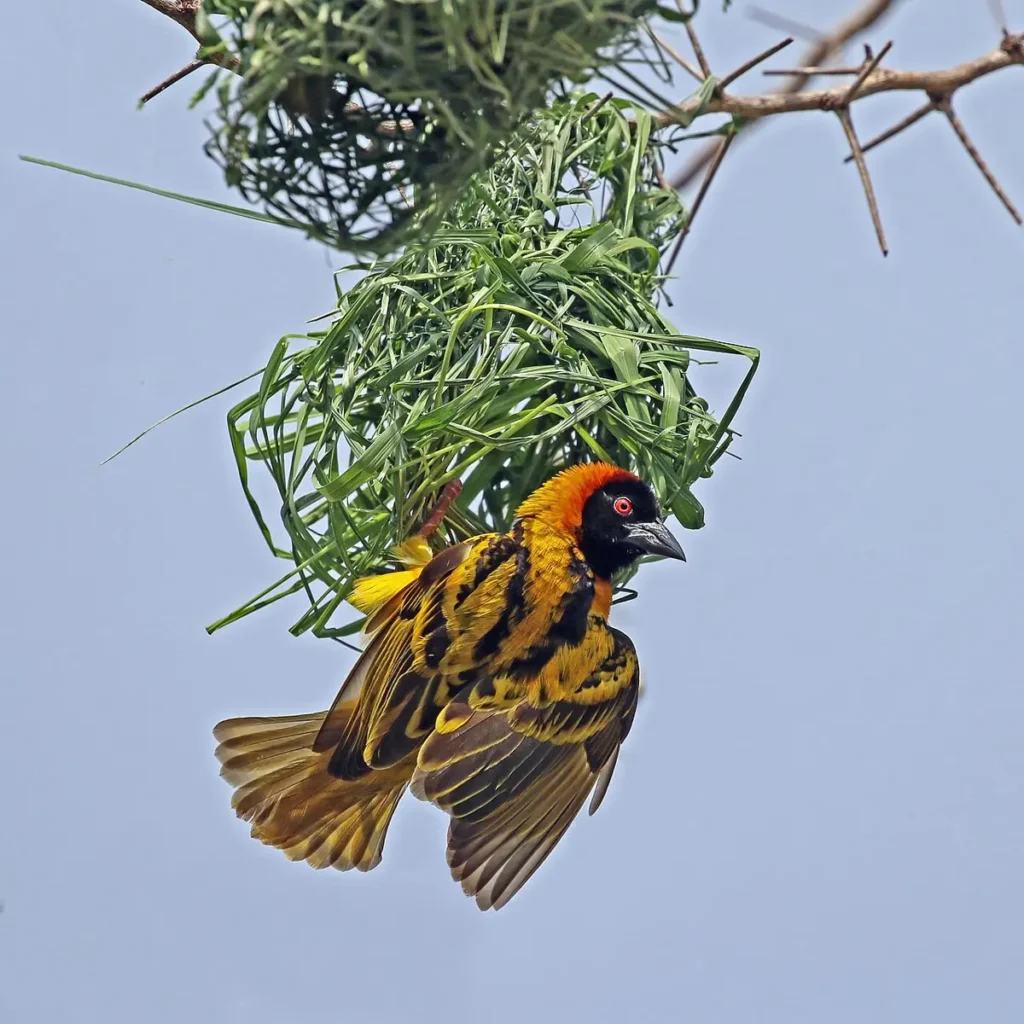
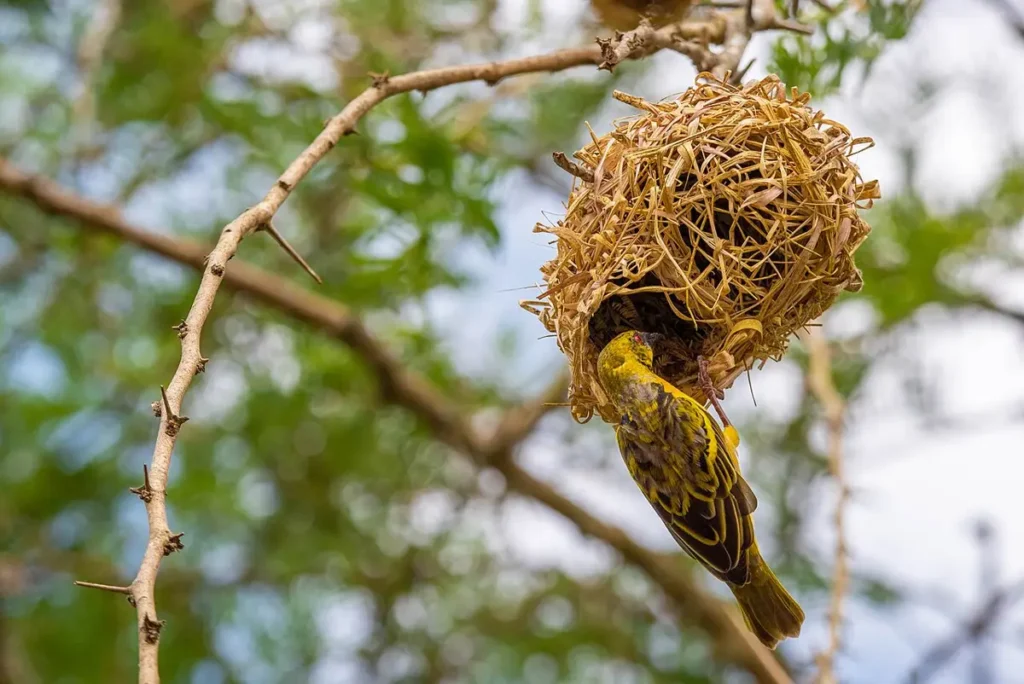
The weaverbirds — family Ploceidae — are among the most immediately visible birds in the Ugandan countryside, and their nests are architectural achievements that invite attention from anyone who pauses at a roadside tree to look. The highland areas around Bwindi and Lake Bunyonyi support multiple weaver species, and the sight of a tree festooned with dozens of intricately woven globular nests, each the work of a single male attempting to attract a mate, is one of the small daily spectacles available to any visitor who travels with eyes open between the lodge and the trekking departure point.
The nest as a mating signal
Male weaverbirds build nests not primarily to house eggs — the female decides whether a nest is acceptable — but to demonstrate their construction competence to potential mates. A female weaver inspects a completed nest with thoroughness, testing the entrance tube, checking the interior quality and assessing the overall structural integrity. Nests that fail inspection are dismantled by the male and rebuilt; some males dismantle and rebuild multiple nests in a breeding season, each attempt an iteration toward the structure that will finally satisfy a female and earn the right to breed. The evolutionary result is nest construction ability so refined that the finished products are genuinely extraordinary feats of engineering by any avian standard.
Weaver species around Bwindi and Lake Bunyonyi
The villages and cultivated areas between Bwindi and Kabale support several common weaver species. The black-headed weaver (Ploceus cucullatus) is ubiquitous in hedgerow trees and gardens, its bright yellow body and black head making it unmistakable. The spectacled weaver (Ploceus ocularis) is shyer, found more in forest edge habitats. The lesser masked weaver (Ploceus intermedius) occurs in drier areas. Around the shores of Lake Bunyonyi, where reed beds and papyrus fringe the water, the compact weaver and various other species associated with wetland habitats add diversity. The altitude and moisture of the southwest highlands creates a combination of weaver habitats not found in Uganda’s drier northern regions.
Colony nesting and the tree colony spectacle
Black-headed weavers are highly colonial — hundreds of pairs may nest in a single tree, creating a visual spectacle of suspended nests and a constant chorus of chattering, chattering, wing-fanning males in breeding plumage. The trees selected for colonies are typically over water or at the ends of thin branches — locations that make access by snakes and climbing predators difficult. Some colony trees in the farmland around Bwindi hold nests from multiple successive breeding seasons; the accumulation of old nests over years, gradually darkening and weathering while new green nests are woven alongside, creates a layered record of colony use that can extend decades. Guides who know the local roads can usually identify reliable colony trees visible from the vehicle.
How weaver nests are constructed
Weaver nest construction begins with the male selecting a suitable branch and stripping fresh green grass blades or palm leaflets. He attaches these to the branch with a series of knots and loops — real knots, pulled tight with the bill, not simply twisted — and builds outward from this attachment point. The nest’s basic spherical structure is completed in one to two days of intensive work; the entrance tube, hanging below the main chamber, is added subsequently. The completed nest is waterproof, well-insulated and structured with an inner chamber that maintains a temperature noticeably warmer than the outside air. The construction technique — using knots — is unique among birds and has been studied by ornithologists interested in the cognitive demands of sequential, planned construction behaviour.
Weavers in Ugandan cultural and everyday life
Weaverbirds are deeply familiar presences in Ugandan daily life — visible in every village, known by multiple local names in different language groups, and their nest-weaving behaviour referenced in proverbs and folk explanations across the country. Their willingness to nest near human habitation means they are among the most observed wild birds in Uganda. Children grow up watching male weavers build and display; the female’s critical inspection of the male’s work is a behaviour so conspicuously parallel to human social assessment that it is frequently used by Ugandan storytellers as a comedic illustration of domestic dynamics. For visitors interested in the cultural dimensions of wildlife in Uganda, weaverbirds are a rich topic that any local guide will engage with warmly.