TALK TO AN EXPERT +256 716 068 279 WHATSAPP OPEN NOW.
Wildlife Beyond Gorillas

Silverback gorillas: leadership, family protection, and what makes them remarkable

Home / Travel News, Stories & Tips / Tales from the Mist / Silverback gorillas: leadership, family protection, and what makes them remarkable

The silverback is the undisputed centre of a mountain gorilla family group. His grey-backed fur — the silver that gives him his name — is not merely a visual marker of age but a statement of status visible from a distance in the dense forest, a living advertisement of his maturity and the authority he carries. Understanding the silverback’s role in gorilla society — the responsibilities he bears, the relationships he maintains, the behaviours through which he exercises leadership — transforms what visitors see during the gorilla trekking hour from an impressive wildlife encounter into a window onto one of nature’s most sophisticated social systems.

The transition to silverback

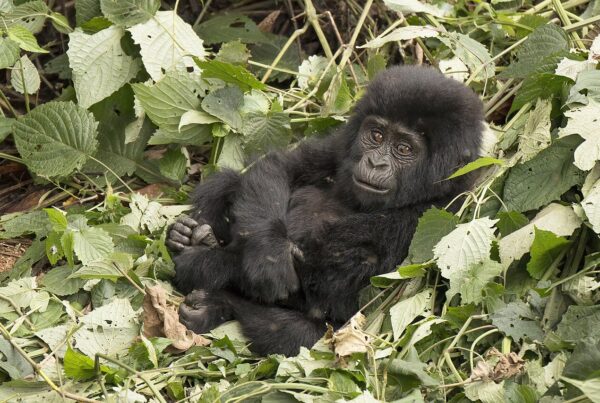
Male mountain gorillas follow a developmental trajectory that takes approximately twelve years to reach full silverback status. Infant males are born weighing approximately 1.8 kilograms and develop rapidly in the first years of life under their mothers’ close care. At around three to four years, as mothers resume cycling and become pregnant again, young gorillas enter the juvenile stage — still closely affiliated with their mothers but increasingly independent in movement and play.

At approximately eight years, males enter the blackback stage — young males who have reached near-adult size but have not yet developed the silver saddle that marks full maturity. Blackbacks occupy a socially ambiguous position in established groups: larger and more powerful than juveniles but subordinate to the silverback, with limited reproductive access and often peripheral social positioning. The blackback stage is a period of significant learning — observing how the dominant silverback manages the group, how he responds to challenges, and how he navigates the complex social dynamics of a multigenerational family.

The silver saddle begins to appear on male gorillas’ backs at approximately eleven to thirteen years, spreading from the lumbar region upward and outward until it covers the entire back by age fifteen or so. This greying is driven by hormonal changes and is accompanied by continued physical development — silverbacks continue growing until their mid-twenties, when they reach their full adult weight of 180 to 220 kilograms. A mature silverback is typically twice the weight of an adult female and one of the most physically powerful animals on earth relative to body size.

The silverback’s social role

The silverback’s primary social role is protection of the family group. This protection encompasses multiple dimensions: defence against external threats including predators (primarily leopards for infants and juveniles), rival silverbacks from other groups seeking to poach females, and human intrusions; mediation of internal conflicts between group members; and provision of group cohesion through the gravitational pull of his presence.

Gorilla groups do not forage as a coordinated unit with the silverback directing movement in the way that some social animal species do. Rather, the group follows the silverback as individuals voluntarily stay close to him, and he in turn makes movement decisions that the group implicitly adopts. When the silverback begins to move in a direction, the group moves. When he settles to rest, others settle nearby. The social fabric of the group is held together by this consistent orientation toward a single dominant individual whose decisions are trusted rather than contested.

Conflict mediation is a less visible but important aspect of the silverback’s role. Within a gorilla group, conflicts between individuals — competition for food, social disputes between females, interactions involving juveniles — occur regularly. The silverback intervenes in serious conflicts, using his physical presence and vocalisations to separate combatants and restore order. His intervention is typically sufficient without physical force — the authority of a 200-kilogram silverback is such that his movement toward a conflict typically resolves it before contact is made.

Reproduction and paternity

In groups with a single dominant silverback — the majority of mountain gorilla groups in Bwindi — the silverback fathers virtually all offspring born into the group. His monopoly on reproductive access is enforced through a combination of physical dominance over any subordinate males present and through active mate guarding of receptive females. Female gorillas cycle approximately every twenty-eight days when not pregnant or nursing, and the silverback monitors female reproductive status carefully, increasing proximity and attention to receptive females.

The silverback’s investment in offspring extends beyond simple paternity. He is an active participant in the lives of the infants and juveniles in his group, tolerating their play and physical contact with a patience that is one of the most endearing aspects of gorilla behaviour to human observers. Juveniles regularly play on silverbacks, climb on their backs, and engage in physical contact that would be remarkable from any other large primate. The silverback’s tolerance — and sometimes apparent amusement — during these interactions reflects the strength of his parental bond and the security that his presence provides to younger group members.

The chest beat: display behaviour explained

The silverback’s chest beat — the most iconic behaviour associated with mountain gorillas — is a complex display with multiple communicative functions rather than a simple aggression signal. The full display sequence typically includes: standing erect, throwing vegetation in the air, running on all fours with vegetation, chest beating with cupped hands to produce the distinctive hollow resonance, and crashing through vegetation. The sound carries considerable distances through the forest and is immediately recognisable.

Research on chest-beating in gorillas has revealed that the beat frequency and acoustic characteristics of an individual’s chest beat are consistent over time — functioning as an acoustic signature that other gorillas in the area can identify. The chest beat can serve as a territorial advertisement (announcing the silverback’s presence and location to potential rivals), as a response to perceived threats or disturbances, and as a communication within the group that can signal excitement or the initiation of movement. It is not exclusively an aggressive display — silverbacks have been observed chest-beating during playful interactions and in what appear to be contexts of social excitement.

For gorilla trekking visitors, a silverback chest beat during the trekking hour is one of the most visceral and memorable wildlife experiences available anywhere. The sound, the physical scale of the display, and the sudden stillness that follows all combine to produce a moment of genuine wildness that bypasses intellectual processing and registers directly at a more primitive level. The correct response — crouching, avoiding eye contact, remaining still — is both the safe and the respectful response, and following the guide’s lead is essential.

Succession: what happens when a silverback dies

The death or incapacitation of a group’s dominant silverback is one of the most destabilising events that can occur in gorilla social structure. In groups with multiple silverbacks, a second male may assume leadership — but this transition is often contested and may involve serious fighting between potential successors. In groups with a single silverback and no other mature males, the death of the silverback often causes the group to fragment, with females and juveniles dispersing to join other groups or, in some cases, being incorporated into an invading male’s group through what can be a violent takeover.

Infanticide by incoming males is documented in gorilla populations and represents one of the most tragic consequences of silverback death. A new silverback who takes over a group may kill unweaned infants sired by the previous male, causing the infants’ mothers to resume cycling more rapidly and become receptive to the new dominant male. This behaviour is adaptive from the new male’s genetic perspective but devastating from the perspective of individual animals and their caregivers.

Long-lived, stable silverbacks who maintain group cohesion over many years create conditions in which infants grow up in safety, subordinate males learn effective leadership through observation, and females choose the group as a reliable protective environment in which to raise offspring. The most successful silverbacks in terms of reproductive output and group stability are often those whose careers span decades — a testament to the long-term value of individual expertise, social intelligence, and consistent leadership in one of nature’s most sophisticated social systems.

Ready to experience Uganda’s mountain gorillas in 2026? Secure your gorilla permits early and let us craft a seamless safari tailored to your travel style, preferred trekking sector, and accommodation level. From luxury lodges to well-designed midrange journeys, every detail is handled for you. Every itinerary is carefully planned to maximize your time in the forest while ensuring comfort, safety, and unforgettable encounters.

Have questions about gorilla permits, travel dates, or the best itinerary for you? Speak with a safari expert and get clear, honest guidance to plan your trip with confidence.

When is the last time you had an adventure? African Gorillas!!! Up Close With Uganda’s Wild Gorillas Touched by a Wild Gorilla: An Unforgettable Encounter Inside Gorilla Families: Bonds, Hierarchies & Jungle Life Face to Face With a Silverback: The Wild Encounter You’ll Never Forget