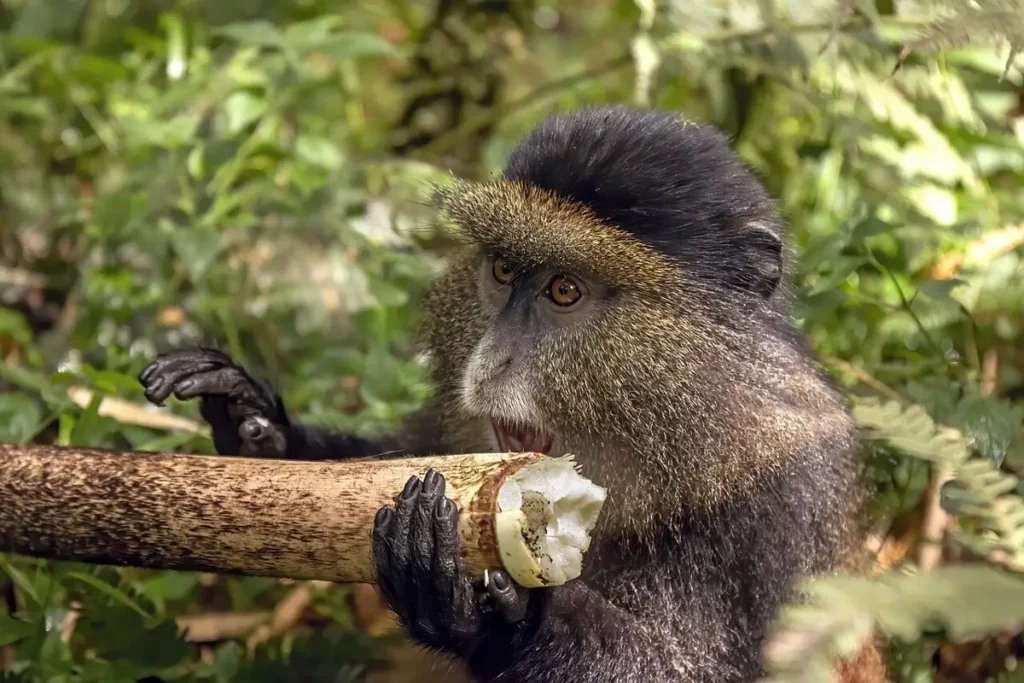
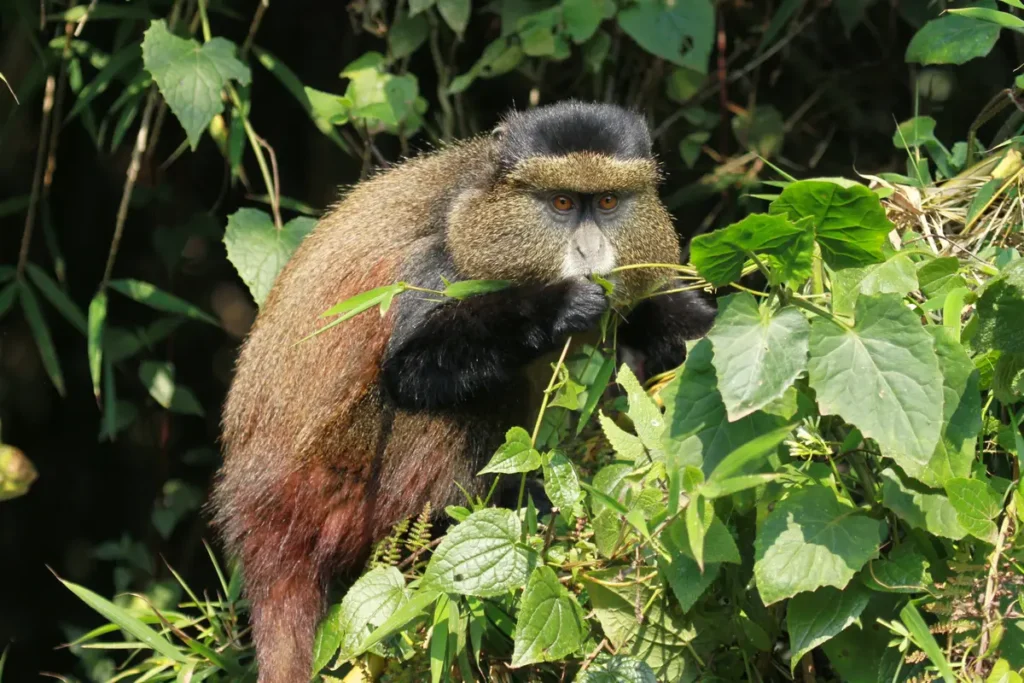
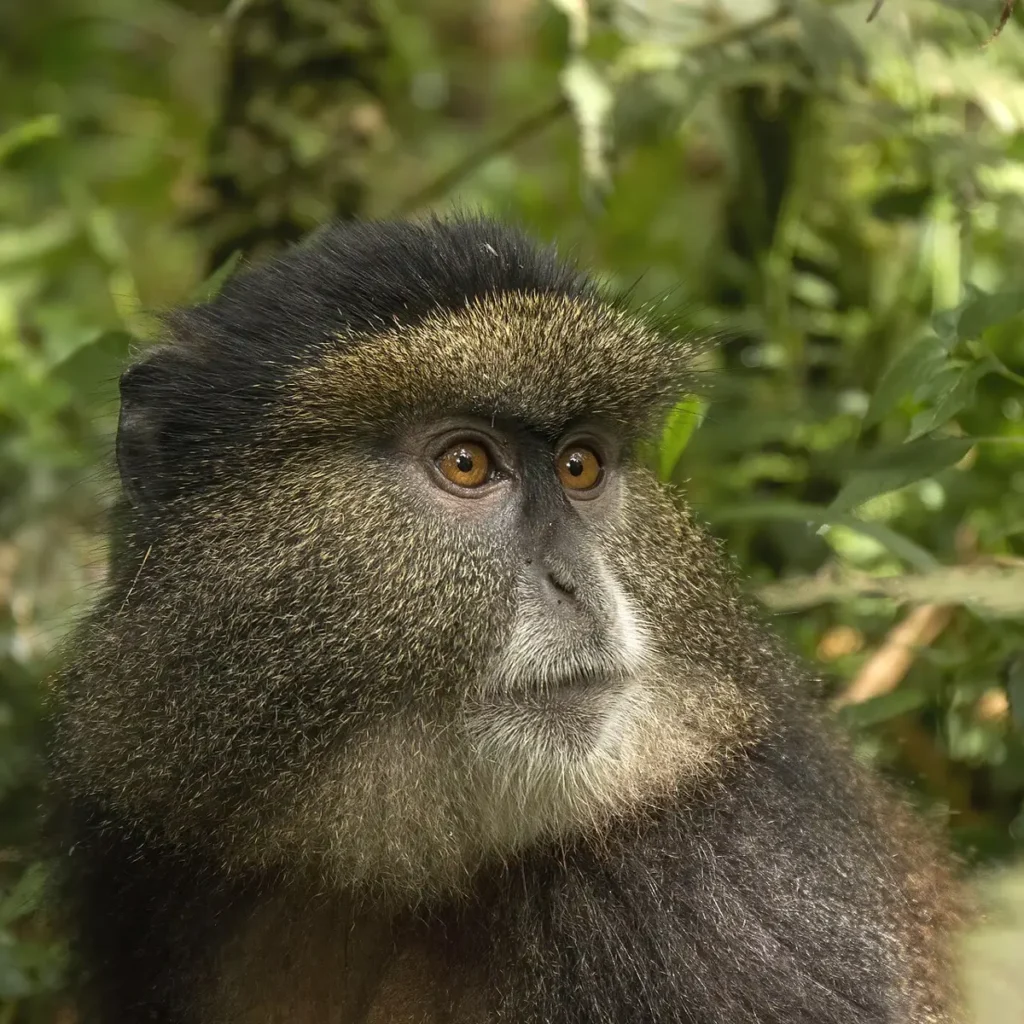
Mgahinga Gorilla National Park is best known as one of Uganda’s two mountain gorilla trekking destinations, but it holds a second primate encounter that many visitors overlook entirely: the golden monkey. Found only in the Virunga volcanic chain that spans Uganda, Rwanda, and the Democratic Republic of Congo, the golden monkey is one of the most visually striking primates in Africa. Its vivid orange-gold flanks, black cap, and bright white face patches make it unmistakeable in the bamboo forest that covers Mgahinga’s middle slopes.
Golden monkey tracking is permitted in Mgahinga and in Rwanda’s Volcanoes National Park. The Uganda experience through Mgahinga is considerably less visited than the Rwandan equivalent, which means smaller groups, more personal encounters, and a more intimate forest experience. For visitors combining a Uganda gorilla trek with other primate encounters, the golden monkey tracking at Mgahinga represents a genuinely distinctive addition to any itinerary.
What is a golden monkey
The golden monkey (Cercopithecus kandti) is a subspecies of the blue monkey, endemic to the Virunga Mountains and the Gishwati Forest in Rwanda. It was classified as a distinct subspecies in the 1990s after genetic analysis confirmed its separation from other blue monkey populations. Its current conservation status is Endangered under the IUCN Red List, with an estimated population of approximately 3,000 to 4,000 individuals across its restricted range.
The defining characteristic is the colouration that gives the species its name. The back and flanks display a vivid golden-orange patch of fur that contrasts with the jet-black limbs, crown, and tail. The face is framed by white or pale grey fur. Adults weigh between three and five kilograms, making them medium-sized monkeys considerably smaller than the primates they share the forest with — gorillas, chimpanzees, and l’Hoest’s monkeys all vastly outsize them. Their size and agility make them spectacular subjects in motion as they leap through bamboo stands at speed.
The bamboo forest: golden monkey habitat in Mgahinga
Golden monkeys inhabit the bamboo zone of the Virunga mountains, which in Mgahinga occupies the slopes between approximately 2,200 and 2,800 metres above sea level. This bamboo forest is a distinct ecosystem different from the hagenia-hypericum forest that mountain gorillas prefer at slightly higher elevations. The bamboo grows densely, its tall hollow stems creating a cathedral-like canopy that filters light into shifting green columns. Golden monkeys feed heavily on bamboo shoots, particularly young shoots that emerge after rainfall, and supplement this with bamboo leaves, fruits from the forest edge, and insects.
The bamboo zone creates a specific photography environment. The vertical lines of the bamboo stems create natural frames for animal portraits. The filtered green light gives images a characteristic warm-cool contrast. When a troop of golden monkeys descends from the canopy to feed on new shoots at ground level — which happens regularly — the encounter brings them to eye level in a way that few primate experiences achieve.
How tracking works in Mgahinga
Uganda Wildlife Authority rangers habituated two golden monkey groups in Mgahinga National Park through a process similar to gorilla habituation. Rangers accompanied the groups daily for several years until the monkeys became tolerant of human presence at close range. Today these groups are tracked daily, with visitors joining rangers and guides for the encounter.
Golden monkey tracking permits cost USD 60 per person as of 2024 — considerably less than gorilla or chimpanzee permits. Groups are typically limited to eight visitors per session. Morning departures from Ntebeko visitor centre begin at 07:30. The trek to the bamboo zone takes between thirty minutes and ninety minutes depending on where the group has been located that morning by park scouts who track movements before tourists depart.
Once the troop is found, the behaviour unfolds quickly. Golden monkeys do not have the slow, deliberate movement of gorillas. They are acrobatic and fast, moving through bamboo in leaping bounds that cover considerable distances in seconds. The habituated troops at Mgahinga are comfortable enough with human presence to continue normal feeding and social activities, but they move constantly through the bamboo. Good photographs require tracking the troop as it moves, anticipating where individuals will emerge, and shooting quickly when clear views present themselves.
Golden monkey habituation experience
Like the chimpanzee habituation experience at Kibale, Mgahinga offers a golden monkey habituation programme that allows visitors to spend a full day with a community still in the process of becoming comfortable with human presence. This experience provides four to six hours with the troop compared to the standard one-hour tracking permit, and it involves genuine fieldwork rather than a structured tourist encounter.
The habituation experience permit costs USD 100 per person. Participants walk with a research team and observe not just the animals but the documentation process — recording group composition, feeding behaviour, movement patterns, and social interactions. For visitors interested in conservation science as well as wildlife observation, this programme provides a rare window into the ongoing research that underpins primate conservation in the Virunga ecosystem.
Group dynamics and behaviour to watch for
Golden monkey groups in the Virungas range in size from twenty to eighty individuals, though the habituated groups in Mgahinga are typically smaller. Within a group, the social structure is multi-male, multi-female with a loose dominance hierarchy among adult males. Affiliative behaviour — mutual grooming, play between juveniles, mothers nursing infants — is visible throughout the encounter.
The most dramatic behaviours are feeding and territorial. When a fruiting bamboo patch is found, multiple individuals converge rapidly and there is vocal competition for the best positions. The sounds of a golden monkey group in active feeding are surprisingly loud — a combination of soft contact calls, higher-pitched alarm notes, and the percussive crack of bamboo being broken. Adult males occasionally chase each other in short bursts that cover the full height of the bamboo stand in seconds.
Infants are the most engaging subjects for most visitors. Golden monkey infants cling to their mothers for the first three to four months of life, gradually becoming more independent as they develop. By six months, juveniles are making short exploratory leaps away from their mothers, fumbling landings and recovering with the elastic resilience of the very young. Watching infant development within the group is one of the most appealing aspects of a full-day habituation experience.
Photography tips for golden monkeys
Golden monkeys present different photography challenges than mountain gorillas. Where gorillas are large and often stationary, golden monkeys are small and constantly moving. A telephoto lens of 300mm or longer is ideal for isolating individual animals against the bamboo background. The bright colouration of their flanks means they are easily distinguishable from the background, but their speed requires continuous autofocus tracking to keep them sharp during motion.
The bamboo forest light is typically low to moderate. ISO settings between 1600 and 3200 are commonly needed. Shutter speeds of at least 1/500 second are necessary to freeze the animals in motion; 1/800 to 1/1000 second is more reliable when they are leaping between bamboo stems. Burst shooting mode is valuable because individual frames in a burst capture the animal at different points in a leap; the best frame may be second or third in the sequence rather than the first.
Combining golden monkeys with gorilla trekking in Mgahinga
Most visitors to Mgahinga are there primarily for the gorilla trek. Combining a gorilla trekking permit with a golden monkey permit on consecutive days is the standard approach. On day one, trek the gorillas in the high forest above the bamboo zone. On day two, track the golden monkeys through the bamboo. Both experiences begin at Ntebeko visitor centre and are booked through Uganda Wildlife Authority.
The combined Mgahinga experience has a different character from Bwindi — the park is smaller, the facilities fewer, and the visitor numbers lower. For travellers who prefer a quieter, less commercialised experience, Mgahinga rewards the slight extra effort of planning around it. The golden monkey tracking adds dimension to a visit that might otherwise feel like a single-day destination.
Conservation status and threats
The golden monkey’s Endangered status reflects the restricted range and habitat fragmentation that threaten the species. The Virunga volcanic chain is one of the most densely populated rural areas in Africa; forest clearance for agriculture continues to reduce the bamboo zone that the species depends on. Disease transmission from humans and domestic animals represents an additional risk, as it does for all primate species with small populations and no immunity to common human pathogens.
Tourism revenue directly supports the Uganda Wildlife Authority ranger presence in Mgahinga that protects both the gorillas and the golden monkeys. Every golden monkey tracking permit purchased contributes to the salaries of the scouts, researchers, and rangers who monitor both habituated groups daily and who patrol against snaring and forest encroachment. The relatively modest cost of a golden monkey permit delivers conservation impact per dollar that compares very favourably with the higher-priced gorilla permit.