Life at Altitude: The Challenge and the Solution
Mountain gorillas inhabit some of the coldest environments occupied by any primate outside of humans. Bwindi Impenetrable National Park sits at elevations ranging from 1,160 to 2,607 metres above sea level, and the gorillas living in its higher zones experience temperatures that can drop to near freezing at night and average 7 to 15 degrees Celsius year-round. This is not savannah-warm primate habitat — it is chilly, fog-wrapped montane forest where cold, moisture, and rugged terrain are daily realities. Understanding the specific adaptations that allow mountain gorillas to thrive in this environment reveals the sophistication of their evolutionary heritage.
Thermoregulation: The Long Fur Advantage
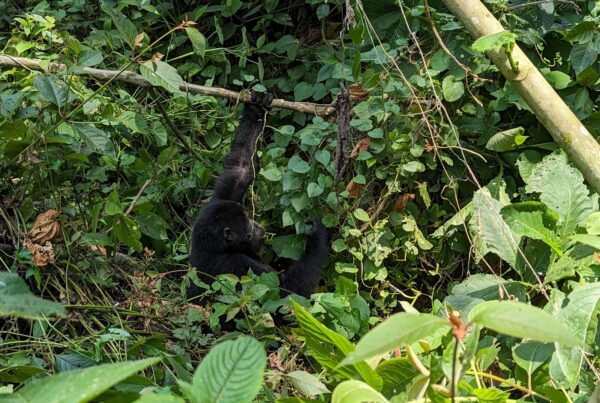
The most immediately visible adaptation of mountain gorillas to their cold highland habitat is their fur — longer, thicker, and darker than any other gorilla subspecies. Mountain gorilla hair typically reaches 5 to 10 centimetres in length, significantly longer than the 2 to 5 centimetres typical of eastern or western lowland gorillas. The coat has a dual-layer structure: a dense undercoat of shorter, fine hairs that trap a layer of warm air against the skin, and longer outer guard hairs that shed water and provide additional insulation.
The dark colouration of mountain gorilla fur maximises solar heat absorption during the periods when sunlight penetrates the forest canopy — one of the reasons gorillas spend time sunbathing in forest clearings and canopy gaps during the midday rest period. Dark fur absorbs more solar radiation than lighter fur, converting sunlight to body warmth effectively in an environment where metabolic heating is expensive in caloric terms.
Behavioural Thermoregulation
Alongside their physiological adaptations, mountain gorillas use behavioural strategies to manage cold. Huddling — close physical contact between group members during cold periods — conserves body heat through shared surface area and reduces the heat gradient between each individual and the surrounding air. Infant gorillas benefit most from this: their small body size gives them an unfavourable surface area to volume ratio for heat retention, and the continuous body contact with their mothers during the first year of life is as much a thermoregulatory requirement as a social bond.
Construction of dense night nests, as discussed separately, is another thermoregulatory behaviour: the insulating platform of bent vegetation reduces heat loss to the ground surface by conductance. Gorillas also modify their activity patterns in cold weather, reducing movement and energy expenditure during the coldest periods.
Anatomical Adaptations: Body Proportions and Mass
Mountain gorillas are larger-bodied and more heavily muscled than their lowland counterparts — a pattern that follows Bergmann’s Rule, the ecological principle that endotherms in colder climates tend toward larger body size because larger bodies have lower surface area to volume ratios and thus lose heat more slowly. The compact, barrel-chested build of mountain gorillas — particularly silverbacks — maximises the ratio of heat-generating mass (muscle and organ) to heat-losing surface (skin).
Their limb proportions also reflect cold-climate adaptation. Shorter extremities relative to body size reduce heat loss from poorly insulated distal limbs — a pattern seen in cold-adapted humans and other cold-climate mammals. While mountain gorillas retain the long arms essential for their ecology, their overall limb:trunk ratio is slightly more compact than that of lowland gorillas.
Dietary Adaptations for Cold Conditions
The mountain gorilla’s dietary ecology is adapted to the plant communities available in highland montane forest. The vegetation of Bwindi and the Virungas differs substantially from lowland forest — less fruit diversity, more abundant herbaceous undergrowth, different tree species composition. Mountain gorillas have evolved digestive systems and food preferences calibrated to these highland plant communities.
The high cellulose content of the leaves and stems that form the bulk of the mountain gorilla diet is processed by specialised hindgut microbiomes that produce volatile fatty acids through fermentation — a low-quality food strategy that works effectively with the abundant, if low-calorie, vegetation of highland forest. Their massive molars and powerful jaw musculature are adapted for processing tough, fibrous vegetation that would be mechanically challenging for less powerfully built herbivores.
Immune System Adaptations
Living in cold, moist forest with dense vegetation creates specific pathogen challenges. Mountain gorillas’ immune systems show adaptation to the specific pathogen community of highland montane forest — including respiratory pathogens that thrive in cold, damp conditions, and gastrointestinal parasites specific to their habitat. However, their immune profile also reflects the relatively low pathogen diversity of high-altitude environments compared to lowland tropical forest, which means mountain gorillas may be more vulnerable to novel pathogens (such as those introduced by human contact) than lowland gorilla subspecies with more diverse pathogen exposure histories.
The susceptibility of mountain gorillas to human respiratory viruses — a major conservation concern — is partly a function of their cold-climate adaptation. Respiratory diseases are among the most common causes of mountain gorilla mortality, and the cold, damp conditions of highland forest may make respiratory infections more severe than equivalent infections would be in warmer, drier environments.
Cognitive and Behavioural Flexibility
Perhaps the most sophisticated adaptation to cold highland life is cognitive: the capacity for flexible, learned responses to environmental challenges. Mountain gorillas adjust their foraging strategies, nest sites, and group movement in response to weather and season, demonstrating environmentally responsive behaviour that goes beyond fixed instinct. The transmission of these flexible responses through social learning — young gorillas observing and learning from experienced adults — means that the population’s collective knowledge of how to survive in their specific environment is continually updated and transmitted across generations.
Final Thoughts
Every aspect of the mountain gorilla — from its long, dense fur to its barrel-chested build, its dietary preferences, and its social thermoregulatory behaviour — reflects millennia of evolutionary refinement for life in cold highland forest. When you watch a silverback sitting contentedly in morning mist at 2,000 metres, apparently unbothered by temperatures that would have most tropical animals retreating, you are watching adaptation expressed. The mountain gorilla is not merely surviving in its cold highland home. It is built for it.
Frequently Asked Questions
The two dry seasons offer the easiest trekking: June to September (the main peak) and December to February. Trails are firmer, rain gear is less critical, and visibility in the forest is better. April, May, and November are wet but beautiful — lush, green, fewer visitors, and UWA offers discounted permits ($600 FNR) during these months.
Rain makes forest trails muddy and the ascent/descent more physical, but gorilla trekking is not cancelled due to rain. Gorillas are present year-round — in fact, wet season gorillas are often less mobile and stay lower in the forest, which can make sightings easier. Waterproof hiking boots and a rain jacket are essential regardless of season.
Bwindi sits at 1,600–2,600m altitude, giving it a cool, mist-shrouded climate year-round. Daytime temperatures during the trek: 15°C–22°C. Evening temperatures at the lodges: 8°C–14°C. It can feel cold after dark, especially at Ruhija sector (2,300m+). Pack warm layers for evenings regardless of season.
No. Bwindi’s altitude keeps temperatures comfortably cool year-round. The forest canopy provides shade throughout the trek. Heat and dehydration are not typical concerns — carrying sufficient water (1.5–2 litres) matters more for hydration than temperature management.
Uganda is home to the mountain gorilla (Gorilla beringei beringei), one of two subspecies of eastern gorilla. They live exclusively in the Virunga volcanic highlands (Uganda/Rwanda/DRC) and Bwindi Impenetrable Forest (Uganda only). Mountain gorillas are the only gorilla subspecies that cannot survive in captivity — every individual you can trek is a wild animal.