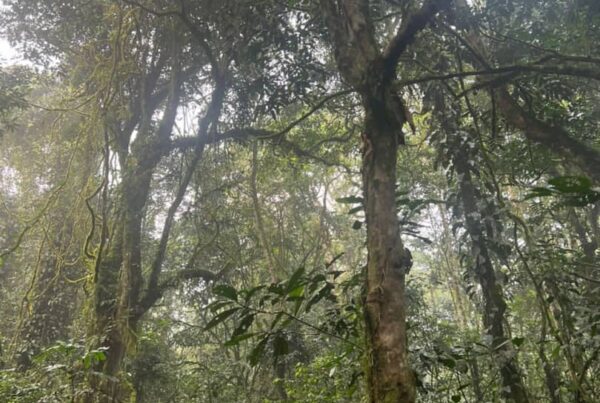
Walk through different sections of Bwindi Impenetrable Forest and you will notice that the vegetation changes dramatically with altitude and aspect. On the lower slopes, a dense mixed forest of broad-leafed trees, lianas, and shade-tolerant understory plants gives way, at higher elevations, to a different kind of landscape: one dominated by tall, hollow-stemmed grass that stands in dense thickets, rustling in the mountain wind. This is the bamboo zone, and it represents one of the most significant seasonal food resources for mountain gorillas in Bwindi and the broader Albertine Rift forests.
What is bamboo?
Bamboo is not a tree but a grass — the largest and most structurally complex member of the Poaceae family. The bamboo present in Uganda’s montane forests, including Bwindi and the Virunga Volcanoes, is primarily Arundinaria alpina (highland bamboo, also classified as Yushania alpina), a high-altitude species native to the Afromontane forest belt of East and Central Africa. It grows at elevations between 2,000 and 3,500 metres, forming pure or near-pure stands that can extend across many hectares of mountain slope.
A bamboo culm — the individual stem — consists of a series of hollow internodes separated by solid nodes. The culm grows from a rhizome (underground stem) and reaches its full height of up to ten metres within a single growing season. Unlike trees, which add growth rings year after year, a bamboo culm reaches its maximum height in months and then gradually toughens and matures over subsequent years without growing further. New culms emerge from the rhizome system each rainy season, providing fresh growth while older culms persist for several years.
Bamboo shoots and gorilla diet
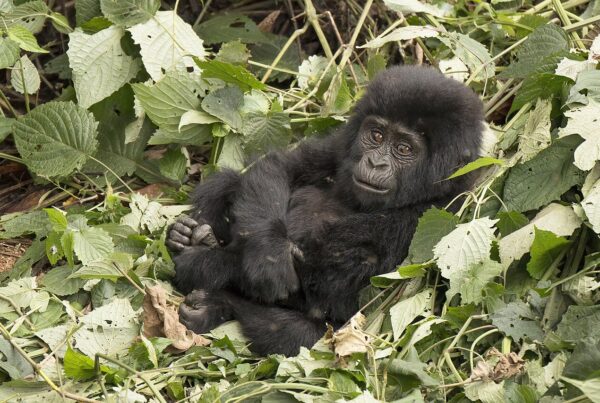
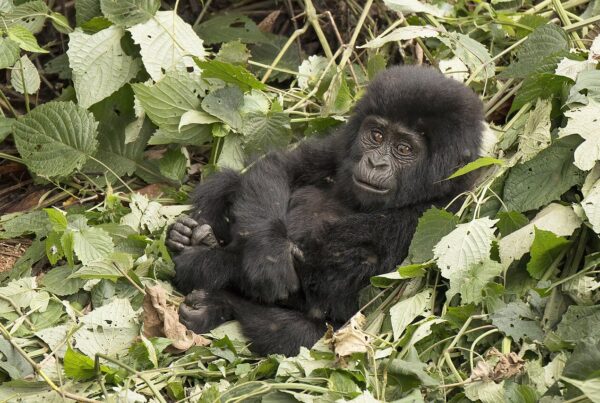
The bamboo shoot — the new culm as it pushes through the soil surface in the early weeks of the wet season — is one of the most nutritious foods available to mountain gorillas, and they seek it out with focused intensity during the short window when it is available. Bamboo shoots are rich in protein (significantly higher protein concentration than mature bamboo culm), low in structural carbohydrates compared to fibrous leaves, and high in water content. For large-bodied primates whose digestive systems are adapted to process high-fibre plant material, bamboo shoots represent an unusually rich food source.
Research on gorilla ranging behaviour in both Bwindi and the Virungas has documented clear seasonal shifts in range use tied to bamboo shoot availability. During the shoot season — typically corresponding to the onset of the long rains in Uganda, approximately March to May — gorilla families in areas with bamboo access may spend the majority of their time in the bamboo zone, moving methodically through the stands and stripping shoots as they emerge. Family groups that normally occupy lower-altitude mixed forest may make seasonal excursions to higher bamboo zones during this period.
Mature bamboo culm and leaves are also eaten year-round by gorillas, though they are less nutritionally dense than shoots. The structural fibre of bamboo culm requires significant chewing and digestion time. Gorillas eating mature bamboo typically split the culms and consume the softer interior tissue rather than the tough outer surface. Watching a gorilla consume bamboo — the methodical splitting, stripping, and chewing of culm sections — is one of the more distinctive feeding behaviours visible during the gorilla hour.
Bamboo distribution in Bwindi
Bwindi Impenetrable Forest has less extensive bamboo coverage than the Virunga Volcanoes, where bamboo constitutes a major proportion of the higher-altitude vegetation. In Bwindi, bamboo is found primarily in the higher-elevation sections of the forest, particularly in the Ruhija sector (which operates at the highest elevations of any Bwindi trekking sector — roughly 2,200 to 2,400 metres) and in parts of the Rushaga and Nkuringo sectors that access higher ground.
The gorilla families that range in higher-altitude Bwindi sectors have more regular bamboo access than those in the lower Buhoma sector, which is dominated by mid-altitude mixed forest. This affects dietary composition across the park: Ruhija sector gorillas consume more bamboo as part of their diet than Buhoma sector gorillas. Researchers using stable isotope analysis of gorilla hair and dung have been able to quantify these dietary differences between family groups, providing a detailed picture of how the landscape’s vegetation mosaic shapes individual family nutrition.
The bamboo mast flowering phenomenon
Bamboo has one of the most dramatic life history events in the plant kingdom: mast flowering. After decades of purely vegetative growth — reproducing only through rhizome expansion and new culm production — a bamboo stand will synchronously flower, set seed, and die. Every culm in the stand flowers simultaneously, produces a massive seed crop, and then the above-ground biomass collapses. The seeds germinate to form a new generation of plants, but the mature bamboo stand itself is gone.
Arundinaria alpina has a flowering cycle estimated at between 40 and 100 years (the precise interval is not well established due to limited historical observation records in Africa). When a large bamboo stand flowers and dies, it creates a temporary gap in the forest canopy and a collapse of the food resource it represented. This has significant implications for gorilla populations that depend on bamboo: a mast die-off in a major bamboo zone could temporarily reduce food availability for the gorilla families that use that area.
Conservation managers at Bwindi and in the Virungas monitor bamboo stand health as part of vegetation assessments, partly to track the long-term availability of this critical food resource. Climate change is an additional variable — shifts in precipitation timing and temperature could alter the phenology of bamboo shoot emergence, potentially decoupling the shoot season from the timing of gorilla family movements that have evolved in response to historical patterns.
Other bamboo-dependent species in Bwindi
Mountain gorillas are not the only species that depend on bamboo in Bwindi’s ecosystem. Chimpanzees and olive baboons also consume bamboo shoots when they are available. The African golden cat — a rarely seen medium-sized felid present in Bwindi — uses dense bamboo thickets for cover and denning. Various rodent species inhabit the rhizome systems beneath bamboo stands. Several Afromontane bird species are associated with bamboo habitat, including the bamboo warbler (a species found in highland bamboo zones across East Africa) and various sunbird species that feed on bamboo flowers during mast years.
The botanical diversity within and around bamboo stands is also worth noting. The dense shade cast by mature bamboo culms limits understory diversity within pure stands, but the margins of bamboo zones — where bamboo transitions to mixed forest — support high botanical diversity, including many of Bwindi’s medicinal plant species used by local communities and the forest species that provide food for frugivores throughout the year.
On a Ruhija sector gorilla trek, or on a guided forest walk in the higher sections of Bwindi, the transition into the bamboo zone is an unmistakeable shift in landscape character — the light changes, the sound changes, and the tracks and signs of gorilla feeding activity become more concentrated and recent. This is the landscape where the ancient relationship between great apes and grass — played out over millions of years of co-evolution in the African mountain forests — is still visible and alive.
- Mountain bamboo of Bwindi: the grass that feeds and shelters mountain gorillas
- Fig trees of Bwindi: the keystone species that feeds the whole forest
- Bamboo zones of the Virungas: ecology of the golden monkey’s highland habitat
- The fig trees of Bwindi: keystone species and the forest’s feeding calendar
- Fig trees as keystone species: how one plant feeds Bwindi’s whole forest community
- The hagenia-hypericum zone: Bwindi’s high-altitude forest belt explained
- Bwindi Impenetrable Forest – Gorilla Trekking in Uganda’s UNESCO Jungle
- Top Gorilla Trekking Destinations in Uganda – Bwindi vs. Mgahinga 2025
- Gorilla Sex, Reproduction & Breastfeeding Process
- Chimpanzees Confirmed in Bwindi Forest