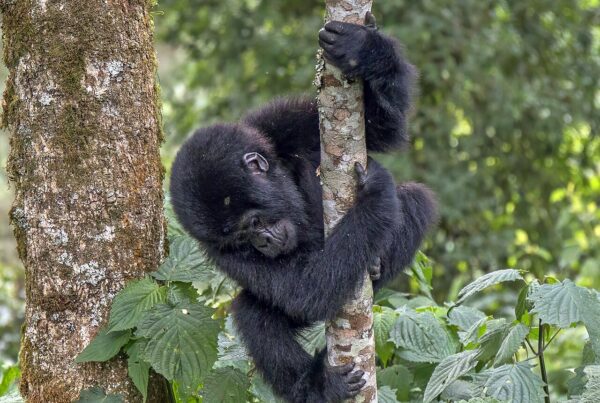
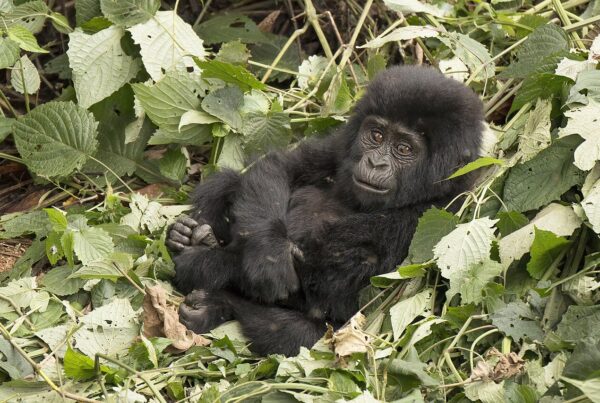
Ian Redmond arrived in the Virunga Mountains in 1976 as a twenty-year-old biology graduate looking for a field research placement. He found Dian Fossey, and stayed. The years that followed — working alongside Fossey at Karisoke, tracking gorillas in the high-altitude forest, navigating the complex politics of conservation in a region that would descend into catastrophic violence less than two decades after his arrival — formed a conservationist whose career has spanned half a century and whose knowledge of mountain gorillas, elephants, and the broader politics of wildlife protection is without parallel among active practitioners in the field.
The Karisoke years
Redmond worked with Fossey at Karisoke from 1976 to 1978, studying the gorilla families and assisting with the anti-poaching operations that consumed an increasing proportion of Fossey’s attention as her conflict with local poaching networks intensified. His specific research contribution during this period focused on gorilla ecology — particularly the mineral-feeding behaviour he observed in both gorillas and elephants, who were known to excavate and consume soil and cave minerals in the Virunga landscape. This behaviour, now understood as geophagy — mineral-supplementation of diet through soil consumption — was not well documented in gorillas at the time, and Redmond’s observations contributed to the scientific record in ways that remain relevant.
The Karisoke period also exposed him directly to the anti-poaching work that defined Fossey’s later career. He participated in snare removal operations, documented the poaching networks operating in the Virungas, and witnessed the personal and organisational tensions that made Fossey’s conservation approach simultaneously effective and controversial. His account of this period — less widely read than Fossey’s own memoir but offering a perspective unavailable in her writing — illuminates the practical and ethical difficulties of early gorilla conservation in a politically complex environment.
Elephant research and the ivory ban campaign
After leaving Karisoke, Redmond’s research interests expanded to include African elephants, and he became one of the key scientific voices in the campaign that led to the 1989 international ban on ivory trade under the Convention on International Trade in Endangered Species (CITES). His research on elephant ecology — particularly his work on the cave-mining behaviour of Mount Elgon elephants in Uganda, who excavate salt from volcanic cave walls using their tusks and trunks — provided both the scientific documentation of elephant intelligence and behaviour and the conservation arguments that supported the ivory ban campaign.
The Mount Elgon elephant cave work, conducted in the 1980s, produced remarkable photographic and scientific documentation of behaviour that had been observed locally but never systematically studied. Elephants entering the dark interior of Kitum Cave, navigating by touch and smell in total darkness, and using their tusks to chip mineral-rich rock from the cave walls — this behaviour, which Redmond documented over multiple years and eventually with colleagues including Mark and Delia Owens — became one of the iconic examples of elephant intelligence used in the public communications campaign for the ivory ban.
Return to gorilla advocacy
Throughout the 1990s and 2000s, Redmond maintained his connection to gorilla conservation through advocacy work with the Born Free Foundation and other organisations, speaking publicly about gorilla conservation needs in the context of the ongoing instability in the DRC and the continuing pressures on the Virunga and Bwindi populations. He was in the Virungas in 1999 when the group of tourists and rangers was attacked by Interahamwe militia — an incident in which eight people were killed, including two American tourists and four Ugandan rangers, in an attack at the Buhoma sector of Bwindi — and his firsthand account of the aftermath provided important context for the international response to the attack.
The 1999 Bwindi massacre had significant short-term effects on gorilla tourism bookings and long-term effects on the security arrangements around Bwindi — leading to increased ranger presence, improved intelligence sharing between Uganda and the DRC, and the eventual development of the security protocols that have kept both visitors and gorillas safe in the decades since. Redmond’s communications work during this period helped to ensure that the incident was understood internationally as a politically motivated attack rather than a reflection of endemic danger to wildlife tourists, and supported the recovery of booking confidence that was essential for the long-term viability of the gorilla tourism economy.
Great Apes Survival Partnership and global advocacy
Redmond has served as an ambassador and chief consultant for the Great Apes Survival Partnership (GRASP), a joint initiative of UNEP and UNESCO that coordinates international conservation efforts for all great ape species across Africa and Asia. This role has taken him into UN climate and biodiversity negotiations, into the political corridors of African governments making decisions about resource extraction and protected area management, and into the media space where public awareness of great ape conservation is shaped.
His approach to conservation communication has consistently emphasised the emotional and empathetic dimensions of the human-great ape relationship — the kinship argument — alongside the ecological and economic arguments. He has spoken extensively about the implications of great ape cognitive research for how we think about conservation obligations, advocating for legal frameworks that recognise great apes as beings with interests deserving protection rather than simply as wildlife resources to be managed.
What Redmond represents for gorilla trekkers
Ian Redmond’s career represents one model for what a lifelong commitment to wildlife conservation can look like: rooted in specific fieldwork with specific animals, extended through research, advocacy, and communication across decades, and sustained by a personal connection to the subject that has never become merely professional. His books, interviews, and public presentations are accessible to non-specialist readers and provide some of the most engaged and informed commentary available on the state of mountain gorilla conservation.
For visitors planning a gorilla trek, reading or watching Redmond’s accounts of his Karisoke years — particularly his recollections of individual gorillas from Fossey’s study groups, several of whose descendants may still be alive in the Virunga families — adds a dimension of historical continuity to the encounter. The gorilla families of Bwindi and the Virungas are not ahistorical wildlife spectacles but communities with decades-long histories, individual personalities that researchers have documented across lifetimes, and connections to the human story of conservation that people like Ian Redmond have dedicated their working lives to understanding and communicating.
- The Guardian Called Uganda Gorilla Trekking the World’s Greatest Wildlife Encounter
- Why Gorilla Trekking in Uganda Is Africa’s Most Unforgettable Wildlife Adventure
- What a 3-Day Uganda Wildlife and Cycling Safari Did to My Family Was Beyond Anything We Expected
- Wildlife in Uganda – Where Nature Still Roars, Hums, and Soars Free
- Why a 2-Day Uganda Wildlife and Cycling Safari Is the Perfect Business Break
- Why Would My Soul Long for a 9-Day Uganda Gorilla Trekking and Wildlife Safari?
- Murchison Falls Uganda Wildlife Safari — 4-Days: Where the Nile Breaks and the Wild Roars
- Wildlife Safaris: What to See, Expect, Prepare & Plan — Plus Where to Go in Africa
- Gorilla Group Formation and Dynamics: The Deep Bonds That Shape Life in the Forest
- Safaris That Offer Unique Wildlife Experiences in Uganda: Beyond the Ordinary