While the World Watches the War, These Travellers Are Quietly Trekking Gorillas in Uganda
A dispatch from Bwindi Impenetrable Forest — where the headlines don’t reach and the silverbacks don’t care.
The Mist Doesn’t Read the News
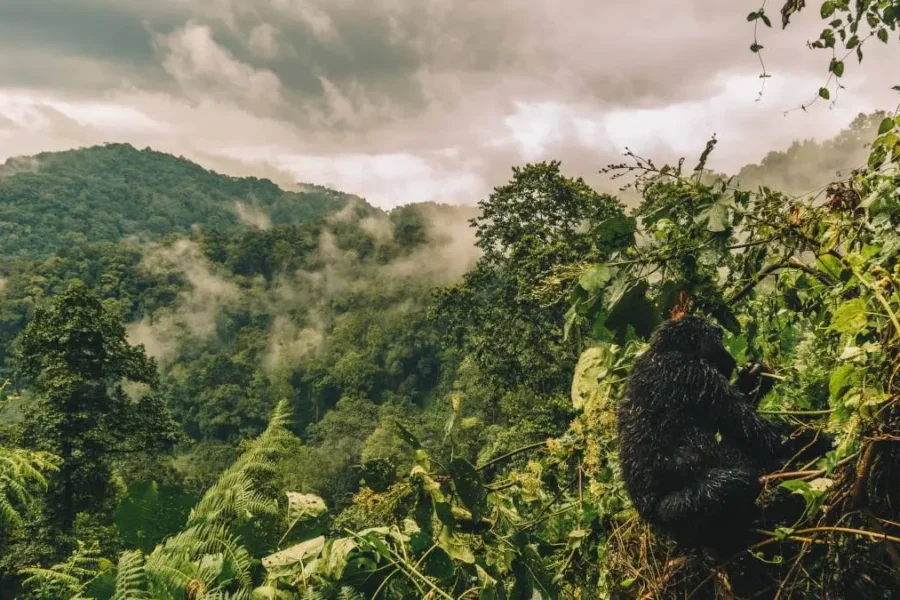
At 6.15 in the morning, the forest above Buhoma is breathing.
The mist sits low on the ridgeline, moving slowly between the mahogany trees like something alive. A hornbill calls from somewhere deep in the canopy. Your boots are already wet from the dew on the grass outside your lodge. Your ranger is ahead of you on the trail, machete in hand, not speaking. There is nothing to say. The forest is saying everything.
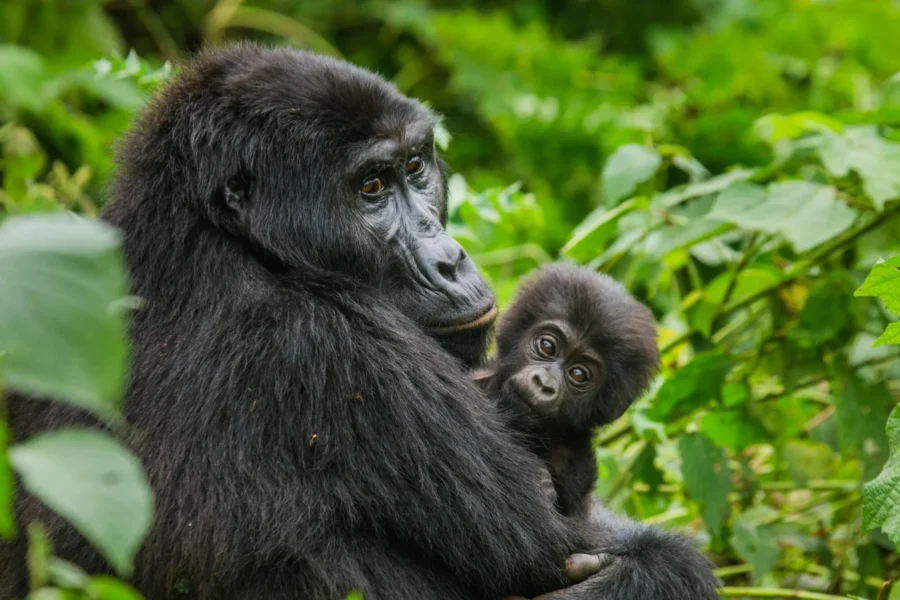
Somewhere in the valley below, a family of mountain gorillas is waking up. A silverback. Three adult females. Two juveniles who yesterday, according to the trackers, spent the afternoon playing in the vines like children on a rope swing. They are there right now, completely unaware of oil prices, missile trajectories, or the rolling ticker at the bottom of a news screen.
And you are here. Which means you made a decision that most people, right now, are too distracted to make.
The world did not stop being beautiful because it also became dangerous in other places.
The Travellers Who Came Anyway
Every week in 2026, a small and quietly determined group of international travellers lands at Entebbe or Kigali, transfers to a lodge at the edge of a rainforest, and walks into Bwindi Impenetrable Forest to spend one hour with mountain gorillas.
They come from London, from Denver, from Sydney, from Berlin. They are retired teachers and company directors and empty-nesters and anniversary couples. Some of them booked a year ago. Some booked three months ago, after checking the advisories, calling their tour operator, and deciding that the news cycle was not a good reason to miss something this rare.
Here is what they found.
| 01 | Couple from Edinburgh, Scotland — Rushaga sector, February 2026
“We almost cancelled three times. Now we can’t stop talking about it.” Booked the 6-Day Double Gorilla Trek. Said the encounter with the Bweza family left them both in tears. |
| 02 | Solo traveller from Chicago, USA — Buhoma sector, January 2026
“I watched a silverback from four metres away. The world felt very small and very large at the same time.” First solo trip to Africa. Chose Uganda after reading safety advisories. Said she would return within the year. |
| 03 | Family of four from Munich, Germany — Nkuringo sector, March 2026
“Our teenagers are not easily impressed. They have not stopped talking about this trip.” Combined gorilla trekking with a Murchison Falls safari. Said Uganda exceeded every expectation. |
These are not exceptional travellers. They are people who did their research and trusted what they found. They are people who decided that a conflict 5,000 kilometres away was not going to cancel the most extraordinary wildlife experience on Earth.
What Actually Happens When You Trek to See Mountain Gorillas
If you have never been, it helps to understand what gorilla trekking actually involves — because the imagination tends to either overestimate the danger or underestimate the emotional impact.
You arrive at park headquarters before 8am. Your ranger briefs your group of eight. You are told where your family was last tracked, how far the walk might be, and what to do when you find them. Then you enter the forest.
The trek itself varies. Some days it is ninety minutes through dense undergrowth before the trackers’ radio crackles and your ranger holds up a fist — stop. Other days the gorillas have moved close to the forest edge overnight and you find them in under an hour.
When you find them, you leave your bags. You approach slowly. You crouch low if you need to. And then you see them.
A silverback sitting with the casual, enormous confidence of something that has never needed to be afraid of anything. A mother nursing an infant no larger than a human baby. A juvenile scrambling up a vine, dropping, scrambling again, completely absorbed in the private comedy of its own entertainment.
You have one hour. The rules are specific: no flash photography, minimum four metres distance, no sudden movement, no eating or drinking in their presence. The rules feel easy to follow because you are not thinking about rules. You are thinking about the fact that you are standing in an ancient rainforest watching an endangered species live its ordinary morning, and that this is one of the most complete moments you have ever experienced.
Nobody has ever stood in Bwindi forest, watched a silverback rest in the morning light, and wished they had stayed home.
Then the hour ends. Your ranger signals. You withdraw quietly. You walk back through the forest in something close to silence, processing what just happened.
Later, over lunch at your lodge, someone in your group will try to describe it and trail off mid-sentence. Not because there are no words. Because the available words are not quite right for the thing you saw.
Why Bwindi Is a World Away From the World Right Now
There is something specific about Bwindi Impenetrable Forest that the name almost captures but not quite.
It is one of the oldest rainforests on Earth — over 25,000 years old, a refuge that survived the ice ages when much of Africa’s forest cover disappeared. It contains more species of trees, birds, butterflies, and primates than almost anywhere else on the continent. It covers 321 square kilometres of ridges, valleys, rivers, and mist.
And it is quiet in a way that feels earned.
There are no roads through Bwindi. No infrastructure beyond the lodges at its edges. The network of mobile communication inside the forest is patchy at best. For the duration of your trek — sometimes two hours, sometimes five — you are genuinely unreachable. The news cannot find you. The notifications cannot find you. The rolling footage of distant conflicts cannot find you.
There is a specific kind of relief that comes from being somewhere the news cannot reach you. Bwindi provides it completely.
The lodges that ring the forest are extraordinary in their own right. From the mid-range comfort of Buhoma Lodge to the elevated luxury of Bwindi Lodge or Sanctuary Gorilla Forest Camp — where your villa sits in the forest canopy itself — the accommodation is designed to deepen the experience rather than distract from it. Fires in the evening. Sounds of the forest at night. Waking before dawn knowing what the morning holds.
This is not an escape from reality. It is a recalibration of it.
The Gorillas You Might Meet
Bwindi is divided into four trekking sectors, each with its own habituated gorilla families. Here is a brief introduction to the world you would be entering.
Buhoma — The Original
The oldest and most established trekking sector, on Bwindi’s northern edge. Families here include the Mubare group — the first ever habituated for tourism in Uganda — and the Habinyanja family. The terrain is steep and beautiful. Accommodation ranges from mid-range to high-end.
Ruhija — The Remote
The highest sector, offering some of the most dramatic scenery in the park. Fewer tourist facilities here, but the sense of genuine remoteness is unmatched. The Oruzogo and Kyaguriro families trek here.
Rushaga — The Richest
The largest sector by number of habituated families. Rushaga is where you are most likely to secure a permit on shorter notice and where the Gorilla Habituation Experience — four hours with a semi-habituated family — is available for those wanting a deeper encounter.
Nkuringo — The Dramatic
On the southern edge of the park, with views towards the Congo and the volcanic peaks of the Virunga range. The terrain here is among the most challenging in the park — and among the most rewarding. The Nkuringo family was one of the first habituated in this sector and has been trekked by visitors for over two decades.
Each sector is its own world. Each gorilla family has its own character. The silverback you meet in Rushaga will not be the same presence as the one in Buhoma. Both will stay with you.
What Else Uganda Holds
The travellers who come to Uganda for the gorillas almost always leave having fallen in love with something else as well.
Uganda is a small country — roughly the size of the United Kingdom — but its ecological diversity is extraordinary. Within a single itinerary you can combine gorilla trekking in Bwindi with chimpanzee tracking in Kibale Forest, game drives in Queen Elizabeth National Park, a boat cruise to watch the hippos along the Kazinga Channel, and an afternoon of quiet at Lake Bunyonyi — one of the most beautiful lakes in Africa, where the terraced hills drop into still water and the pace of life is almost incomprehensibly calm.
Uganda also has the tree-climbing lions of Ishasha — one of only two places in Africa where lions have developed the habit of resting in fig trees. It has Murchison Falls, where the entire volume of the Nile is compressed through a six-metre gap in the rock. It has more bird species than any country in Africa.
A gorilla trek is the reason most international visitors book. Uganda is the reason they want to return.
The Thing About Waiting
Here is a truth about travel that the news cycle obscures: there is never a perfect time.
There will always be something happening somewhere. A conflict, a political tension, an economic uncertainty, a health advisory, a natural disaster in a distant region. The world has always been simultaneously dangerous in some places and breathtakingly beautiful in others. These two things have always coexisted, and they always will.
Mountain gorillas are one of the rarest large mammals on Earth. There are just over 1,000 of them left. They live in three countries. They are accessible to visitors in only a handful of carefully managed locations. The experience of standing in their presence — genuinely in their presence, not behind glass, not on a screen, not in a documentary — is one that a relatively small number of humans will ever have.
The people who have that experience consistently report the same thing: they wish they had done it sooner.
Not one of them has ever said: I’m glad I waited until the world settled down.
The gorillas will not wait for the news to improve. The mist will not wait. The morning in Bwindi will happen with or without you.
The question is only whether you will be there for it.
Start Planning Your Trek
If something in this piece has settled an uncertainty or lit a small fire — that is the right response. Go with it.
Our team is based in Uganda. We arrange gorilla trekking permits, accommodation across all four Bwindi sectors, and complete safari itineraries for solo travellers, couples, families, and small groups. We know the forest. We know the families. We know which sector suits which kind of traveller.
Permits for peak months — July through September and December — are filling. The time to act on the dream is now.