USA–Iran–Israel Conflict Travel Advisory: Why Uganda & Bwindi Remain Green Zone Destinations in 2026
If you are a serious planner — someone who wants official data, not reassurance — this guide is for you.
It covers exactly what the major travel advisory bodies say about Uganda in 2026, how Uganda compares on a global safety scale to other destinations you may have visited, what the conflict means for your flight routing, and an eight-point pre-departure checklist to give you complete confidence before you book.
No vague reassurances. Just facts, sources, and a clear picture of where Uganda sits on the global safety map right now.
1. Understanding Travel Advisory Levels — What the Ratings Actually Mean
Before looking at Uganda specifically, it helps to understand how government travel advisory systems work. Both the US State Department and the UK Foreign, Commonwealth & Development Office (FCDO) use tiered systems that are updated in near real-time based on conditions on the ground.
US State Department — Four Levels
- Level 1 — Exercise Normal Precautions: Lowest advisory. Standard travel destination.
- Level 2 — Exercise Increased Caution: General awareness recommended. Includes France, Germany, Japan.
- Level 3 — Reconsider Travel: Meaningful safety concerns present.
- Level 4 — Do Not Travel: Highest level. Reserved for active war zones and high-threat environments.
UK FCDO — Three Tiers
- No advisory: Normal travel. Standard precautions apply.
- Some parts: Specific regions or activities carry elevated risk.
- Advise against all travel: Highest warning level. Reserved for active conflict zones.
The key point: these systems are designed to distinguish between genuine danger and general caution. A Level 2 or ‘normal precautions’ rating is not a warning — it is a green light with standard awareness.
2. The Advisory Comparison Table — Uganda vs. the Conflict Region
The table below places Uganda in direct context with the countries involved in or adjacent to the current Middle East conflict, as well as familiar Western European destinations for comparison. All ratings reflect publicly available advisory data as of 2026.
| Country / Region | US State Dept Level | FCDO Status | Relevant to Conflict? |
| Israel | Level 4 – Do Not Travel | Advise against travel | Yes – epicentre |
| Iran | Level 4 – Do Not Travel | Advise against travel | Yes – epicentre |
| Lebanon | Level 4 – Do Not Travel | Advise against travel | Yes – regional spillover |
| Jordan | Level 2 – Exercise Caution | Some parts – caution | Adjacent – monitor |
| Egypt | Level 2 – Exercise Caution | Normal precautions | Regional proximity only |
| Kenya | Level 2 – Exercise Caution | Normal precautions | No connection |
| Uganda ✓ | Level 2 – Exercise Caution | Normal precautions | Zero connection |
| Rwanda | Level 1 – Normal Precautions | Normal precautions | Zero connection |
| France | Level 2 – Exercise Caution | Normal precautions | Zero connection |
| Germany | Level 2 – Exercise Caution | Normal precautions | Zero connection |
The picture is unambiguous. Uganda sits at the same advisory level as France and Germany. Rwanda — the entry point many gorilla trekkers use via Kigali — is at Level 1, the safest possible rating.
The conflict zone countries are at Level 4. Uganda is not in the same category, the same region, or the same conversation.
3. What the FCDO Says Specifically About Uganda’s National Parks
The FCDO travel advice for Uganda is detailed at a regional level. For the national parks relevant to gorilla trekking — Bwindi Impenetrable Forest and Mgahinga Gorilla National Park — the FCDO does not advise against travel.
The FCDO notes standard precautions for Kampala and border areas near the DRC and South Sudan. The southwestern national parks, where gorilla trekking takes place, are not flagged with elevated risk.
The FCDO advice makes no mention of the Middle East conflict in relation to Uganda, because there is no connection to make.
If the FCDO had any concern about British tourists visiting Bwindi in 2026, they would say so explicitly. They have not.
4. What the US State Department Says — And What Level 2 Actually Means
Uganda’s Level 2 designation from the US State Department causes some travellers to pause. It is worth understanding exactly what this rating means in practice.
Level 2 — Exercise Increased Caution — is the default rating for the vast majority of the world’s popular travel destinations. It reflects the reality that no country is completely without risk, and that travellers benefit from standard situational awareness.
Countries Currently at Level 2 Alongside Uganda
- France
- Germany
- Italy
- United Kingdom
- Japan
- Australia
- New Zealand
- Kenya
- Tanzania
Uganda’s Level 2 rating is not connected to the Middle East conflict. It relates to standard urban crime awareness and isolated regional border sensitivities — the same categories of general caution that apply to dozens of popular tourist destinations globally.
The State Department’s specific note for Uganda’s national parks does not advise against travel to Bwindi, Mgahinga, or any gorilla trekking region.
5. Flight Safety — Routing, Airspace & What Airlines Are Actually Doing
For planners concerned about flight safety, this section covers the specific routing considerations for Uganda-bound travellers.
Entebbe International Airport
Entebbe International Airport (EBB) remains fully operational. All major international carriers continue scheduled services including Kenya Airways, Ethiopian Airlines, Qatar Airways, Emirates, KLM Royal Dutch Airlines, and British Airways. No carrier has suspended or significantly altered Uganda routes in response to the current conflict.
Airspace & Overflight
Airlines operating routes to East Africa from Europe or North America routinely pass through or near several regional airspace zones. Carrier operations teams monitor airspace restrictions daily and adjust routing accordingly. This is standard operational procedure — not reactive crisis management.
For flights from the UK, Europe, and North America to Entebbe or Kigali, current routing passes clear of the active conflict airspace. Your airline’s operations team is managing this in real time as part of standard protocol.
The Kigali Gateway Option
Many gorilla trekkers enter Uganda via Kigali International Airport (KGL) in Rwanda — particularly those heading to Bwindi’s southern sectors. Rwanda’s Level 1 advisory and Kigali’s well-connected flight hub make this an excellent and fully operational entry option. Multiple European and Middle Eastern carriers serve Kigali without route disruption.
If your airline had safety concerns about routing to East Africa, they would reroute or suspend the service. They have not done either. That is itself a meaningful data point.
6. Travel Insurance — Reading the War Clause Correctly
This is the area where the most confusion exists among planners, and it is worth being precise.
What a War Exclusion Clause Covers
Standard travel insurance policies contain exclusions for losses arising from war or armed conflict. These clauses are designed to exclude cover when the country you are visiting becomes a war zone — not when conflicts occur elsewhere in the world.
Uganda is not a war zone. The war exclusion clause in your policy does not apply to your Uganda gorilla trek because the conflict is not in Uganda.
What to Verify With Your Insurer
- Confirm that the war exclusion is geographically specific to your country of travel
- Ask whether gorilla trekking is covered as an activity under your policy
- Confirm cancellation cover terms — including what counts as a covered reason
- Ask whether the policy covers medical evacuation from a remote national park
- Get the key answers confirmed in writing before you depart
Specialist Gorilla Trekking Insurance
Several specialist travel insurers offer policies tailored to adventure and wildlife travel in Africa. These policies are written with East African trekking in mind and explicitly cover gorilla trekking as an activity. They are worth considering for the clarity and specificity of their cover terms.
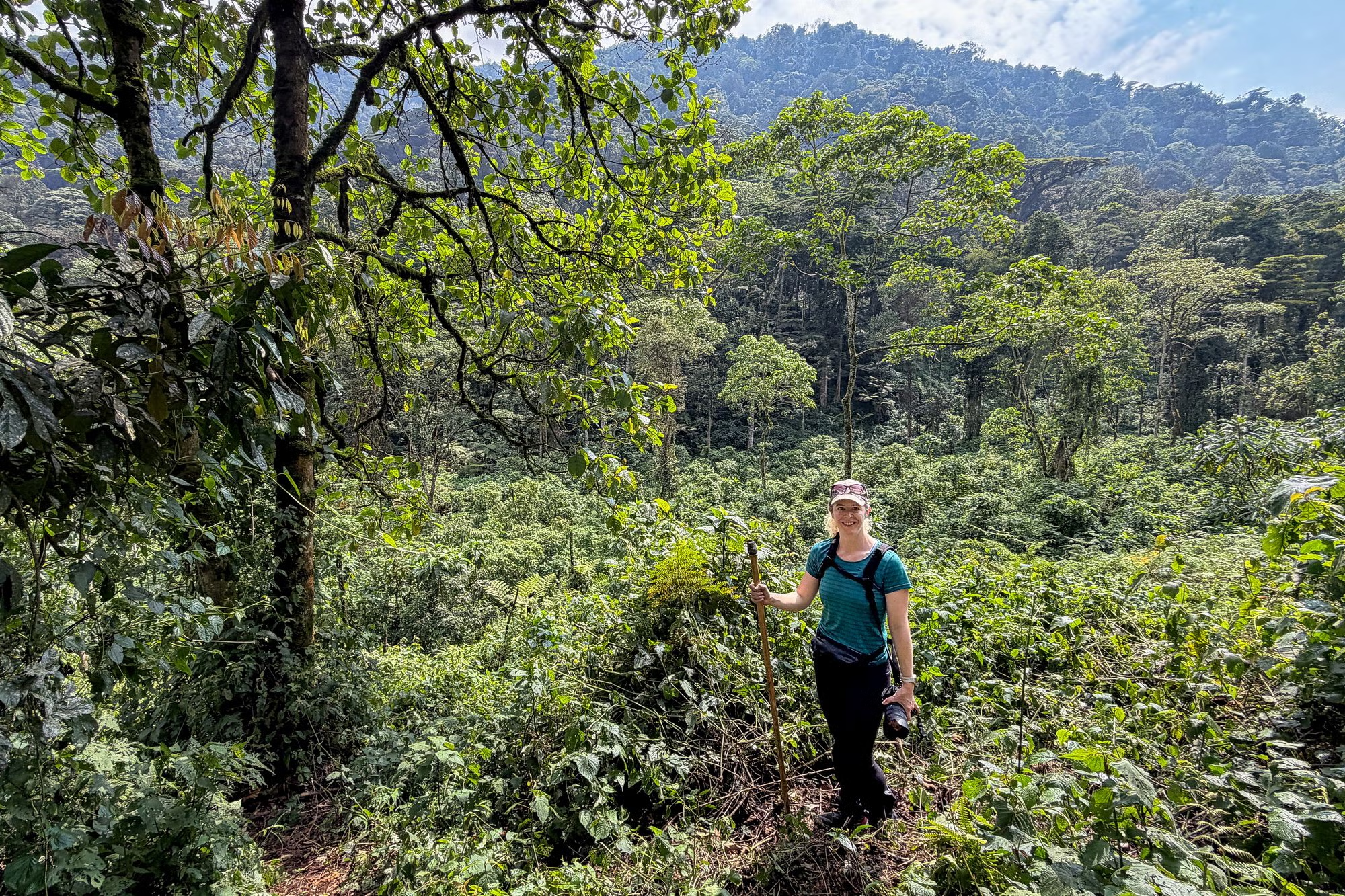
7. On-the-Ground Reality — Bwindi in 2026
Advisory tables and insurance clauses are one layer of the picture. Here is what is actually happening at Bwindi right now.
- All four trekking sectors are open and operational: Buhoma, Ruhija, Rushaga, and Nkuringo
- Uganda Wildlife Authority rangers are conducting daily gorilla tracking and visitor management
- Lodges ranging from mid-range to ultra-luxury are receiving international guests
- Gorilla families are habituated and being visited by permit holders from the UK, USA, Germany, Australia, and across the world
- No security incidents related to the Middle East conflict have been recorded in any national park in Uganda
- Permit availability for 2026 exists — but July through September and December are approaching full capacity
The parks are not quieter because of the conflict. They are continuing as normal — with some permit windows tighter than others because demand for Uganda gorilla trekking has remained strong among travellers who have done their research.
8. Your Pre-Departure Checklist — Eight Steps for Complete Confidence
Use this checklist before finalising your booking or before departure. Each step takes minutes and gives you documented confidence in your decision.
| Action Item | What to Check / Do | |
| 1 | Check FCDO / State Dept advisory | Confirm Uganda remains Level 2 or below — no advisory against travel to parks |
| 2 | Verify your flight routing | Confirm your airline is not routing through restricted Middle East airspace |
| 3 | Review travel insurance war clause | Confirm exclusion applies to country of travel, not global events |
| 4 | Confirm gorilla permit status | Contact UWA or your operator — permits are non-transferable, check cancellation terms |
| 5 | Check lodge cancellation policy | Most reputable lodges offer flexible cancellation — confirm in writing |
| 6 | Register with your embassy | UK: FCDO LOCATE; US: STEP programme — takes 5 minutes, useful precaution anywhere |
| 7 | Download offline maps | Maps.me or Google Maps offline — standard prep for any remote trekking destination |
| 8 | Save emergency contacts | Uganda Wildlife Authority: +256 414 355 000 | Your lodge direct line | Local guide contact |
Complete these eight steps and you will have done more pre-travel due diligence than the vast majority of international tourists heading to any destination in the world. You will also have everything you need to travel with full confidence.
9. The Planner’s Summary — Five Key Facts
- Uganda is at US State Department Level 2 — the same as France, Germany, Italy, and Japan. It has no advisory connection to the Middle East conflict.
- The FCDO does not advise against travel to Uganda’s national parks, including Bwindi and Mgahinga. No park-specific warning has been issued in 2026.
- Flights to Entebbe and Kigali are operating normally. No major carrier has suspended or diverted Uganda or Rwanda routes due to the current conflict.
- Travel insurance war clauses do not apply to Uganda — the conflict is not in Uganda. Verify your specific policy wording with your insurer.
- Bwindi is open, operational, and receiving international guests right now. Permits are available for 2026, but peak months are filling.
Ready to Confirm Your Booking?
If this guide has given you the data you need, the next step is straightforward. Our team is based in Uganda and can give you a real-time, on-the-ground assessment of current conditions — not filtered through a news desk, but direct from the people who work in and around Bwindi every day.