The Deserts of Africa
Africa is often imagined as a continent of jungles and savannas, but deserts define a vast portion of its geography. From the world’s largest hot desert to ancient coastal fog deserts and stark semi-arid zones, Africa’s deserts shape climate, ecosystems, human history, and wildlife survival. These landscapes are not empty wastelands. They are complex environments with unique adaptations, deep cultural histories, and powerful ecological influence.
African deserts stretch across North, Southern, and Eastern Africa, controlling rainfall patterns, migration routes, and even global atmospheric circulation. Understanding them is essential to understanding Africa itself.
Overview: Why Africa Has So Many Deserts
Africa straddles the equator, placing much of the continent under global high-pressure zones where descending air suppresses rainfall. Trade winds, ocean currents, altitude, and continental position further intensify dryness. In some regions, cold ocean currents cool the air so much that rain cannot form, while in others, intense heat evaporates moisture before clouds can develop.
Over millions of years, these forces created some of the most extreme dry environments on Earth. Yet life persists—often in astonishingly specialized forms.
Sahara Desert
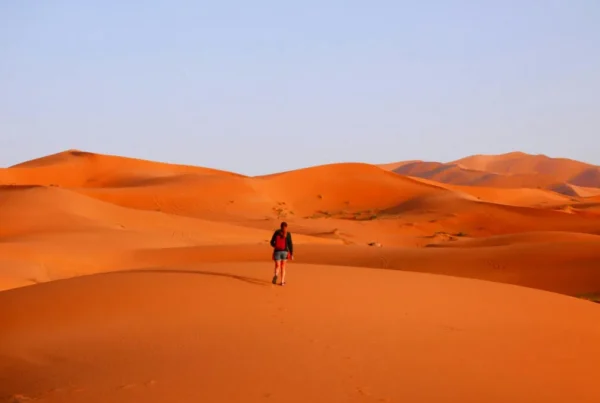
The Sahara is the largest hot desert in the world, covering more than 9 million square kilometers. It stretches across North Africa from the Atlantic Ocean to the Red Sea, spanning over a dozen countries. Contrary to popular belief, the Sahara is not just endless sand. It includes rocky plateaus, gravel plains, dry riverbeds, salt flats, mountains, and occasional oases.
Temperatures in the Sahara can exceed 50°C (122°F) during the day and drop near freezing at night. Rainfall is extremely rare, with some areas receiving no rain for years. Despite this, the Sahara has not always been dry. Archaeological evidence shows that it experienced several “Green Sahara” periods when lakes, rivers, and grasslands supported human settlements and wildlife.
Today, nomadic groups such as the Tuareg have adapted to this harsh environment through deep ecological knowledge, mobile lifestyles, and livestock herding. The Sahara remains a powerful climatic engine influencing weather far beyond Africa.
Namib Desert
The Namib Desert is one of the oldest deserts on Earth, estimated to be at least 55 million years old. It stretches along the Atlantic coast of Namibia and parts of Angola and South Africa. Unlike most deserts, the Namib is shaped more by fog than rain.
Cold ocean currents cool the air above the Atlantic, creating thick fog that rolls inland. Many plants and animals survive almost entirely on moisture from this fog. Iconic species such as the welwitschia plant and fog-basking beetles are found nowhere else on Earth.
The Namib’s towering dunes, some over 300 meters high, are among the tallest sand dunes in the world. Beneath this stark beauty lies a highly specialized ecosystem that depends on precise climatic balance.
Kalahari Desert
The Kalahari is not a true desert in the classic sense, but a semi-arid sandy basin covering Botswana, Namibia, and South Africa. It receives more rainfall than the Sahara or Namib, allowing grasses, shrubs, and scattered trees to grow.
This vegetation supports large populations of wildlife, including antelope, lions, cheetahs, and elephants. The Kalahari is home to some of Africa’s most important conservation areas and migratory systems.
Human history in the Kalahari is ancient. Indigenous San communities lived here for tens of thousands of years, developing remarkable tracking skills and survival strategies. The Kalahari demonstrates that deserts exist on a spectrum rather than as lifeless extremes.
Danakil Desert
The Danakil Desert, located mainly in Ethiopia with extensions into Eritrea and Djibouti, is one of the hottest and most hostile places on Earth. Parts of it lie below sea level, and average temperatures often exceed 35°C (95°F) year-round.
The landscape is shaped by volcanic activity, salt flats, lava fields, and acidic pools. It sits within the East African Rift, where tectonic plates are slowly pulling apart. This makes the Danakil one of the few places on Earth where a new ocean basin is actively forming.
Despite the extreme conditions, Afar communities harvest salt from the desert using traditional methods. Life here exists at the very edge of what biology allows.
Libyan Desert
The Libyan Desert is one of the driest and most extreme sections of the Sahara, covering eastern Libya, western Egypt, and northwestern Sudan. Some areas have recorded decades without measurable rainfall.
Vast sand seas dominate the region, interspersed with isolated oases such as Siwa, which have supported human settlement for thousands of years. The Libyan Desert also contains some of the hottest surface temperatures ever recorded on Earth.
Rock art and ancient lakebeds show that this region once supported wildlife and early human cultures. Today, it stands as one of the planet’s most arid environments.
Nubian Desert
The Nubian Desert lies east of the Nile in northern Sudan and southern Egypt. Unlike the Sahara’s vast sand seas, the Nubian Desert is dominated by rocky terrain and gravel plains.
Rainfall is extremely scarce, but the Nile River provides a narrow corridor of life through this otherwise barren landscape. Historically, this desert played a key role in shaping ancient Nubian and Egyptian civilizations by acting as both a barrier and a resource zone.
Gold mining in the Nubian Desert dates back thousands of years, highlighting its long-standing economic importance despite harsh conditions.
Karoo Desert
The Karoo is a semi-desert region in South Africa, divided into the Great Karoo and the Little Karoo. It experiences extreme temperature variation, with hot summers and cold winters.
Though dry, the Karoo supports unique plant life, especially succulents adapted to limited rainfall. Sheep farming has historically been the main economic activity, shaping both the landscape and settlement patterns.
The Karoo illustrates how semi-deserts can sustain agriculture and biodiversity under careful management.
Life and Adaptation in African Deserts
African deserts are home to extraordinary adaptations. Plants store water, reduce leaf surface area, or grow only after rare rains. Animals avoid heat by being nocturnal, burrowing, or relying on metabolic water from food.
Human communities have also adapted through nomadism, architecture designed for cooling, clothing that protects from sun and sand, and deep ecological knowledge passed down for generations. Deserts are harsh, but they reward those who understand them.
The Role of African Deserts in Global Climate
African deserts influence far more than local environments. Dust from the Sahara fertilizes the Amazon rainforest and affects Atlantic hurricane formation. Desert heat drives atmospheric circulation patterns that shape rainfall across Africa and beyond.
As climate change intensifies, desert boundaries are shifting. Some regions are becoming drier, while others experience unpredictable rainfall. Understanding Africa’s deserts is therefore critical for future food security, conservation, and climate planning.