How Strong Is an Orangutan?
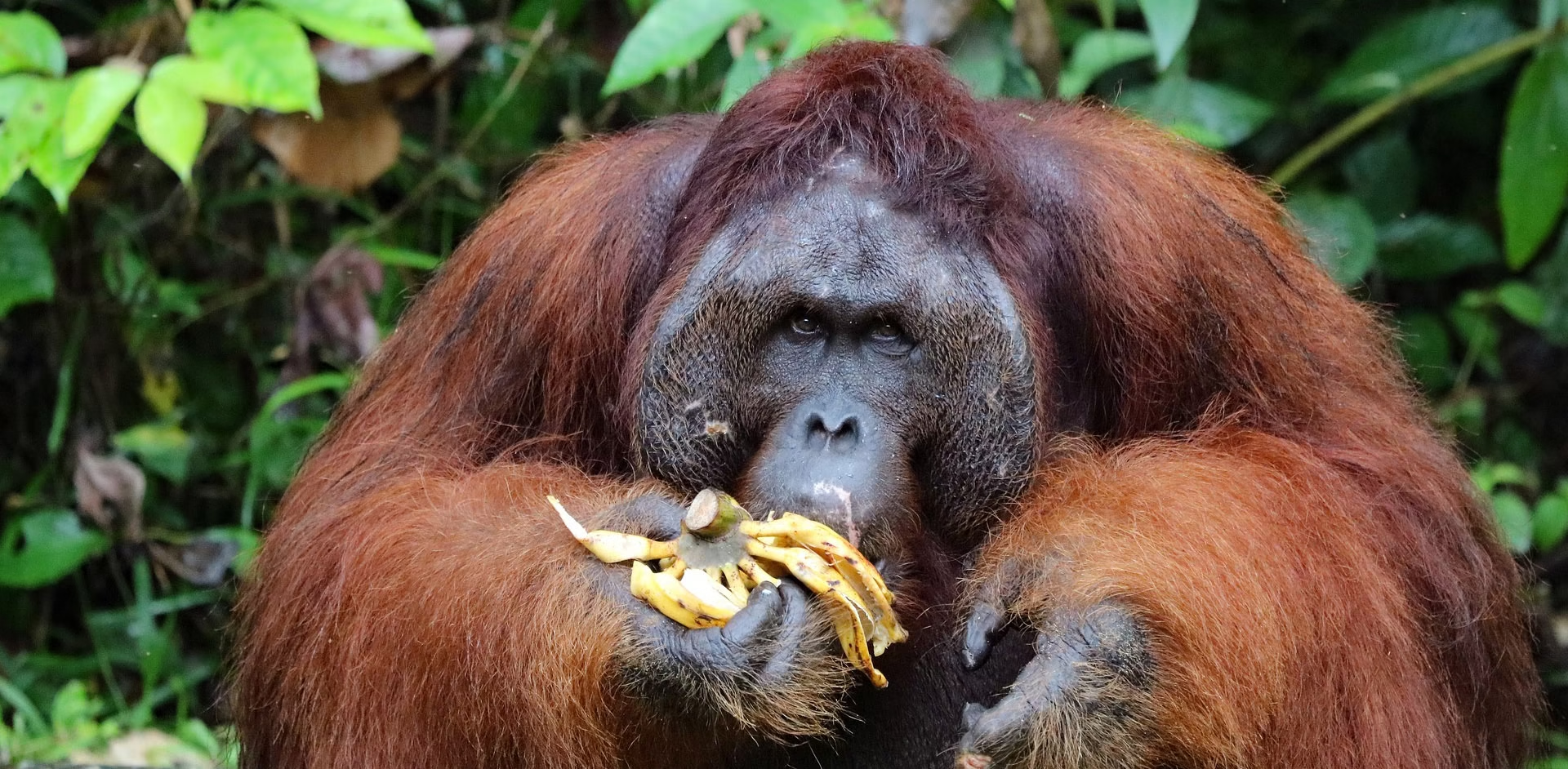
Orangutans are the largest arboreal mammals on Earth, native to the rainforests of Borneo and Sumatra in Southeast Asia. Although they share roughly 97 percent of their DNA with humans, their physical strength far exceeds ours. This difference is not accidental. Orangutan strength is the result of evolutionary pressure to survive, move, and feed almost entirely in the forest canopy, where gravity, balance, and body weight pose constant risks.
Despite their generally calm behavior and slow movements, orangutans possess extraordinary muscular power, particularly in the upper body. Their strength is specialized, efficient, and optimized for pulling, hanging, and controlled force rather than speed or endurance.
Orangutan Size and Body Structure
An adult Orangutan typically stands between 3.5 and 5 feet (1.1–1.5 meters) tall when upright and weighs anywhere from 75 to 200 pounds (34–91 kilograms). Adult human males, by comparison, average 5 feet 4 inches to 6 feet (1.63–1.83 meters) in height and 130 to 200 pounds (59–91 kilograms) in weight.
This means humans are generally taller and often heavier than orangutans. Yet raw size alone does not determine strength. Orangutans concentrate a far greater proportion of their mass in the upper body. Their arms are exceptionally long, often reaching twice their body height, and their shoulders, chest, and back muscles are massively developed. Their legs, by contrast, are relatively weaker, reflecting a life spent suspended in trees rather than walking on the ground.
How Strong Is an Orangutan Compared to a Human?
Modern biomechanical research shows that orangutans are approximately five to seven times stronger than the average adult human in upper-body pulling and hanging tasks. This difference is most obvious during arboreal locomotion, where orangutans routinely support their full body weight using one arm while reaching, feeding, or carrying offspring.
A landmark 2009 study published in the Journal of Experimental Biology measured force output during orangutan climbing and suspension. Researchers found that orangutans can generate up to 500 pounds (227 kilograms) of force with a single arm. Observational data suggest that adult males can easily pull or manipulate objects weighing 200–300 pounds (90–135 kilograms) without visible strain. Extrapolated estimates indicate that a large adult male could potentially exert force equivalent to 500–600 pounds (227–272 kilograms) under optimal conditions.
It is important to note that orangutans do not typically lift objects vertically from the ground as humans do. Their strength is expressed through pulling, gripping, and suspending weight, not through upright deadlifting.
Why Humans Lift Differently
Humans outperform orangutans in certain ground-based strength tasks because of posture and muscle coordination. Upright walking allows humans to recruit leg, hip, and core muscles together, distributing load efficiently. Well-trained humans can deadlift 300–400 pounds (136–181 kilograms) using coordinated muscle groups and mechanical leverage.
However, this does not contradict orangutan superiority in raw upper-body power. Humans evolved for endurance, persistence hunting, and long-distance walking, not for hanging from branches. Orangutans evolved in exactly the opposite direction. When it comes to pulling strength, grip endurance, and sustained suspension, humans cannot compete.
Orangutan Strength in a Physical Conflict
Direct confrontations between humans and orangutans are extremely rare. Orangutans are largely solitary and avoid conflict whenever possible. Nevertheless, strength comparisons can be inferred by comparison with chimpanzees, which are far better documented in human attacks.
Chimpanzees, estimated to be 1.5 to 2 times stronger than humans, have inflicted catastrophic injuries in rare attacks, including bone fractures, amputations, and severe facial trauma. Orangutans are significantly stronger than chimpanzees, particularly in pulling and gripping tasks, often exerting nearly twice the pulling force.
In a close-quarters physical struggle, a human would be completely overpowered by an adult orangutan. An orangutan could fracture a limb simply by twisting or pulling. While orangutans have a lower bite force than chimpanzees—estimated around 575 PSI compared to 1,300 PSI—their jaws are still powerful enough to crush bone and tear flesh. Survival in such a confrontation would be extremely unlikely.
Despite this, there are no confirmed cases of wild orangutans fatally mauling humans. Even in captivity, serious incidents are rare. This reflects temperament, not weakness. Orangutans lack the hyper-aggression seen in chimpanzees and generally retreat rather than attack.
Muscle Architecture Behind Orangutan Strength
Orangutan strength is rooted in muscle structure and skeletal leverage. Their deltoid, pectoral, latissimus dorsi, and forearm muscles are disproportionately large compared to humans. These muscles generate force across longer ranges of motion because orangutans have longer muscle fibers, particularly in the biceps, which average around 20 percent longer than human equivalents.
Longer fibers allow stronger contractions without rapid fatigue. Muscle attachment points also sit farther from joint centers, increasing leverage by up to 15 percent. This means each muscle contraction produces more rotational force at the joint.
Their shoulder joints are highly mobile, allowing extreme ranges of motion without injury. Tendons and connective tissues are stiffer and thicker, improving force transmission and reducing energy loss. The result is a body optimized for slow, controlled, high-force movement rather than speed.
Evolutionary Origins of Orangutan Power
Orangutans spend up to 90 percent of their lives in trees. In Southeast Asian rainforests, fruiting trees are widely spaced and often high above the ground. Individuals capable of reaching distant branches, suspending themselves for long periods, and maneuvering massive bodies through the canopy gained a strong survival advantage.
Over millions of years, natural selection favored individuals with stronger upper bodies, longer arms, and reinforced joints. Bone geometry co-evolved with muscle growth. Orangutan arm bones became thicker and more stress-tolerant, while tendons stiffened to support prolonged suspension.
Unlike chimpanzees, which rely on speed and aggression, orangutans evolved toward strength, patience, and mechanical efficiency. Their calm demeanor masks a body built to handle forces that would tear human muscles and joints apart.