Are Humans Primates?
Yes. Humans belong to the biological order Primates, a group defined by shared anatomy, genetics, and behavior. This group includes lemurs, monkeys, apes, and humans. Within this order, humans are classified in the family Hominidae, commonly known as the great apes. This placement is based on rigorous scientific evidence and is one of the most firmly established conclusions in biology.
Primate Classification and Human Placement
Biological taxonomy organizes living organisms according to shared traits and evolutionary ancestry. Humans fit squarely within the primate framework at every taxonomic level. Our skeletal structure, sensory systems, brain organization, and developmental patterns all align with those of other primates. Humans are not adjacent to primates or loosely related to them; we are fully nested within the group.
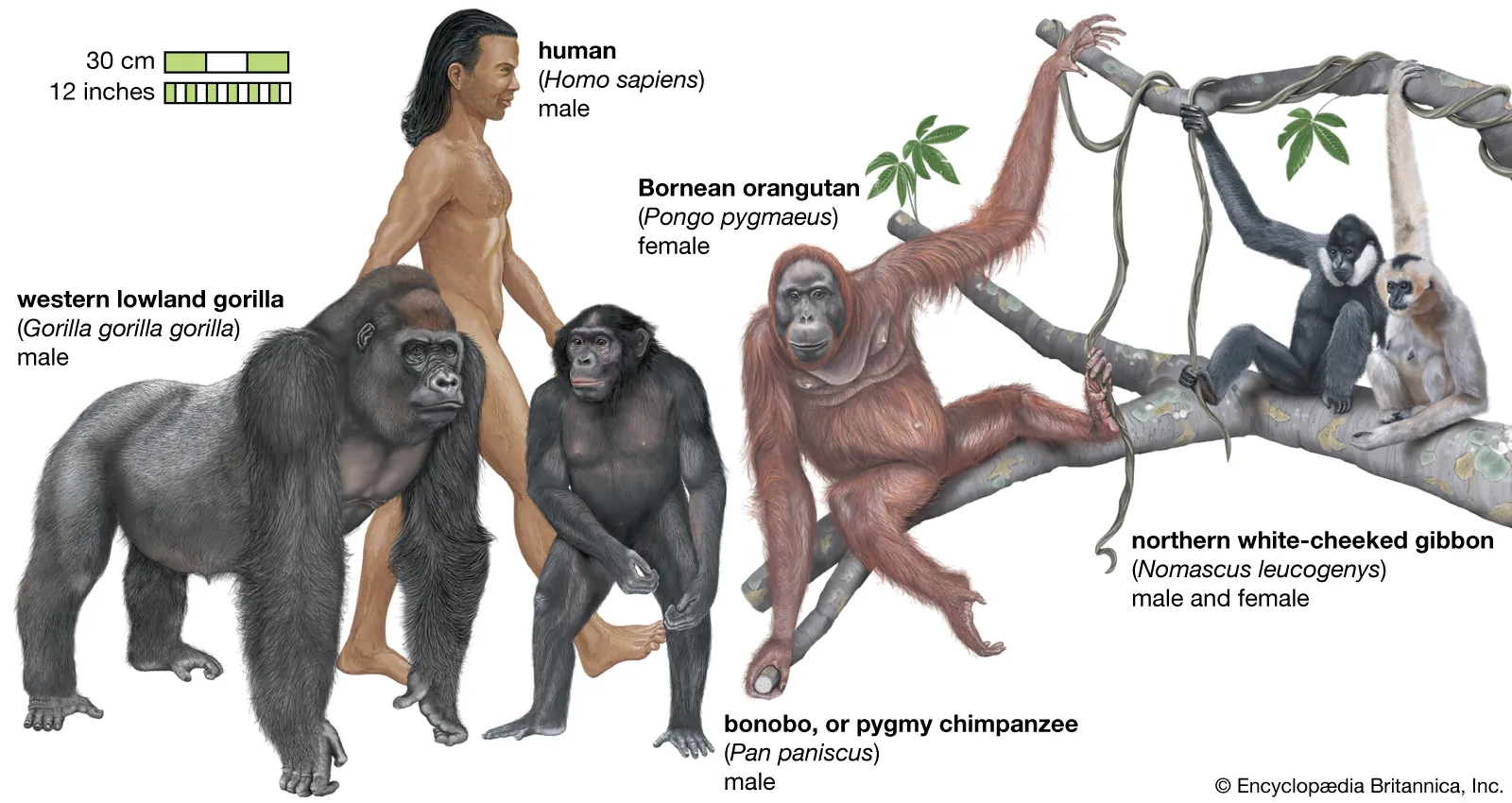
Within Primates, humans belong to the great ape lineage alongside chimpanzees, bonobos, gorillas, and orangutans. This means humans are more closely related to these apes than those apes are to monkeys. Humans did not evolve from modern monkeys, but instead share common ancestors with them, branching from the same evolutionary tree.
Shared Anatomical Traits of Primates
Human anatomy reflects classic primate design. Our hands possess five digits with flat nails instead of claws, allowing precise grip and manipulation. Our shoulders and hips allow wide ranges of motion, a legacy of climbing ancestors. Forward-facing eyes provide binocular vision and depth perception, which is critical for navigating complex environments. Color vision enhances the ability to distinguish objects, particularly food resources.
These traits are not uniquely human. They are inherited primate characteristics that predate the human lineage by tens of millions of years. Even upright walking is best understood as a modification of primate limb structure rather than an entirely novel trait.
Brain Structure and Cognitive Continuity
All primates possess relatively large brains compared to other mammals, particularly an expanded neocortex. This region supports memory, planning, social awareness, and problem-solving. Human brains follow the same organizational blueprint but are expanded in size and connectivity.
The human neocortex, especially the prefrontal cortex, is disproportionately large. This expansion supports abstract reasoning, long-term planning, symbolic thinking, and complex social behavior. Human intelligence represents an extreme amplification of primate cognition, not a break from it.
Genetic Evidence for Human Primate Identity
Genetics provides the most decisive evidence that humans are primates. Humans share approximately 99 percent of alignable DNA with chimpanzees and bonobos, about 98 percent with gorillas, and roughly 97 percent with orangutans. These similarities extend across entire genomes, including shared genes, regulatory sequences, and chromosomal structures.
One of the strongest genetic confirmations is human chromosome 2. Humans have one fewer chromosome than other great apes because two ancestral ape chromosomes fused together. The fusion site remains visible in human DNA, providing direct physical evidence of shared ancestry that cannot be explained by coincidence.
Divergence Times and Fossil Corroboration
Molecular clock analyses estimate that humans diverged from the chimpanzee–bonobo lineage approximately 5.5 to 7 million years ago. The split from gorillas occurred around 8.5 to 12 million years ago, and from orangutans roughly 9 to 13 million years ago. These divergence estimates align closely with fossil discoveries of early hominins in Africa.
The agreement between genetic data and the fossil record reinforces a single, consistent evolutionary history placing humans firmly within the primate lineage.
What Sets Humans Apart From Other Primates
The primary distinction between humans and other primates lies in the scale and integration of cognitive abilities. Human brains are significantly larger than expected for a primate of our body size, particularly in regions associated with executive function. This allows advanced planning, self-reflection, and abstract reasoning.
Humans are the only primates to use fully structured language. Grammar and syntax allow communication of symbolic, abstract, and temporal ideas. This capacity enables cumulative culture, where knowledge is preserved and expanded across generations, driving technological, artistic, and scientific progress.
Another defining trait is habitual bipedalism. Humans are fully upright walkers, with skeletal adaptations optimized for two-legged locomotion. This freed the hands for tool use and fine manipulation, reinforcing the feedback loop between physical and cognitive evolution.